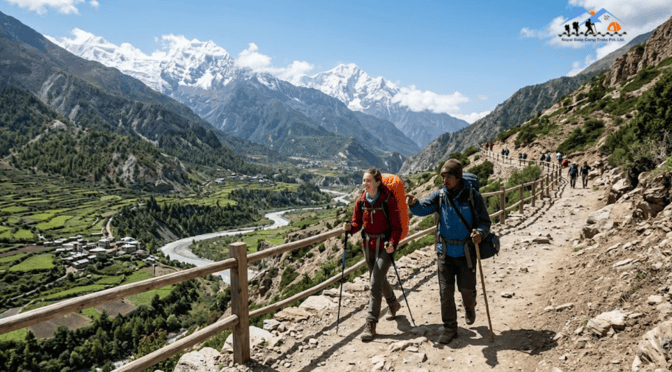
It is not uncommon for trekkers to come and ask us the same question: “Which trek should I choose, Mardi Himal or Annapurna Base Camp?”
It can be confusing because they both have beautiful mountain views, start from the Kathmandu gateway to Pokhara and are great treks for a genuine Himalayas adventure.
However, the experience is not the same:
The trail, altitude, cost, walking hours and crowd situation are all different, which is why people look for a clear guide on Mardi Himal vs Annapurna Base Camp before deciding to book a trip.
If you are working on your budget, you may also want to read about the Mardi Himal Trek cost to know what to expect before coming to Nepal.
At Nepal Base Camp Treks, we have guided both of these routes for many years, so the information here is reflected from the trail, not simply copied from elsewhere.
Quick Comparison
You will find that many trekkers compare Mardi Himal vs Annapurna Base Camp because both treks start from Pokhara and offer close-up mountain views; however, the overall experience is quite different.
This is a quick look at the comparison between these amazing treks in Nepal.
| Key Feature | Mardi Himal Trek | Annapurna Base Camp Trek |
| Total Days | 5-7 days (short & focused) | 7-12 days (long, classic) |
| Highest Point | 4,500 m (Viewpoint/Base Camp) | 4,130 m (Base Camp) |
| Crowd Level | Less crowded | Busier during peak season |
| Difficulty | Moderate – shorter and steeper sections | Moderate – hard and longer days |
| Best For. | Short trip, quiet views and beginner | Iconic “sanctuary” feel, photo fanatics |
Location and Accessibility
Both trekking routes start with a gateway to Pokhara from Kathmandu, although the trailheads differ.
The Mardi Himal Trek typically commences at Kande or Phdi along a trail that travels through Australian Camp and follows forest trails – although not as dense – before opening up to higher ridges.
The ABC trek begins in Nayapul and travels alongside rivers, up stone stairs, behind small villages and then into the alpine zone.
Both treks require an ACAP permit and a TIMS card that we organise for trekkers to avoid the intense paperwork and queues when trekking.
If you prefer to avoid the crowds of transport and pre-book lodges, our guides will arrange your trip from airport pickup to the final drop-off of the trek.
Duration & Distance
The comparison of Annapurna Base Camp vs Mardi trek area is most evident in relation to the number of days trekking and total distance.
The Mardi trek typically takes about 5-7 days with shorter but steeper climbs each day.
The ABC trek typically takes 7-12 days, with longer valley walks and more steps daily.
While in the Mardi trek, you should walk a daily average of 6-10 km per day, whereas ABC can be between 12-15 km per day, depending on your pace.
If you would like to see what the Mardi trek looks like on a day-by-day basis, you can check the full Mardi Himal trek itinerary, which outlines the number of hours walking, daily sleep points, and altitude gains.
You will need more stamina for the ABC trek as it includes more time inside the mountain bowl.
Altitude and Acclimatization
The maximum elevation of the Mardi Himal trek reaches 4,500m, whereas Annapurna Base Camp is at an altitude of 4,130m.
Many trekkers inquire about the Mardi Himal trek altitude before booking because it ascends more quickly.
In addition, ABC is a better acclimatization route since more overnight stops are included in the journey to Base Camp.
Both the Mardi and ABC treks are high-altitude trails, but ABC has less steep elevation change and allows for better body acclimatization.
If you are inexperienced with high mountains, ABC is less scary, while those trekkers who have limited time, but are physically fit, would prefer Mardi!
Level of Difficulty
When comparing Mardi Himal vs Annapurna Base Camp, most trekkers inquire about which route will hit harder on the body.
The answer largely depends on the way a trail is constructed more than it does on altitude.
Mardi Himal trek has faster elevation gain and steeper forest elevation, which is why people often search for Mardi Himal trek difficulty before booking.
Annapurna Base Camp (ABC) has a longer approach, which makes the difficulty come from repeating stone steps and the duration between villages.
These are both moderate treks, but ABC will have a more significant natural state of acclimatization due to the number of days of the ascent and the availability of more teahouses.
If you like a more relaxed ascent and time to recover, our 12-day Mardi Himal trek package was designed to be beginner-friendly, rather than rushed.
Terrain, Weather and Physical Load
The terrain represents one of the most significant differences between the Annapurna Base Camp vs Mardi trek comparison.
Mardi begins in a deep forest and can then shift to exposed ridge trails in the wind and cold, only to head deeper into the wilderness for the last portion of the trek.
ABC does not have ridge exposure; instead, it has the long staircase climbs near Chhomrong, Bamboo and Deurali, which can tire your knees and ankles, particularly on descent.
Weather can make your trek feel harder than another, especially with Mardi being a real pain in the winter, as the ridge can get icy and ABC being tougher in the monsoon, as the stone steps get slippery.
Trekking poles, light backpack weight, and proper layering make a noticeable difference on both trails
Who Each Trek is Best For (Fitness & Trekker Profile)
Both of these treks can be completed as a beginner with the right preparation and advice, but the type of trekker varies.
Mardi is best for trekkers with limited time, comfortable with short climbs, seeking tranquil trails and close proximity views of Machapuchhre.
Annapurna Base Camp is a better option for trekkers who prefer gradual altitude acclimatization, more teahouses, interaction with other trekkers and progressing at a steady pace rather than a faster climb.
If you are trekking alone, ABC is a better option due to the villages being closer together.
Regardless of the route you choose, we highly recommend selecting travel insurance that includes helicopter evacuation coverage above 4,000 meters, as both treks take place in high-altitude zones where weather and health conditions can change rapidly.
Comparing Costs
The differentiation in cost between Mardi Himal vs Annapurna Base Camp mainly comes down to the number of days you take on the trail.
For the average 5–7 day Mardi Himal Trek, you will have to pay around USD $450-$650 inclusive of guide, permits, food, lodging and transportation from Pokhara.
Whereas, a 7–12 day Annapurna Base Camp trek will usually fall into the USD $650-$1,100 price range, depending on group size, room type and seasonal lodge rates.
At Nepal Base Camp Treks, we offer a 12-day Mardi Himal trek (USD $790) because a slower itinerary allows for better acclimatization to altitude, additional cultural stops in Gurung villages and easier days of walking.
Accommodation & Food Costs
The cost of teahouse rooms on both trekking routes is $6 to $10 per night at lower altitudes and $10–$15 at higher altitudes.
Meals are priced the same way: dal bhat averages $4 to $6 on Mardi and $6 to $8 on ABC because food needs to be carried to the ABC sanctuary at a greater distance.
Hot showers, battery charging and Wi-Fi are typically an additional fee between $2 to $4 each.
ABC has more teahouses and menu variety, while Mardi has fewer lodges but a greater emphasis on direct hospitality from the Gurung community.
Privately led groups often agree with lodges for priority room booking, which is important in the busy trekking season, while solo trekking is less expensive per meal but has potential limits.
Permits & Entry Fees
Both treks will require an ACAP permit (USD $30) and a TIMS card (USD $20).
These fees are intended to support conservation, maintenance of the trail and ecotourism practices inside the protected Annapurna area.
There are no additional national park fees for either trek unless you add side trips like Jhinu Hot Springs.
When booked with a registered operator, any permits will be prepared prior to arrival, and you will not have to visit the tourism office while in Pokhara.
If you don’t have permits for Mardi Himal trek or the ABC trek, then you won’t be permitted entry through the checkpoints.
Scenic Highlights
One of the primary reasons why trekkers draw a comparison between Mardi Himal vs Annapurna Base Camp is because of the views.
Both trails bring truly epic moments of Himalayan adventure, but once you are on the trail, the scenery simply feels different:
- Intimacy of the Peaks – The Mardi Himal Trek has you right under Machapuchhre (Fishtail) and the stunning rocky ridge of Mardi Himal, while at Annapurna Base Camp, you are surrounded by the vertical walls of Annapurna I, Annapurna South and Hiunchuli.
- Style of Terrain – Mardi follows quiet, narrow forest trails and high ridge walks, while the ABC trek takes you through alpine farms, bamboo forests and culminates in a glacier basin surrounded by steep, snow-capped peaks.
- Photography Highlights – Mardi offers dramatic sunrise shots from High Camp and the Upper Viewpoint, while ABC shows the famous golden light over Annapurna Sanctuary.
- Nature & Flora Diversity – Mardi attracts many for the dramatic rhododendron forests in spring, while ABC has less forest (but more alpine gardens).
- Cultural Experience – Mardi has fewer villages, but a better experience with the Gurung culture, while ABC has more teahouses, trekkers and public cultural spaces.
Weather & Ideal Trekking Period
Selecting the right season is one of the key factors to consider when evaluating the Mardi Himal vs Annapurna Base Camp trek.
Both routes are open all year, but the experience itself varies greatly based on the weather conditions, temperature, visibility and trail conditions nonetheless.
The best trekking season for both routes is in the Spring (March – May) and Autumn (September-November), which brings clearer skies, dry trails and the best mountain views possible.
In the Winter, it will be quiet on the trails and colder nights, while the Monsoon brings rain, leeches and cloudy views in the Annapurna region.
If you prefer fewer crowds with good weather, then the very late November or early December is an excellent choice for you.
Spring is extra beautiful for Mardi as the rhododendrons are blooming and the flora diversity, while the Annapurna base camp is especially majestic from crisp visibility after the Monsoon season.
If you prefer a more thorough planning down to months, check our full detailed guide on the Mardi Himal trek best time for breakdowns of Mardi weather.
Safety and Support
Not every Himalayan trail is created equal when it comes to safety, which is a common reason why trekkers weigh Mardi Himal vs Annapurna Base Camp prior to booking.
Mardi is quieter and has fewer teahouses and there are entirely sections of the trails where fog or snow can hide a path, while daily foot traffic will bring more signage on the Annapurna Base Camp.
Since 2023, Nepal has implemented a new trekking guideline that requires all foreign trekkers to register with a company or licensed guide for safety, to track their rescues and to validate their insurance.
So, the most you could register would be a solo trekker, but you can’t simply go trekking solo.
Whereas, for Nepali trekkers, these rules do not apply.
Our guides at Nepal Base Camp Treks are all English speaking, trained in altitude response so that you can pace the trek and acclimatize to the altitude naturally and not painfully.
Traveling Without a Guide
Some blog posts still suggest that you can do the Mardi Himal trek without a guide; however, the law and reality on the trail are altogether different now.
The Mardi trek has long stretches in between lodges and ABC is at a higher altitude, which means there is more AMS risk if you’re not climbing properly.
A guide books you a room in the peak season, takes care of any TIMS or ACAP permits and plans for emergencies so you don’t waste any energy on logistics.
Local hiking guides do not take away the adventure; they remove avoidable problems and allow you to comfortably experience an adventure in the Himalayas without worrying about route decisions, paperwork or safety.
Packing Essentials for Both Treks
It is ideal to be prepared before leaving the Kathmandu gateway.
You have to include packing essentials smartly, which is one of the most essential steps needed for both Mardi Himal and Annapurna Base Camp.
Because weather changes quickly in the Himalayas, you will want to carry light layers that keep you warm, dry and comfortable at altitude.
Having proper gear also makes for safer altitude acclimatization, as being too cold or wet, and being dehydrated are some of the fastest ways to get sick on the trail.
We practice eco-tourism practices, so we always suggest a bit of reusable bottles, waste-free toiletries and clothing that lasts longer than one trek.
What to Include in your Bag
- Layered clothing suited for warm valleys and camping in the cold
- Rainproof jacket even if going in the best trekking season
- Trekking boots you have used before, or broken in
- Refillable water bottle + purifier (to reduce waste to landfills)
- Headlamp, gloves, thermal socks, sunscreen, lip balm.
- Small medical kit + personal medication
- Copy of passport, ACAP permit, TIMS card, and insurance details
If you want more details, you can also read the blog about the Mardi Himal Trek packing list.
Concluding Thoughts
Choosing between the Mardi Himal vs Annapurna Base Camp trek is based on the type of trekkers you are, not which trek is “better”.
Mardi Himal is right for the trekker who wants a shorter, quieter trek with closer views of Machapuchhre, gentler altitude acclimatization and some cultural immersion in the Gurung area.
It’s good for beginner trekkers, travelers who have limited time or anyone who prefers calm forests and scenery walks with a diversity of flora.
Annapurna Base Camp is for trekkers wanting a longer trek with more tea houses at a higher altitude and feeling the drama of standing inside the famous Annapurna Sanctuary.
It’s the classic trek for those wanting a larger Himalayas experience with a clear achievement of a trek.
Both treks begin from the same Kathmandu gateway, both are safe with proper planning and both offer you memories for a lifetime.
If you’re ready to make trekking plans or would like help selecting the best route, just let us know your timeline and trekking experience in advance and we will assist you from there.