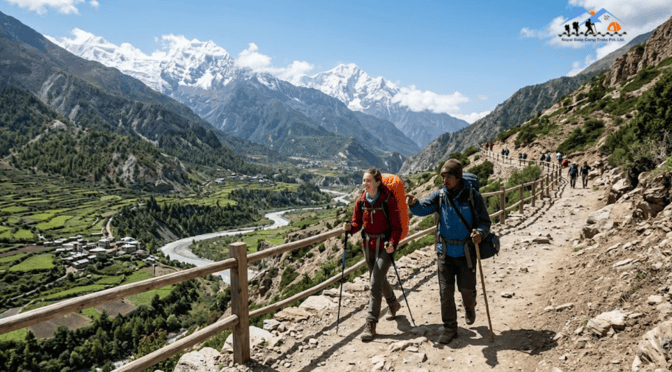
Most trekkers are surprised by the Mardi Himal trek altitude as it rises fast and climbs high, rewarding you with breathtaking views at every step.
Starting near the green hills of Pokhara, the Mardi trek route takes you through ridges and forests before reaching the wonderland of Mardi Himal Base Camp at around 4,500 meters.
This is one of the most scenic treks for trekkers in Nepal, where the altitude plays a significant role.
Every day, you will feel the air getting lighter, the temperature getting colder and your body has to work harder to adapt to the increasing elevation.
That’s where acclimatization and pacing yourself properly become critical.
No matter the fitness level of a trekker, you may feel the effects of altitude sickness at such a height.
Fortunately, the guides Nepal Base Camp Treks employs are local and experienced in making sure that your ascent to the altitude is safe.
They will plan rest stops, monitor your health and ensure you not only survive but also enjoy the experience.
In this guide, you will understand how the altitude of Mardi changes day by day, how to acclimatize properly and how to enjoy your Mardi Himal trek in a safe and smooth way.
Mardi Himal Trek Altitude Overview

As you may already know, the Mardi Himal trek elevation ascends to high ridges approaching the 4,500m mark — but what you may not know is how quickly the environment shifts along the way.
Within days, the warm Pokhara valleys transition to misty forests and a short period after that, those very forests open to snowy views populated the Himalayan horizon.
Did you know? Mardi Himal elevation gain is one of the highest, almost right off the starting line in the Annapurna Region.
Your experience with altitude change on Mardi also affects how you experience it:
One moment you’ll be among terraced fields, the next, walking under blooming rhododendrons and then, before you know it, you’re High Camp above the tree line.
The air cools, the stars get brighter, your steps get slower — it’s a beat that every trekker eventually learns.
Additionally, choosing the best time for the Mardi Himal trek will take your trekking experience to the next level.
Pro Tip: Once you are above 3,000 meters, take your time. Drink often, eat well, and let your body follow a slower rhythmic descent. The true highlight of this high altitude trekking experience isn’t getting to the top, but the way that you travel to the top.
Starting Point to Summit: A Day-by-Day View of Altitude

Every trek has a story to tell and on the Mardi Himal trek, that story is told a little bit at a time through altitude.
Each day will have a different rhythm, different terrain and a little less oxygen in the air.
Here is what your journey will look like from the low valleys to the high altitude ridges.
| Day | Route | Altitue | Experience |
| 1 | Pokhara → Kande → Deurali | 2,100 m | A warm-up walk through the village and forest trails. |
| 2 | Deurali → Forest Camp | 2,600 m | The forest deepens where there are rhododendrons, camping under moss. |
| 3 | Forest Camp → Low Camp | 2,970 m | The trees will start to thin, where you will see your first mountain views. |
| 4 | Low Camp → High Camp | 3,540 m | The air feels less dense, the trail is steep, the views are wide. |
| 5 | High Camp → Mardi Himal Base Camp (Viewpoint) → return | 4,500 m | The big day – where the air is thin, the only sound is the wind, and the views are breathtaking. |
| 6 | Descent to Siding or Lumre → Pokhara | 1,800 m | A gentle return to warmth and comfort. |
Fact: From Pokhara to Base Camp, there will be a total elevation gain of about 3,700 meters in under a week. This is part of what makes the Mardi Himal trek difficulty moderate: short, with rapidly rising altitude.
How To Acclimatize To Higher Altitude
The Mardi Himal trek altitude goes straight up from the green hills surrounding Pokhara to the icy ridges way above 4,500 meters and that rapid change in altitude demands some respect.
After Low Camp, the air thins quickly, the wind seems cold and each breath has a little less oxygen.
The secret to enjoying every ridge instead of fighting every step is to know how to acclimatize.
Acclimatizing just means giving your body time.
Walk slowly, rest often, dress for the cold and drink a lot of water.
The goal is not speed; it is rhythm.
Above 3,000 meters, gaining 300–500 meters per day can challenge anyone’s viability; you need to balance work and rest anytime you are above 3,000 meters above sea level.
Signs and Symptoms of Acclimatization Sickness
Altitude sickness (AMS) is one of the biggest impediments to trekking in high-altitude regions of Nepal.
It can happen to anyone, from beginners to experts, if the ascent is too quick.
Early signs include:
- A continual headache
- Nausea or lunacy
- Dizziness or unusual tiredness
- Slight shortness of breath even on easy climbs
- Difficulty sleeping
If ignored, these early mild signs can lead to more serious problems such as HAPE (High Altitude Pulmonary Edema) or HACE (High Altitude Cerebral Edema) – both life-threatening.
Practical Acclimatization Tips for Your Mardi Himal Trek
Good acclimatization isn’t about being tough; it’s about timing and awareness.
Use the following field-tested tips to be safe and strong on your Mardi Himal trek:
- Climb slowly. Try to limit your increased Mardi Himal trek altitude to 300 – 500 meters per day after your first night at 2,800.
- Drink. 3 – 4 liters of water per day or herbal tea to help your body adjust to the dry air of the mountains. Water helps reduce altitude sickness risks in higher altitudes.
- Eat more. Carbohydrates are more energizing at altitude than protein-heavy meals. These will fill you with energy to move on the trails.
- Rest is crucial. Take 5-minute breaks each hour so that you can recover some of your stamina.. Overdoing it causes AMS to affect you faster.
- Limit alcoholic beverages and smoking. Alcohol and smoking will lower oxygen absorption and slow down recovery.
- Sleep lower than your high point for the day. “Climb high, sleep low” is always a good standard.
- Use acclimatizing walks. Hike around camp, i.e., around Low Camp, to support your lungs and body to adjust.
- Carry a first-aid kit, including ORS and ibuprofen, to treat injuries that can occur while conquering the Mardi Himal trek altitude. Include Diamox if you have medical clearance, too.
- Notice differences in breathing. If one set of stairs is harder than simply some steps down the trail, be sure to rest longer.
Pro Tip: Being slow-moving and watching your acclimatization is what we’ve said is the best medicine. Take slow steps, breathe deeply and enjoy the view. This is the rhythm of the Himalayas!
Best Spots for Acclimatization Along the Trek

Acclimatizing is more than just resting; it’s about seeking out the places where you let your body breathe and recover.
The Mardi Himal trek offers some perfect points that have calm air, quiet surroundings and a gradual climb that helps you acclimatize naturally.
Forest Camp (2,600 m)
This is your first true “test” above the hills.
As you gain altitude in Mardi Himal, you will feel an elevation difference in the air around you.
It is a wonderful climate to slow down, hydrate and soak up the stillness among the oaks and rhododendron trees.
Being here allows your lungs to have a little “head start” before climbing even higher.
Low Camp (2,970 m)
Here, the views start to open up.
It will be apparent that your breathing will shift slightly, which is a sign that you are in high altitude terrain now.
Taking a short acclimatization walk toward Badal Danda further prepares your body for the climb the next day.
High Camp (3,540 m)
This is the entrance to the summit viewpoint and an important location for rest as well as an extra night.
The air is thin, the temperature drops quickly and your body needs time to adjust before pushing toward Mardi Himal Base Camp (4,500 m).
Staying Safe from Altitude Sickness on the Mardi Himal Trek
Even with the perfect acclimatization plan, there is still the potential for a nasty surprise in the mountains.
The Mardi Himal trek altitude is high and rises rapidly, which leaves your body requiring more time to acclimatize.
It may seem simple, but knowing the right time to slow down or even descend can help you stay safe in your trek.
When to Descend – Knowing It’s Time
A light headache or shortness of breath is typical as you enter the high altitude, but sharp dizziness, nausea or blurred vision should cause serious concern.
If one of these symptoms does not resolve after resting and drinking water, it’s time to descend.
Usually, after dropping as little as 300–500 meters, you will notice quick improvement.
Pro Tip: If you feel worse than you did that morning, you should avoid sleeping at a higher elevation. Symptoms of altitude sickness and its complications worsen overnight. Descent of a few hours is much safer than doubtfully continuing an upward trek.
Smart Recovery
After descending from the higher Mardi Himal trek altitude to a safe level, follow all precipitation protocols until you have completely recovered.
Enjoy warm fluids, eat a simple meal and begin to warm your core body temperature.
Most trekkers will begin to feel better in a short time.
If you aren’t feeling well, avoid returning to a higher elevation for at least one full day.
Mistakes common to the trekker
- Ignoring the early signals and “toughing it out”.
- Not drinking enough water or sometimes skipping meals.
- Taking strong medication with no guidance.
- Pushing on to the Mardi Himal Base Camp despite headaches or dizziness.
The rule is simple: If your body protests, listen to it. The mountains will reward patience. A healthy trekker looks around; a hurried one won’t look around at all.
Practical Advice for a Safe and Enjoyable Mardi Himal Trek
Although the Mardi trek is short, it’s important to prepare for a quick rise in altitude.
From the lakeside town of Pokhara to the high-altitude Mardi Himal Base Camp, here are some tips to ensure that your adventure is safe and enjoyable.
Obtain Permits
You will need Mardi Himal trek permits, which include a TIMS card and an Annapurna Conservation Area Permit (ACAP).
Both are obtainable in Pokhara or Kathmandu.
If you lose one, you can return to the town and obtain another copy of your permit.
Also, keep copies of your permits in your bag so you can show them at checkpoints along the trekking route.
Follow an Intelligent Itinerary
To overcome the Mardi Himal trek altitude smoothly, you must plan your itinerary of the Mardi Himal trek intelligently, so that it has a good mixture of acclimatization and adventure.
It’s best not to rush to get to the top; you should climb to the high altitudes slowly and steadily to avoid altitude sickness and maintain your energy.
Pack Light and Pack Smart
Your Mardi Himal packing list should incorporate layered clothing, a pair of gloves, trekking poles and a reusable water bottle.
As you climb or descend, the weather will change quickly depending on the height and elevation.
So you need to be ready for a frost when you are at a higher elevation.
Choose the Right Season
A common question among trekkers is “What is the best time to go Mardi Himal trek?“
And the answer is in spring and fall.
In the springtime, the skies are clear, the weather is mild and the trails are flowing with bloom.
Fall is considered the perfect trekking season for its clean beauty and the celebrations of festivals in Nepal, such as Dashain and Tihar.
Although a winter trek to Mardi Himal will be much quieter, it may end up being a cold night at high elevation.
Solo or Group Trek?
A trek with a group can be fun and provide some added safety.
You should also be aware that solo trekking in Nepal is not permitted unless you are hiring a licensed guide.
For more, read our Mardi Himal trek without a guide blog.
FAQs
What is the elevation of Mardi Himal trek?
The Mardi Himal trek altitude reaches approximately 4,500 meters at Mardi Himal Base Camp, with High Camp around 3,540 meters.
Due to the rapid elevation change, trekkers must make a slow ascent and follow a proper day-wise plan itinerary to safely adjust to the high elevation.
How hard is the Mardi Himal trek?
The difficulty rating is moderate.
The trek is short, but there are a few steep sections, especially between Low Camp and High Camp.
Other than altitude and weather, the land is very manageable, which may make it suitable for beginners with reasonable fitness and patience.
What is the uniqueness of Australian Camp?
Australian Camp (2,100 m) is a common first stop on the Mardi Himal trek.
It has great panoramic Himalayan views and comfortable teahouse accommodations.
Also, it serves as a warm-up competition for slightly higher elevations and cooler temperatures.
What will I experience on the trek?
You can expect a lot of natural and cultural experiences along the trekking route, including rhododendron forests, some Himalayan wildlife and local Gurung villages.
If you trek with a group or with a guide, the views and cultural experience are, without a doubt, one of the more scenic treks in Nepal.
Conclusion
The Mardi Himal trek altitude has a lesson to teach beyond physical endurance – it teaches balance.
As you gain altitude, breaths slow and steps become more measured.
That’s the beauty of trekking high in the altitudes of Nepal: as the climb challenges your body, the silence feeds the soul.
From Australian Camp to Mardi Himal Base Camp, the altitude is not the enemy; it’s the purpose of the journey.
Walk slowly, breathe deeply and allow the Himalayan altitude to remind you that peace exists in movement.
Are you ready to rise above the clouds?
Start your Mardi Himal experience today and see how the mountains shift the way you see the world.