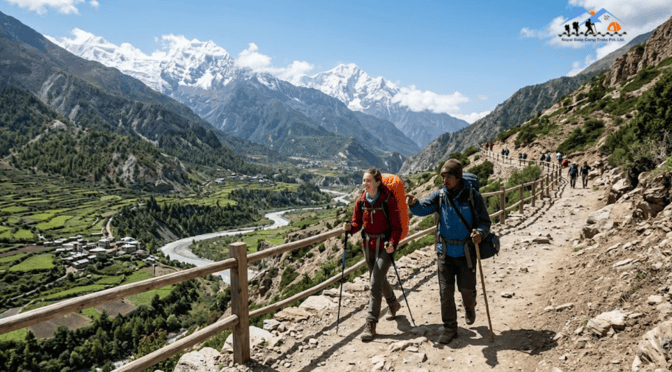
When talking about the most beautiful short Himalayan treks in Nepal, the Mardi Himal trek always comes up in the conversation.
And why won’t it?
You will walk quiet trails through rhododendron forests and reach right next to Mount Machhapuchhree (Fishtail Peak).
That makes many first-time trekkers question:
“Can I do the Mardi Himal trek without guide?”
The answer: You cant anymore.
Since April 2023, the government of Nepal has declared that all international trekkers are required to hire a guide or hire a trekking agency for any trekking route that falls under a conservation area.
As Mardi falls under the Annapurna Conservation Area, which means solo trekking is not permitted on this trek.
For those trekkers who attempt to trek on their own on the Mardi Himal route, entry will be denied at various checkpoints and they may even face charges for breaking the law.
In this guide, we at Nepal Base Camp Treks have explained everything a beginner needs to know about the Mardi Himal Trek without a guide, from your safety, required permits and real challenges of Solo Mardi trekking.
Reasons to Trek Mardi Himal First
If you’re attempting trekking in Nepal for the first time, here are several key reasons to go for the Mardi Himal trekking.
- Beginner-Friendly Difficulty Level – The difficulty of the Mardi Himal trek is rated as moderate. There are 5-6 hours of hiking daily on obvious trail routes with no technical climbing; it is pure hiking in the mountains.
- Close-Up Views of the Himalayas – Within the entire week of the Mardi trek, you will have incredible views of Machhapuchhre (Fishtail Peak), Annapurna South and Hiunchuli, which is much closer up than the Annapurna Base Camp trek.
- Achievable Altitude – The Mardi Himal trek altitude reaches 4,500 m, which offers stunning panoramic views with a relatively low risk.
- Duration – Within 5-7 days from Pokhara, you will complete the entire route – an excellent option for those with limited but adventurous time.
- Less Crowded – The Mardi trek allows for more pockets of peace compared to the Annapurna Base Camp and Poon Hill options, allowing you to experience quiet meditation in nature without as many tourists.
- You Get Major Rewards with Less Commitment – Within a week, you will have experienced some of the best trekking Nepal has to offer – forests, ridges, villages and some sunrises over the never-ending Himalayas.
Pro Tip – If it’s one of your first days in the mountains, the Mardi Himal Trek is an excellent and healthy blend of comfort, challenge and amazement.
Mardi Himal Trek Overview
Starting Point: Pokhara → Kande
Highest Elevation: 4,500 m (Mardi Himal Base Camp)
Duration: 5-7 days
Route: Forest Camp → Low Camp → High Camp → Base Camp → Siding Village
The Mardi Himal Trek begins in the relaxed town of Pokhara, often referred to as the adventure capital of Nepal.
For trekkers who are outside Nepal, we have a 12-day Mardi Himal trek package, which will help you fully enjoy the time in Mardi Himal.
After a brief drive to Kande, the path gently ascends through terraced fields and small villages and then enters a vibrant rhododendron forest in the spring.
This journey also takes you through a series of tranquil stops, such as Forest Camp, Low Camp and High Camp, all of which bring you closer to the Himalayan horizon.
Each time you move higher, the trees disappear and the air becomes crisp, offering panoramic views of Machhapuchhre (Fishtail Peak), Annapurna South and Hiunchuli.
Trekkers stop at High Camp to rest and prepare for the trek to Mardi Himal Base Camp (4,500 m), our final destination..
The ascent is relatively short, but steep. You will not want to miss the sunrise over snow-peaks, glimmering gold in the morning light.
Most trekkers complete the Mardi trek from Pokhara in a week or so, on a simple itinerary.
This makes this trek, in particular, one of Nepal’s most straightforward Himalayan treks; it’s short, stunning and doesn’t require advanced hiking.
Trekking Solo: Is It Safe for a Beginner?

Yes, Mardi Himal is absolutely safe for beginners who are well-prepared.
However, as of April 2023, the Nepal Tourism Board has required all foreign trekkers to trek with a licensed guide or a registered trek company.
This rule applies to the Annapurna region, where the Mardi lies.
Thus, it is no longer possible to trek the Mardi Himal trek without guide.
This means if you are trekking alone, you will not be able to get the official TIMS permit or enter the Annapurna Conservation Area.
While some may suggest doing the solo Mardi trek, it is not safe and you could be stopped by checkpoints, be fined or not allowed into or back out of the trek.
Why Solo Trekking is Risky
A solo trek to Mardi Himal without a guide had challenges before this regulation change too:
- Trail confusion. Some parts of the trail are obscured by fog or snow and it is easy to miss the signs, resulting in you getting lost.
- No rapid assistance. If you are injured or have altitude sickness, this can complicate getting emergency help.
- Weather conditions. Near High Camp, the weather changes rapidly–rain, wind or snow.
- Tiredness and altitude. If you go too quickly or do not take enough rest days, you can have altitude sickness.
- Permit and safety checks without a guide could cause you trouble at ACAP.
The Benefits of Trekking with a Guide
While the sound of the Mardi Himal trek without guide sounds intriguing, having a licensed guide can make the trek easier, safer and more enjoyable.
It can help with any of the following:
- Safe navigation without getting lost.
- Obtaining permits and booking tea houses.
- Safety in varying weather conditions and elevations.
- Engaging with local customs and communicating with local villagers.
Even if you have been to Nepal before, traveling with a local guide from Nepal Base Camp Treks will help you feel at ease.
You will enjoy some of the freedom of moving at your own pace; however, you will also enjoy being safe, legal and supported.
Planning Your Own Solo (or Semi-Supported) Mardi Himal Trek

While it is no longer possible to trek the Mardi Himal trek without guide, you can do a semi-guided trek.
It’s a trek that allows walking on your own, but provides for a licensed guide or local support for permits, routes and safety.
Here is how to do it right.
Permits & Documentation
You will need two main permits required for the Mardi trek:
- Annapurna Conservation Area Permit (ACAP) – NPR 3,000 (≈ USD 25)
- TIMS Card (Trekkers’ Information Management System) – NPR 2,000 (≈ USD 15)
Both of these permits can be acquired through registered trekking agencies or at the Nepal Tourism Board offices in Kathmandu and Pokhara.
You will also need to carry:
- Your passport and two passport-sized photos
- Plus, copies of both permits are needed to present them at checkpoints when on the trekking route.
You cannot legally enter the Annapurna region without these.
Recommended Trekking Route and Itinerary
If you find yourself in Pokhara, the Mardi Himal trekking route is one of the best short adventures you can undertake without too much travel.
You’ll start just an hour’s drive from Lakeside, entering beautiful rhododendron forests that will take you to the high ridges of the Annapurna Himal.
Here is a simple 5–7 day Mardi Himal trek itinerary from Pokhara:
Day 1: Drive from Pokhara → Kande → Trek to Deurali (2,550 m)
Start your Mardi trek with easy forest trails and the sounds of small villages.
Day 2: Trek from Deurali to Forest Camp → Low Camp (2,970 m)
While the trees thin out, the views of the mountains get wider and the air is cooler.
Day 3: Low Camp → High Camp (3,580 m)
Get up on the alpine ridges with amazing views of Machhapuchhre (Fishtail Peak).
Day 4: High Camp → Mardi Himal Base Camp (4,500 m) → High Camp
Sunrise at Base Camp was the best moment of the trek.
Day 5: Trek to Siding Village → Drive back to Pokhara
Descend through the small Gurung settlements and drive back by jeep.
Budget Tips for a Stress-free Trek
If you’re going for a budget trek for the Mardi Himal route, expect to spend on average between US$35 – 45 a day, including food, accommodation and permits.
Approximate daily breakdown:
Meals & tea houses: NPR 2,000 – 3,000 (US$15 – 25)
Transport (Pokhara – Kande – Pokhara): NPR 600 – 800 (US$5 – 7)
Guide or porter: US$25 – 35 per day (including their food and stay)
Total for permits: NPR 5,000 (TIMS + ACAP)
If you want a more thorough breakdown, see our full guide on Mardi Himal Trek Cost.
Pro Tip: Make sure you take enough Nepali rupees before leaving Pokhara, as there are no ATMs along the trail and most tea houses only take cash.
Accommodation and Tea Houses on the Mardi Himal Trek
Although the Mardi Himal trek without guide is now prohibited, the Mardi region still retains its intimate and independent character.
The tea houses that line the imposing trek are all family-run establishments, and they are what make this trek feel intimate and adaptive, even as a guided trek.
What to Expect in Tea Houses?
Each stage of the trek, from Forest Camp to High Camp, offers basic accommodation consisting of a small bedroom with wooden walls, twin beds and warm blankets.
In certain stages, you will find affordable stays that offer shared facilities and a hot shower.
Here is what you will get:
Rooms: Twin beds, wooden walls and warm blankets. Some rooms will have attached bathrooms, while others will have just one shared bathroom per floor.
Meals: Typical home-cooked Nepali meals including dal bhat, noodles, soups or pancakes.
Electricity & Wifi: Solar power only, so it is primarily for lighting. Wifi works at the lower camps, but typically for a fee.
Views: Every morning at High Camp, you will have your tea (and breakfast) with a view of the golden sunrise over Machhapuchhre (Fishtail Peak).
Effectively, while Nepal mandates guides for foreign trekkers, you still have all the same tea house freedom – the freedom to pick your meals, engage in conversation with locals and immerse in the unhurried mountain rhythm of life.
Your guide ultimately just assists with logistics and permits while you enjoy the same authentic experience..
Why It Still Feels like an Individual Trek?
This small-scale tea house system of Mardi Himal, as opposed to large group treks, allows you to maintain control of your own pace, breaks and meals (all while remaining safe and legal under Nepal’s new trekking regulations).
Thus, you still have a personal, peaceful and liberating adventure alongside your guide; exactly how trekking in Nepal should be.
Advice for Easily Trekking Mardi Himal Solo
While solo Mardi trek is no longer officially permitted, trekking in Mardi Himal will provide the same spirit of independence and freedom that independent hikers are drawn to.
The trail is quiet, the people are friendly and the tea houses gently motivate you to keep hiking, while your guide ensures you are safe, compliant and connected.
Here’s how to create a smooth, safe and memorable experience while trekking Mardi Himal:
Advice 1: Smart Route Navigation – Even with a Guide
The route is marked fairly well with a red and white paint mark nudge every now and then and friendly locals naturally assist at every turn.
Even if you have a guide looking after directions, it’s a good idea to be aware of the route:
- Download your offline route map (Maps.me, AllTrails) on your phone.
- Head off early in the morning – the fog, depending on when it settles in, can make the trails of the forest very unclear if you’re not paying attention.
- Communicate with your guide or the lodge owner where you are planning to head next.
Pro Tip: You can still walk freely, if you wish, ahead of others or at your own pace – your guide will only follow nearby for your safety, so it’s still relatively independent.
Advice 2: Staying Safe at Higher Elevations
If you ascend too quickly to the Mardi Himal Base Camp (4,500 m), you are high enough to begin showing symptoms of altitude.
- Take your time and rest often.
- Drink plenty of fluids (3-4 liters a day), which is one of the most important hydration tips.
- Bring a first aid kit with altitude pills and pain medication.
- Avoid alcohol or caffeine when you are at High Camp.
Just in case your guide has emergency contacts with them, it is always smart to have the local numbers in your phone and share your itinerary with someone in Pokhara.
Advice 3: Keep the Spirit of “Solo” Alive
Many trekkers worry that hiring a guide removes the “solo feel,” so they want to do the Mardi Himal trek without guide.
However, it does not do that.
You will still walk quietly through the lush, amazing rhododendron forests, relax in tea houses and mark your own walk-to-time.
Your guide is there solely for your safety, so think of them as a local friend, not a supervisor.
Take photos, journal your trek, or enjoy a silent moment – this is the spirit of solo trekking.
Advice 4: Trek Responsibly and Respectfully
The Mardi trek is located in the Annapurna Conservation Area, where many rare wildlife and fragile ecosystems live.
Therefore, to ensure sustainable tourism and follow wildlife precautions, you should:
- Carry all your trash back down with you.
- Use refillable water bottles, and do not buy plastic water.
- Be respectful of local customs – when you see villagers, say “Namaste,” and wear modest clothing when you are in rural areas.
Keep in mind: Even one small act of respect sustains the beauty of the trail for those traveling next.
Gear, Packing Essentials & Preparing for Solo Trekkers
Packing your gear correctly will make or break your trek experience, especially if you’re doing the Mardi Himal trek without guide or a semi-guided format.
As weather and altitude can change quickly, pack smart and pack light.
Essential Trekking Gear
You don’t have to buy high-end expedition gear, just the essentials that are reliable and suitable weather-wise.
Clothing:
- 1 Warm down jacket (for High Camp & Base Camp mornings only)
- 1 fleece or soft-shell jacket
- 2-3 quick-dry t-shirts
- 2 trekking pants
- 1 thermals (for sleeping in or cold nights)
- Gloves, warm hat & sun cap
Footwear:
- Good quality trekking shoes with ankle support
- 2-3 pairs of socks (mix of wool & synthetic)
- Slippers or sandals to wear in the evening
Other Essentials:
- Sunglasses and sunscreen [always!]
- Trekking poles (highly recommended for very steep inclines/downhill)
- Power bank or solar charger (limited electricity in tea houses)
- Lightweight backpack (30-40 L)
Pro Tip: Remember to pack light! 10kg starts to feel heavy; anything above will feel twice as hard at altitude, especially for beginners.
Health & Safety Kit
Even on a short trek like the Mardi Himal trek, it’s important to be prepared to take care of yourself.
- Diamox tablets or other altitude medicine (consult your doctor first)
- Band aids, blister pads and antiseptic cream
- Pain relief tablets and electrolytes
FAQs
Can I do the Mardi Himal Trek without guide in 2025?
No. As of April 2023, all foreign trekkers in Nepal must hire a licensed guide or join a registered trekking agency to obtain their permit and for safety reasons.
What is the difficulty level of the Mardi Himal trek?
The Mardi Himal trek is moderate; each day you will walk for 5-6 hours.
The highest point will be at around 4,500m, making it perfect for relatively fit beginners who want a Himalayan experience.
How many days does it take to trek to Mardi Himal?
The time on the trail is usually 5-7 days; however, international trekkers should be prepared to plan a total of 9- 12 days to accommodate their arrival in Nepal, permits and local transfers.
What permits do I need for the Mardi Himal trek?
You will need the TIMS card and the Annapurna Conservation Area Permit (ACAP), both of which can be obtained from a registered trekking agency in Nepal.
What is the best time to trek Mardi Himal?
The best times to trek Mardi Himal are in the Spring (March-May) or Autumn (September-November), where you will benefit from clearer skies, milder temperatures and flowering rhododendrons, perfect for trekking, photos, and views.
Conclusion
The hike to Mardi Himal is short, peaceful and full of stunning mountain vistas – just the thing for anyone wanting to see the real beauty of Nepal.
Although it is no longer possible to do the Mardi Himal trek without guide, the hike still retains a peaceful, secluded atmosphere.
With an official guide, you follow the same stunning trail, sleep in cozy tea houses and take your own pace – only with extra security and support.
It’s a moderate trek, about 5–7 days from Pokhara and ideal for beginners or those with limited time.
You’ll enjoy sunrise on Machhapuchhre (Fishtail Peak), serene forests and the friendly smiles of rural villagers along the way.
If you are coming from abroad, then Nepal Base Camp Treks can arrange everything for you so that you can simply relax and enjoy the adventure itself.
The rules might have been altered, but the magic of the Mardi Himal trek hasn’t – peaceful, breathtaking and unforgettable.