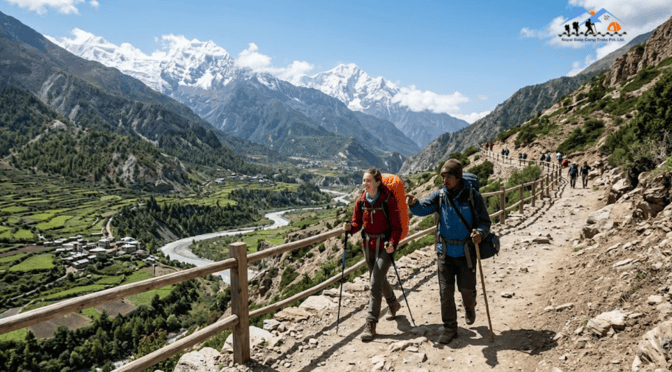
Every amazing adventure begins with a backpack, but that doesn’t mean every backpack starts right.
The Mardi Himal trek is short, but it’s steep, unpredictable and full of rewarding moments for the well-prepared.
At a certain part, you will walk under the beautiful blooming rhododendron trees, especially in Spring, while in other parts, you will be crunfhing snow at 4,500 meters in Mardi Base Camp.
That’s where the smart Mardi Himal Trek packing list helps you to complete the full Himalayan trek experience smoothly.
Pack too lightly and you will be shivering above Forest Camp.
Pack too heavy and every step uphill feels like punishment.
This is why putting together the proper packing list is the first step, one that will help you stay warm, dry and on your feet during your trek.
With Nepal Base Camp Treks, it doesn’t have to be an ordeal.
We employ local guides and porters who carry decades of trekking experience, so they know what you need, what you can avoid and how to make your base camp trek feel effortless.
Quick Summary of the Mardi Himal Trek
The Mardi Himal Trek from Pokhara is short in the Annapurna region that climbs from the warm valleys of the city to the snow-covered ridges of Mardi Himal Base Camp (4,500 m).
It’s ideal for beginner trekkers and nature enthusiasts seeking the big views of the Himalayas without the crowds of Annapurna or Everest.
You’ll travel through rhododendron forests, quiet tea houses and along ridges with views of Machhapuchhre (Fishtail Peak).
Every step will be revealed with spectacular scenery, quiet trails and authentic mountain hospitality.
Duration: 5 – 7 Days (standard) or 12 days full package with Nepal Base Camp Treks
Max Altitude: 4,500 m
Trek Type: Base camp trek, moderate difficulty, perfect for first-time trekkers
Highlights: Forest Camp – Low Camp – High Camp – Mardi Base Camp – Sidhing – Pokhara
Unlike standard trekking options, NBCT’s Mardi Himal trek includes all your permits, meals, guides and porters – providing an easy and safe experience in higher altitudes.
For more in-depth information, read the guide on Mardi Himal Trek Difficulty before packing your backpack.
Whether you’re reviewing your Mardi Himal trek packing list or organizing a base camp trek, this trek includes all the key components of what the Himalayas in Nepal are famous for.
Understanding the Mardi Himal Trek Conditions Before You Pack
At Nepal Base Camp Treks, we often advise our clients that the trekking duration ultimately depends on how efficiently you pack.
This is not just a walk in the hills; this is a journey from the warm valleys of Pokhara to the icy air of Mardi Himal Base Camp (4,500m).
Knowing the trail to this altitude (the weather at each altitude, as well as access to facilities) will help you to distinguish what to leave in and what to leave out of your bag.
Weather and Terrain at Different Altitudes
When Mardi Himal trek weather changes faster than you can zip your jacket.
From Kande (1,000 m), you will start on warm forest trails with birds and rhododendrons for a few days.
Then, a few days later, you will be walking on misty ridges, with some chilly air at High Camp (3,580 m).
At the trail at or near Mardi Himal Base Camp, temperatures might double and below freezing, especially at sunrise.
Here is a quick summary:
Low altitude (1,000 – 2,000 m): Warm, humid and green – (20-25 °C)
Mid altitude (2,500 – 3,000 m): Breezy, cool, rhododendron forests
High altitude (3,500 – 4,500 m): Cold, windy and unpredictable -5 to 5 °C
All the more reason your Mardi Himal trek packing list should include a waterproof jacket, fleece jacket, thermal wear and reliable hiking boots.
Lodges and Amenities along the Trekking Route
Life on the trail centers around cozy tea houses where trekkers share stories over dal bhat and black tea.
Most of the tea houses on the Mardi trek provide twin beds, warm meals and basic facilities, which are sufficient to keep you comfortable, but not luxurious.
You can expect:
- Shared bathrooms with basic bedding.
- Additional charges for Wi-Fi, charging of portable devices and hot showers (NPR 300-500).
- Local people who treat you like family.
To have a clear idea of what the costs cover and what the costs do not cover, please see our Mardi Himal Trek Cost guide.
When trekking with Nepal Base Camp Treks, we have pre-booked reliable tea houses along the trekking route, arranged and organized all necessary permits and made each stop safe and welcoming — no surprises, no stress.
NBCT Note: Our local team inspects all tea houses we partner with – your comfort and hygiene are always our first priority.
Duration and Trek Type
If you have limited time, but you are looking for amazing mountain views, consider the Mardi Himal trek.
In only 5-7 days of trekking, you will move through dense, lush forests, hike up open ridges and finally experience breathtaking views and proximity to the sacred Machhapuchhre (Fishtail Peak).
The Mardi Himal trek is rated moderate in difficulty, which means no ropes, no glaciers, but a smoothly transitioning uphill path to test endurance and reward patience.
Because it is a soft trek, the lightweight Mardi Himal trek packing list offers more opportunities.
If you’re looking to extend your trek or if you would like to learn more about the Annapurna region, consider combining the Mardi Himal and Poon Hill Trek for a more immersive experience in Nepal’s landscapes and culture.
Both treks follow adjacent routes and have similar terrain and it is easy to combine the two for one fabulous Himalayan trekking experience.
Essential Packing List for Mardi Himal Trek
Your packing list for Mardi trek can improve or ruin your overall experience.
From guiding hundreds of trekkers to Mardi Himal Base Camp, we can confirm that smart packing = smart trekking.
This is your ultimate Mardi Himal trek packing list – tested, refined and entirely tested in the field by our own guides who have trekked for over two decades.
Clothing for the trek
Layering is your best friend in the Himalayas.
The weather at Mardi trek changes quickly – sunny morning, misty afternoon and freezing at night.
These are what we would recommend:
- 2–3 breathable base layers (T-shirt or thermal that can quickly dry).
- 1-2 fleece or lightweight down jackets.
- 1 waterproof jacket and rain cover.
- 2 trekking pants (convertible if possible).
- 1 warm cap/beanie and 1 sun cap.
- 2- 3 pairs of hiking socks (preferably merino wool).
- 1 pair of lightweight gloves + one pair of insulated gloves.
This combination will keep you warm and not overpack, just right for a short trek to base camp as Mardi Himal.
Footwear and Accessories
Your feet will take you from forest trails to snowy crests; you’d better treat them right.
So, you need to ensure you have these in your Mardi Himal trek packing list.
- 1 pair of hiking boots (ankle support + waterproof)
- 1 pair of light sandals/slippers for tea shops
- 1 pair of gaiters (for snow/mud)
- Trekking poles (great for going downhill, especially steep)
Always break in boots at least a week before arriving in Nepal.
Nothing ruins a trek quicker than new shoe blisters at 3,000 meters!
A note: Many trekkers buy boots in Pokhara, but the imported pairs are often fake. Bring your own or check with our team for shops we’ve used.
Gear and Equipment Checklist
Good trekking gear will keep your load efficient and your experience enjoyable.
For backcountry trekking, here are what you may want to carry (or rent while in Pokhara):
- Light day-pack (25–35L) + duffel bag/liner for the porters to carry your gear.
- Sleeping bag (–10 degrees Celsius) or you can also rent one before you depart.
- Headlamp with extra batteries.
- Empty water bottles or Camelbak hydration bladder (you’ll want at least 2L).
- First aid kit (band-aids, Diamox, painkiller, lip balm, etc.).
- Power bank or solar charger for your handheld device.
- Sunscreen, sunglasses and lip balm (high UV protection).
- Travel insurance documents + passport copies.
Optional Items for Comfort
There are a few extras that can make your mountain experience more enjoyable:
- A sleeping bag liner (for warmth and hygiene)
- Snacks or protein bars
- A neck buff or scarf
- A notebook or travel diary
- Earplugs (coffee houses can get lively)
Remember that packing is all about balance when selecting your Mardi Himal trek packing list and the lighter you pack, the better your trek will be.
Your NBCT Reminder – The porters will carry 12-15kg per person. Pack well and respect the load limit of our porters!
Extra Equipment You May Need (and Why)
Packing smart is not only about the basics; it also considers the unexpected moments that are characteristic of the Himalayan trekking experience.
Just as we have witnessed countless times, a few smart extras can turn discomfort into comfort while uncertainty becomes peace of mind.
Safety and Health Additions
Most trekkers bring the standard first-aid kit, but these few additions can make a notable difference at higher elevations:
- Altitude relief patches or ginger chews for alleviating minor headaches
- Packs of rehydration salts (for electrolyte balance on long climbs)
- A small pack of muscle rub or cold-resistant balm for sore knees
- Face buff, or UV neck buff (windburn protection above 3,000 m, protects neck above 3,000 m)
- Mini thermal blanket – weighs nothing, but could save a life in an emergency (think winter conditions or injuries)
Insider Tip: Store all items in a small pouch for ease of use while on the trail. Store it so you do not have to unpack your bag during a hike.
Smart Tech and Charging Solutions
You will soon come to realize that electricity is a luxury above Low Camp.
Don’t rely on using tea-house plugs. Instead, try to be self-sufficient:
- Mini solar panel that clips onto your backpack (charges while you walk)
- Multi-port USB splitter so you can charge multiple devices at once
- Small combo hand warmer-power bank (nice to have for freezing mornings)
- Extra SD card for cameras — there won’t be any backups available up that high
Trail Comfort & Efficiency Upgrades
In addition to water and food, these small, lightweight items in your Mardi Himal trek packing list will make your trekking experience more comfortable:
- Collapsible mug or bowl – good for soup or tea anywhere
- A reusable straw filter – instead of boiling loops of water
- A trekking towel – dries really fast and can be used as a scarf or pillowcase
- Compression sacks – to keep clean from dirt
- A small sitting mat – for lunch breaks
What You Should Leave Off the Mardi Himal Trek
When you are making a checklist for the Mardi Himal trek packing list, remember this one rule: “light is right.”
Every extra item will feel heavier as you gain elevation and even a short trek can seem long if you have to carry unnecessary items.
From our 20+ years of being good guides, this is what we suggest trekkers leave off:
- Extra jackets, hiking pants or hiking socks – One fleece jacket, a waterproof shell and two pairs of socks are all you need.
- Heavy jeans, cotton clothing or heavy sweaters – They are moisture magnets and dry slowly.
- Duplicate hiking boots, extra hiking poles or sleeping bags that you will not use – These are available for rental in Pokhara instead.
- A heavy towel, pillow or bulky items – Switch to fast-dry and microfiber towels instead.
- A large packed toiletry item – Only pack small refillable bottles of essentials like shampoo or lotion.
- Hair dryers, perfume or makeup kits – These crank up unnecessary weight that you will not use in the mountains.
- A combination of too many snacks or energy bars – You can buy fresh ones at the tea houses along the trail.
- Multiple power banks, chargers or cameras – One quality setup with extra batteries will suffice.
- Heavy books, laptops, or equipment that you will not use – The views on the Mardi trek are way better than sitting behind a screen.
Expert Tips for Packing Light, Smart,
- Layer smart – not heavy- Instead of packing one large jacket, pack a base layer, fleece and a waterproof jacket. This allows you to stay warm in high-altitude environments and can be comfortable on your descent.
- Choose lightweight, quick-dry fabrics – Stay away from cotton and pick synthetic and merino that dry quickly, stay odor-resistant and weigh less overall.
- Make sure some of your items can serve double duty – For instance, a scarf can be a face mask or a trekking towel can serve as a pillow cover. Including such items in your Mardi Himal trek packing list is a great idea.
- Keep heavy items near your spine – If your backpack is loaded correctly, heavy items such as a power bank, an aid kit or a water bottle should be near your back for balance.
- Distribute the load evenly across your pack – When hauling your pack for long climbs and it is not balanced, it can cause shoulder strain. Before starting your hike, ensure you have a proper fit.
- Keep your essentials accessible – In the outer pockets of your pack, pack your first aid kit, headlamp, snacks, or extra batteries so you can continue operating while you’re hiking.
- Use packing cubes or compression sacks as a way to corral your layers and keep your clean versus used layers separately.
- Follow the 10kg rule – Don’t overpack, even if your porter is doing it for you, as long as you stay within the weight allowance, your trekking will be far more enjoyable.
Preparing for High Altitude during the Mardi Himal Trek
Altitude is one of the major differences between a typical hike and the Mardi Himal trek.
In a matter of days, you will be moving from roughly 1,000 m near Pokhara to 4,500 m at Mardi Himal Base Camp.
While having a proper Mardi Himal trek packing list is crucial, this trek is a quick ascent that can take its toll on your body if you aren’t prepared.
NBCT Tip: Walk slowly, drink more, listen to your body and you will conquer at high altitude.
How to Acclimatize Safely
Your body will need to adjust to less oxygen.
While Mardi Himal is a short base camp trek, it’s a steep and continuous climb.
Here are a few ways to acclimatize safely:
- Ascend gradually: Stick to your Mardi Himal Trek Itinerary, which will allow for safe altitude acclimatization between Forest Camp, Low Camp and High Camp.
- Stay Hydrated: Drink at least 3-4 liters of water every day. Consider a reusable water bottle or hydration bladder.
- Take in adequate carbohydrates: Meals like rice, soup and noodles provide your body with energy as it adjusts to higher altitudes.
- Avoid tobacco and alcohol: These will slow the absorption of oxygen and increase fatigue.
- Take frequent short breaks: If you trek slowly and take frequent breaks, you will not be straining your heart and lungs.
Travel Insurance for Peace of Mind
Going to altitude means adventure, but it also means worry.
That is why every trekker needs travel insurance that includes high-altitude evacuation, medical emergencies and cancellation.
Most travel insurance will not automatically cover altitude, so you should double-check altitude coverage for trekking at least 4,500 m in Nepal is essential.
FAQs
What should the weight of your backpack be for the Mardi Himal trek?
If you have a porter, keep it under 10-12 kg. If you are trekking independently, it should be around 8 kg.
A lighter backpack will make the Mardi Himal trek much more enjoyable and safer on steep trails.
Can I rent trekking equipment in Pokhara?
Yes! You can rent trekking poles, sleeping bags and down jackets very easily in Pokhara.
NBCT works closely with the local trekking industry to provide you with a list of trusted shops that have clean and high-quality gear.
Is travel insurance mandatory for Mardi Himal?
Yes – travel insurance is mandatory for any trek above 4,500 m in Nepal.
Make sure that it covers medical emergencies and evacuation above the altitude of 4,500 m.
When is the best time to trek Mardi Himal?
The best time to trek Mardi Himal is March to May and September to November to enjoy clear skies, rhododendron blooms and perfect temperatures for this scenic short base camp trek.
Is the Mardi Himal trek suitable for beginner trekkers?
Yes – Mardi Himal is one of Nepal’s most beginner-friendly treks.
The NBCT guides will help you with gradual acclimatization, so that even first-time trekkers will reach Mardi Himal Base Camp without difficulty.
How cold is it at High Camp or Base Camp?
You may get temperatures below -5 °C at High Camp or Base Camp, so plan to pack thermal layers, down jackets, gloves and a beanie!
Final Thoughts
Your Mardi Himal trek packing list is more than a list; it’s the beginning of your story in the Himalayas.
Every mindful packed item will make walking through the rhododendron forests feel less heavy, climbing higher on your ascent toward Mardi Himal Base Camp (4,500 m) more confident and sleeping in a tea house under the stars more relaxing.
At Nepal Base Camp Treks (NBCT), we have seen how the right level of preparation can make a trek transform into an incredible experience.
Our guides and planners will ensure that you have the perfect trekking gear, weather-ready layer and local knowledge to navigate a wonderful journey across Nepal’s Annapurna Region.
So pack wisely, travel light and let the mountains do the rest!
Are you ready to begin your Mardi Himal experience?
Let all of us at NBCT sort out your route, gear and permits; you just need to bring the dream.
Start planning your trek now and see what we mean by smart packing makes for a great journey!