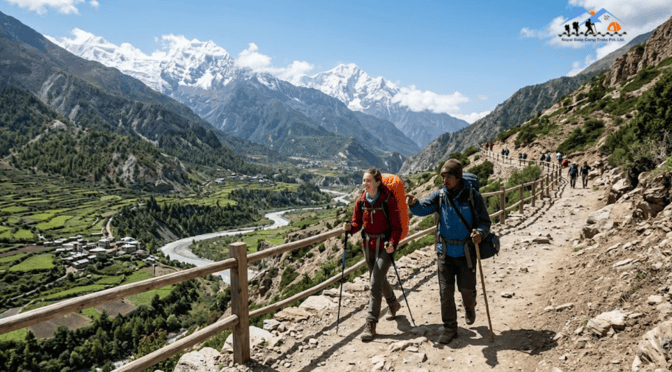
Imagine ending your trekking day with a cup of tea, sleeping in a wooden room and hearing the distant sound of prayer wheels.
That is what the teahouse experience Manaslu looks like.
Along the breathtaking Manaslu Trek, every stop is a story to be told.
These teahouses in Manaslu Circuit Trek are more than simply places to stay.
You can consider them as lifelines built by the local people, who take joy in welcoming all travelers, opening their doors and serving Momo and Dal bhat.
The Manaslu Trek Route winds its way in and out of hidden valleys, past suspension bridges and ancient monasteries, providing one of the most authentic treks in Nepal.
This restricted area still feels untouched compared to other trekking trails in Nepal and the hosts are friendly, the views of the mountains are outstanding and many areas feel incredibly quiet.
If you’re planning your adventure and are worried about the cost of the Manaslu trek, permits or where you’ll sleep when you reach your destination, just relax.
With over 20 years of experience as a trekking agency in Kathmandu, we at Nepal Base Camp Treks will organize your guides and accommodations and begin planning routes, so that you can focus on what matters: walking, breathing and living the Himalayas.
A Brief Description of the Manaslu Circuit Trek and Teahouse Culture
If you are seeking a perfect blend of wild and welcoming, look no further than the Manaslu Circuit Trek.
This trek is remote enough to provide a sense of adventure, yet rich in hospitality thanks to the unique teahouse experience of Manaslu.
As you walk through the villages on the trek, you will not only see prayer flags fluttering in the breeze and kids yelling “Namaste,” but you will also see teahouses tucked in between stone walls, set among rhododendron trees.
They are not simply places to sleep; they also provide a window into Himalayan life.
Every night is a different story: the local host provides you with butter tea, trekkers tell jokes around the stove and you quietly listen to the snowflakes falling outside your window.
That is the real beauty of the Manaslu teahouses, which is about belonging, not luxury.
In Short, The Manaslu Trek Journey:
Duration: Roughly 14 to 17 days of total mountain adventure.
Highest Elevation: Larkya La Pass (5,160 m), the climax of the trek.
Accommodation: Simple yet welcoming family-run teahouses.
Best For: Trekkers looking for culture, solitude and beauty in its natural state.
Did you know? The Manaslu trek without a guide is not accessible and honestly, you would not want to do it without one. The trails weave in and out of hidden valleys and sacred spots that only local professionals really comprehend.
What Are Teahouses and Why Do They Matter On the Manaslu Trail?
Teahouses on the Manaslu Trail are small family-run lodges where trekkers eat, sleep and rest while traveling through the Himalayas.
They are the core of the teahouse experience Manaslu, offering a sense of safety and community, all in one of the most remote areas of Nepal.
Hosted and run by local people from the Manaslu region, teahouses offer basic amenities – simple wooden rooms, warming blankets, shared bathrooms and a dining area where you sit together after a tiring day of trekking for dal bhat.
In this remote part of Nepal, where camping was previously the only option, teahouses have changed the game.
They have made the trail less crowded, more sustainable and more community-based.
Trekking with tents and gas stoves has to staying at elevated mountain homes, where guests are supporting the families that preserve the culture and environment of this region.
Teahouses offer an experience of local life and hospitality, from home-cooked meals to warm, welcoming people.
Fun fact: As you continue to climb higher, the accommodations become simpler, but the connection becomes deeper. At high altitude, even a hot cup of tea seems like a luxury.
So, when trekkers talk about the experience of teahouses in Manaslu Circuit trek, they are really talking about the adventure of being invited into an experience and relationship with someone, way above the clouds.
Inside Your Accommodation — Comfort and Accommodations
When you trek with Nepal Base Camp Treks, the teahouses on Manaslu Circuit Trek become part of your story.
You won’t just check in, you’ll be welcomed like family.
That’s the real teahouse experience Manaslu provides: simple comfort, warmth and true spirit of hospitality are what make this region feel like home in the mountains.
Room Configuration and Sleeping Arrangement
You’ll sleep in cozy wood rooms with two single beds, clean blankets and a window to enjoy the view of faraway snow peaks.
The bedding always feels basic, but it is always warm and part of the fun.
At altitude, the air is colder, so our guides always encourage you to pack one thin sleeping bag liner to stay extra cozy.
Some of the rooms have thinner walls, so you might hear quiet laughs or the crackle of the kitchen fire next door, which is a gentle reminder that life here runs on simplicity and community.
Bathroom and Hygiene Facts
Most teahouses have shared bathrooms.
In the lower villages, you will likely find Western-style toilets and running water.
As you go up in elevation, the facilities become less developed.
At this point, you will be offered a squat toilet or possibly a bucket of hot water heated by firewood or solar panels.
However, you don’t have to worry; we will steer you in the right direction to the cleanest and most dependable options at each stop.
Pro tip from our guides: Bring tissues, sanitizer and flip-flops for your evening bathroom visits; both little things make a major difference after a long day of trekking.
How Comfort Changes with Elevation
As you begin to ascend more into the Manaslu region, teahouses become quieter and more rustic in nature.
They likely have limited power and shared basic facilities, but the views are truly magical.
In Samagaon, you wake up to mountains glowing pink at sunrise and you sit at dinner in Dharamsala, sipping tea under a blanket of stars.
Dining Above the Clouds – Food & Drink with Manaslu Teahouses
One of the highlights of the teahouse experience Manaslu is the food, which is hearty, home-cooked fare that hits the spot after a long day walking.
Every meal turns into a warm memory of a special bond between you, other trekkers and your local hosts who cook nightly dinners with attention to detail and care and not just with recipes.
Dal Bhat Power
You’ll hear it everywhere: “Dal bhat power, 24 hour!”
And it’s true, this simple, classic Nepali meal will keep you fueled for the entire trek.
From various teahouses, you will be served a plate heaped with steaming rice, lentil soup, vegetable curry and spicy pickles.
And the best part? You can have free refill.
After a lengthy day of climbing onward and upward in the Manaslu region a steaming plate of dal bhat is pure heaven.
Local Flavors and Dishes Made with Yak
Along the way, there will also be some unexpected local food that will get your taste buds dancing.
The smell of steaming momos (Nepali dumplings), Tibetan bread with honey and delicious, creamy yak products like butter tea and yak cheese will all surprise you.
This food connects you directly with local people and their culture, as much of this food comes from parts of the world where yak herding has kept families strong for many generations.
Hot Drinks and Nighttime Socials
Each evening, as the cold settles outside, the dining hall is bright with laughter and the aroma of tea.
You could order milk tea or hot cocoa, while local sea buckthorn juice is great for trekkers due to its many vitamins and ability to work in the thin air of Nepal.
Some of the tea houses even have Wi-Fi zones, which let you share your travels before the lights go out.
However, most trekkers will find that true community happens around the fire and not on a social channel.
Electricity, Wi-Fi and Hot Showers – The Comfort Triangle
As you head deeper into the Himalayas, you will find new meaning to comfort.
The teahouse experience Manaslu won’t be about luxury, it will be about warmth, light and connection in the simplest form.
Power and Charging
At high elevations of the mountains, electricity is a rare commodity.
You can find basic plugs in your room or dining area in the lower Manaslu regions.
However, in upper sections, teahouses run on solar power, which is why you need to pay a small fee for charging devices (around 200-400 NPR).
We highly recommend that you bring a portable charger so that you won’t miss capturing beautiful scenarios just because your phone dies.
Location: Where You’ll Find Wi-Fi (and Where You Won’t)
You’ll likely find Wi-Fi or mobile data connection at villages in the lower section, such as Machha Khola or Namrung.
But as you ascend higher into the Manaslu region, the signals become weaker, which is part of the allure of these restricted areas.
You will find yourself chatting with your group in the evenings, rather than scrolling through social and realizing that the best type of connection does not require the internet.
Hot Water and Showers: Expectation vs Reality
On the trek, having a hot shower is like finding treasure!
Some of the teahouses will offer solar-heated water, while others will heat the water over wood-burning stoves.
The higher you go, the simpler the shower gets and the more precious that bucket of warm water feels.
Every member of our team at Nepal Base Camp Treks will ensure you are getting access to the cleanest, safest basic facilities available at any stop, no matter how remote.
Well-Known Villages with Great Teahouses on the Manaslu Route
As you get deeper into the mountains, each village provides a fresh version of the teahouse experience Manaslu, from warm river valleys to real high altitude slopes.
See our Complete List of Villages on the Manaslu Trek here.
Soti Khola
In Soti Khola, a bustling riverside village where the air is warm, the trail doesn’t feel so steep and the teahouses are designed for comfort, your trek begins.
Here you have larger rooms, larger dining halls, better food options and hot showers.
It is the last place on the Manaslu trail where life feels “easy”, so take advantage of your time here and settle in, get your pack sorted, have a leisurely cup of tea, before you begin to ascend.
This village offers warm temperatures, full menus and first-night comfort
Machha Khola & Jagat
Entering Machha Khola and Jagat solidifies the feel of your trekking experience.
The valley narrows, the air turns cool and the teahouses become simpler, quieter as well as more soulful.
Rooms are simple but clean, meals are hearty and the local people running the teahouses welcome trekkers with an endearing warmth.
It is the best place to slow down and get comfortable with the mountains.
Lho & Samagaon
This is the place that will drop your jaw.
In Lho, you will have your first complete view of Mount Manaslu, where you will see it glowing pink at sunrise and larger than life on top of the rooftops of the village.
Then you will proceed to Samagaon, one of the most beautiful villages in the Himalayas.
The accommodations here feel less like a teahouse and more like a stone lodge, surrounded by prayer flags, prayer wheels and Tibetan Buddhist culture.
You will start your side trip to Manaslu Base Camp from this village, too.
Samdo and Dharamsala
Now everything is different. Samdo is the last true village, which is small, windy and full of yaks and stone houses.
Next is Dharamsala (Larke Phedi), the last stop before crossing Larkya La Pass.
There is only 1-2 teahouses and they are basic, offering shared rooms, limited power, no Wi Fi and an early bedtime.
However, there are plenty of stars in the sky, the soup is hot and everyone in the dining room is aware that tomorrow is the big day.
Larkya La Pass and Beyond
The ascent to Larkya La Pass (5,160 m) marks the transition from a beautiful to a serious Manaslu trek.
The air thins, the temperatures decrease and the teahouses become more basic than those in lower villages, but this is the beauty of that part of the journey that will make you truly feel you are trekking.
Dharamsala (Larke Phedi), where you will spend your night before crossing the pass, is a high-altitude basic lodge where trekkers go to bed early to wake before dawn.
Here, there are no private rooms, no hot showers and no wi-fi.
You have to share a bed, use warm blankets and sit in a dining room with a full of people who are all preparing for a long day, adding another memory to your teahouse experience Manaslu.
You will feel the difference right away, as it takes more effort to take every step, the breath feels short and even a cup of hot water feels like fuel.
But when the sun rises, illuminates the glacier and you begin to walk towards Larkya La Pass, the challenge becomes part of the reward.
Once you cross the pass and descend into Bimtang, everything softens again.
You will have warm rooms, better food and really, your first rest after your many days at altitude.
It is the toughest part of the Circuit Trek, but it is also the toughest part you will remember the longest.
Cultural Experience Within Manaslu Teahouses
The teahouse experience Manaslu is not merely about food and accommodation; it is about hospitality, culture and nightly customs while on the trek.
It is also the part of the trek in Nepal that most adventurous travelers will remember long after they leave the mountains behind them.
Meeting the Tamang & Tibetan families
Most teahouses in Manaslu Circuit Trek serve travelers with food and hospitality, which is managed by Tamang and Tibetan Buddhist families, who have lived and traveled among the landscapes of the Manaslu Region for generations.
They are the stewards who cook for trekkers, tend to the fires and convert basic timber lodges into cozy resting places for trekkers after long days of walking.
You will encounter many familiarities like prayer flags above the doors, prayer wheels at the entrance and steaming plates of well-cooked dal bhat served with little to no comment.
Even at higher elevations, nomadic families will greet you with tea, a blanket and a smile because hospitality is not business, not industry, it is a proud culture.
After trekking all day and meeting and passing through the villages, you finally realize – you are not just passing through villages, you are being welcomed.
Evenings Around the Stove
No matter what teahouse you finish your day with, the routine is the same: everyone finds themselves in one warm dining room, around a stove.
This will be a teahouse experience manaslu that will linger in your memory.
Boots dry by the fire. Down jackets hang above as someone melts snow for hot water.
Someone check for Wi-Fi. Someone orders extra dal bhat because the refills are free.
These evenings feel like a stop in time itself, where strangers enter into a camaraderie, trekkers share stories and the clouds fall completely silent outside.
That’s when you get a sense that the teahouses in Manaslu Circuit Trek are more than lodges.
They are living rooms in the middle of the Himalayas.
Helpful Tips for Staying in Teahouses on the Manaslu Trek
The teahouse experience Manaslu is delightful, friendly and charming, but it is still the Himalayas, so preparing ahead of time makes things a lot better.
Herer is what savvy trekkers do to stay warm, rested and comfortable on the way to the pass.
What to Pack for Comfort in Teahouses
Teahouses provide blankets, meals and beds, but when you are on the trail and gain elevation, access to electricity and hot water can be lacking.
If you think ahead and pack a few items, even the most basic tea houses will feel homey after walking all day.
Here are the most useful items:
- Sleeping bag liner (it gets colder after Samagaon)
- Power bank (charges usually cost additional)\
- Headlamp (for dark rooms + early starts)
- Wet wipes and tissue (not always provided)
- Light slippers or warm socks (shoes will stay outside of the room)
- Water purification tabs or bottle filter (will be cheaper than buying bottled water every day +)
If you would like a complete checklist, take a look at our Manaslu Trek Packing List.
Etiquette & Responsible Trekking
Teahouses are family homes, not hotels; hence, treating them as such will help you get an amazing experience of Manaslu region.
In the small towns of the Manaslu region, small recoils of acts of kindness go a long way.
Examples of good teahouse manners:
- Remove your shoes before entering rooms
- Don’t waste food, firewood or hot water; nothing is easy to bring up in this region
- Ask local people before taking a photo of them or in a place of worship
- Keep the dining hall quiet after meals
- Eat your meals where you are staying (unwritten rule in trekking culture)
- Pack out your trash; there is not much waste disposal up here in the mountains
- Show respect, wear modest clothing and respect the people
Why Teahouse Experience Makes the Manaslu Trek Special
The Manaslu Circuit trek is more than crossing high passes and seeing huge mountains.
What makes this trail stick with you is the way you live your life each day through the teahouses.
The teahouse experience Manaslu feels so human and intimate because you are living alongside families, not just in lodgings made for tourists.
You eat home-cooked simple dal bhat, drink tea around a stove and sleep in rooms made from stone and wood like the local people from the Manaslu region.
Evening in the teahouses feels calming, comforting and shared.
After a long day of walking, each trekker settles in, takes off shoes and socks to dry by the fire, someone asks for more hot water and prayers are sung softly.
The sound of the wind outside and sometimes nothing at all, brings a feeling of remoteness to a long day of walking.
That silent mountain feeling stays within you long after the trek is over.
The teahouses in Manaslu Circuit are basic, but they provide something more important than basic comfort and warmth.
It is a chance to slow your body and mind down, engage with people and feel the culture instead of witnessing and observing it from afar.
It is a collection of human experiences, crammed into small, rich moments that last long after the trail is finished.
If you are prepared to plan, interested in learning more or taking the first steps toward the trail, begin with the people who know the trail best.
Start with Nepal Base Camp Treks.
The trail is ready. The teahouses are waiting.
The only thing missing is you.