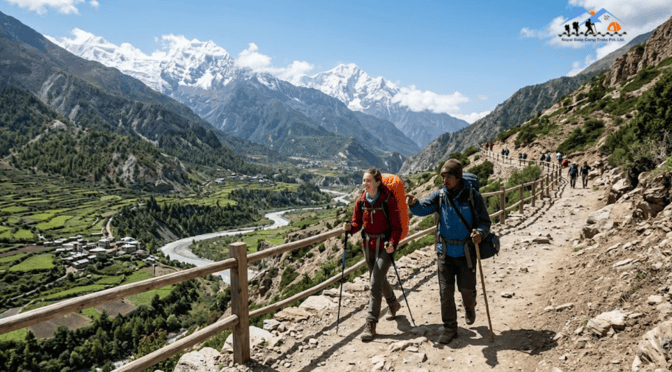
Have you ever wanted to stroll through villages where the mountains seem like you could reach out and touch them?
Where crossing swinging bridges, passing prayer wheels and sleeping under the stars with absolutely no city light nearby is a regular occurrence?
That’s the Manaslu trek route, a 12-day hike circumnavigating the base of Mount Manaslu, the 8th highest mountain in the world.
This route is the real deal – a less-travelled alternative to the busy Everest or Annapurna circuits.
It’s a return to rawness, to remoteness and to a version of Nepal that still somehow feels sacred.
And you are here because you want to hike it, wisely.
You’re not just looking for a map, you want the whole picture;
What happens on each day of the trek?
In which villages will you be stopping?
How high will you be going and how hard will it be?
What should I pack?
What trekking permits do you need?
And finally… what will make this trek so memorable?
We’re Nepal Base Camp Treks and this is not just another blog post.
This is the ultimate 2025/26 guide to hiking the Manaslu Circuit like a local, not lost tourists.
We have done this trek hundreds of times.
We have witnessed first-time trekkers pull themselves over Larkya La with tears in their eyes, and veteran trekkers proclaim that it is the best trek they have ever completed.
This blog offers a breakdown of the Manaslu circuit trek route, complete with a day-by-day breakdown, up-to-date route map, permit information and accommodation.
Let’s get started with the trailhead – but not before one last reminder:
Overview of the Manaslu Trek Route

Trekking Duration: 12 days
Trekking Distance: ~180 km
Start Point: Machha Khola
End Point: Dharapani
Highest Point: Larkya La Pass
Permit: Restricted Area (Trekking guide mandatory)
The Manaslu Circuit trek is a 180 km circuit trek that surrounds the giant Mountain Manaslu (8,163m) in the Gorkha region of northern Nepal.
Manaslu trek route is a restricted trail, meaning it is protected, underdeveloped and only open for trekkers who trek with a licensed guide and permit, making it an authentic and peaceful trek.
You will start at Machha Khola in the lowlands and wind your way through wonderful villages, like Jagat, Namrung, Lho, Samagaun and Samdo, each one elevating you some more each time.
The highest point of your trek is Larkya La Pass, a snowy saddle with a height of 5,160m and spectacular views of Manaslu, Himlung Himal, Cheo Himal and even Annapurna II.
After crossing the high point pass, the way winds down, traveling across Bimtang to the end of the trek in Dharapani, where it joins the Annapurna Trail.
Along the way, you will trek 6 – 8 hours per day, staying in warm and friendly teahouses, while also crossing suspension bridges over roaring, running rivers!
The elevation is gradual to allow for acclimatization.
As for the change of scenery? One of the best parts is that you are changing every day – from subtropical jungle to alpine glacier.
Why This Route Is So Special
- It’s a true circuit – no retracing your steps, only new scenery every day
- You’ll encounter villages on Manaslu trek where Tibetan culture lives and is not commercialized
- The trail has fewer trekkers, so you get silence, solitude, and scenery
- It is one of the very few treks that allows you to access Manaslu Base Camp, Birendra Lake or tack on the Tsum Valley Manaslu Circuit trek extension
- And yes, Larkya La is hard. But it’s the kind of hard that will stay with you forever
If you are looking for a trek that is remote but easy to walk, wild but accessible, the Manaslu trek route might just be Nepal’s best-kept secret.
Day-by-Day Manaslu Trek Itinerary with Stop Points

Trekking the Manaslu route is not just a walk – it is an outdoor exploration through incredible landscapes, isolated villages and ancient cultures.
Here is how the journey will break down, day by day, with actual stop points, acclimatization plans and local handy tips to make your trek preparation much smoother.
Day 1: Drive from Kathmandu to Soti Khola
The adventure begins
Leaving the craziness of the city behind, you will have a long but scenic drive to Soti Khola – the official starting point of the Manaslu trek route.
You can expect about a 7–9-hour drive with some pretty bumpy roads, some riverside views and your first taste of rural Nepal.
Stop Point: Soti Khola
Trek Time: Full day drive
Tip: Finalise all personal trekking gear before this day, as wi-fi and shops are becoming a rare commodity.
Day 2: Soti Khola to Machha Khola
From today, you will use your feet on the Manaslu trail!
You will be following cliff-hugging paths, lush forest land and roaring rivers.
There are a few small teahouses along the way – great spots to refuel and your first taste of local cuisine like dal bhat and garlic soup!
Stop Point: Machha Khola
Trek Time: 6–7 hours trek
Experience: A warmup walk with lots of natural scenery and rustic vibes.
Day 3: Machha Khola to Jagat
The Manaslu trek route today, feels wild today: narrow trails, waterfalls to cross and swinging bridges.
You will arrive in Jagat, which is a stone village and is where your trekking permits will be officially checked.
Stop Point: Jagat
Trek Time: 6 hours
Tip: Jagat is the beginning of the Restricted Area and from here, only guided treks are permitted. (So if you were planning a Manaslu trek without a guide, sorry, this rule doesn’t allow trekkers to enter without a guide.)
Day 4: Jagat to Deng
You will trek through bamboo forests and lovely hamlet villages such as Philim.
The views will be a transition as you will begin to see more mountain ridges, landslides and the ancient Mani walls appear.
Stop Point: Deng
Trek Time: 6–7 hours
Experience: A true venture into the wilderness where the outdoor exploration begins in earnest!
Day 5: Deng to Namrung
You will cross some suspension bridges and witness the slow inception of Buddhist thoughts firmly embedded in the livelihoods of the people.
Namrung will welcome you with stone gates and architecture with a stark Tibetan influence.
Stop Point: Namrung
Trek Time: 6 hours progressive outing
Experience: Beginning high mountain life with some of our best destination guide photography opportunities.
Day 6: Namrung to Lho
Today, you will hike through pine forests and barley fields and chortens as the air begins to thin..
You will start to see the true beauty of the villages on the Manaslu trek- untouched, soulful and scenic.
Stop Point: Lho Village
Trek Time: 4-5 hours
Tip: Head to the Ribung Monastery for golden hour, looking back over Manaslu.
Day 7: Lho to Samagaun (Acclimatization)
Today’s plan is slow so that your body can adjust to the altitude here at Samagaun, which is at around 3,530m.
Samagaun has a few side hikes as well, including a short walk to Birendra Lake or to Manaslu Base Camp (optional).
Stop Point: Samagaun
Trek Time: 4 hours
Note: This is your main day of altitude acclimatization.
Day 8: Samagaun to Samdo
You are well above the tree line now with snowy peaks all around!
Samdo is the last village before the pass and feels a lot like the end of the world.
Stop Point: Samdo
Trek Time: 4-5 hours
Experience: A rough village with strong Tibetan roots. You will get opportunities for some cultural experiences and a glimpse of life near the border.
Day 9: Samdo to Dharamsala (High Camp)
Take a leisurely trek to the last teahouse before the pass. This is a barebones camp at 4,460m.
You’ll be sleeping early since tomorrow is the hardest, but most rewarding day.
Stop Point: Dharamsala (Larkya Phedi)
Trek Time: 3–4 hours
Tip: Stay hydrated, check your trekking gear again and mentally prepare yourself for the pass.
Day 10: Cross Larkya La Pass to Bimthang
On this day, Manaslu trek route leads you to peak of the trek!
You will walk a few hours before sunrise, cross snowy trails, then get to Larkya La Pass at (5,160m).
The views there is stunning that it will shake your soul.
Stop Point: Bimthang
Trek Time: 8–10 hours
Day 11: Bimthang to Tilije
You’re back down below 3,000m. Stroll through rhododendron forests and yak grazing pastures.
After days and days of dal bhat, a fun surprise in Tilije – fresh pastries from a bakery and a mini-market!
Stop Point: Tilije
Trek Time: 6 hours
Experience: A fantastic day to reflect on your adventure and, if you haven’t yet, enjoy more local cuisine.
Day 12: Tilije to Dharapani and Drive Back
This is an easy day with less elevation.
You will get to Dharapani; this is where the Manaslu trek joins the Annapurna Circuit on the route.
After Dharapani, you will drive back to Kathmandu via Besisahar.
Stop Point: Kathmandu
Trek Time 3–4 hours hike + drive
Tip: Yep, you completed your Manaslu trekking! Have a party.
Terrain and Altitude: What to Expect Along the Manaslu Trekking Route

The Manaslu trek route features diverse landscapes that range from warm river valleys to glacier-filled high passes.
This dynamic terrain is what makes it such an incredibly dramatic trekking route in Nepal.
From Lowlands to Highlands
Your trek starts at Machha Khola (710m) with the trail winding alongside the Budhi Gandaki River.
You can expect thick vegetation, rice fields and narrow trails cut into the side of steep cliffs.
The Manaslu trek weather will be hot and humid, with the sound of bustling village life surrounding you on all sides.
When we arrive at Namrung (2,630m), a vast change in scenery will occur.
Suddenly, you’re surrounded by pine forests, the temperatures drop noticeably and the trail opens to views of snowy peaks in the distance.
On the Manaslu trek, there will be hanging bridges and traditional villages (living artifacts) that allow you to feel as if you traveled back in time.
Once we reach Samagaun (3,530m), the altitude will kick in.
You won’t be moving slowly, since there will be no difficulty in the terrain, but because your body has to acclimatize.
At this point, acclimatization is vital.
A side hike to either Manaslu Base Camp or Birendra Lake would be beneficial.
High Altitude Difficulties
The ultimate challenge? Larkya La pass – 5,160m.
It’s rocky, exposed and often snowy, depending on the season – particularly in early spring and late fall.
Trekkers leave before sunrise to take advantage of still air, without windy afternoons.
The difficulty cannot be overstated – but it is an adventure you will remember fondly.
The sun rises at this altitude and the many mountain views on the Manaslu Circuit trek are truly magical.
When you cross the pass, the descent to Bimthang at 3,590 meters, feels as if you have landed on another planet – wide open valleys, glacial river valleys and a silence that is loud and echoes.
Altitude Gain Plan
One of the best aspects of the Manaslu trek route is how patiently this route allows you to acclimatise.
Instead of big elevation gains over a few days, as in many other trails, the Manaslu trek altitude gain is achieved over many short days.
Instead of hiking for days straight up, this route offers resting points at varying altitudes – like Samagaun and Samdo, as well as join in optional side trips to adjust your body to increasing altitude.
Learn difficulty level of Manaslu Circuit Trek.
Key Villages and Cultural Insights on the Manaslu Trail

This experience is not just a hike through the mountains; this is a trek through a living culture!
With every stop along the Manaslu Trek route, you come to a different Himalayan village, shaped by Tibetan culture, Buddhist devotion and raw mountain resilience.
Lho, Samagaun & Samdo – Rocks that tell stories
Lho (3,180m) is where the views really begin to open up.
You will be walking by chortens and prayer walls, and you will see Manaslu soaring in front of you.
Lho is a small village, one of the peaceful ones, with a lovely monastery just above it.
Samagaun (3,530m) is bigger – the heart of the highlands.
From Samagaun, you can take short hikes to Manaslu Base Camp, Birendra Lake or just hang about, figuring out village life.
Yak herding, weaving and stone houses in Tibetan style give you a glimpse of a life that is timeless.
Then you arrive at Samdo (3,875m) – the last permanent settlement before the pass.
Samdo is only 15km from the Tibetan border.
The vibe in Samdo is stark, yet spiritually charged.
You will find no cars, no roads and no wi-fi here.
Just people who have learned how to live in this wilderness and worship the peaks that surround them.
Possible Side Trips: Tsum Valley and Manaslu Base Camp
If the Manaslu trek route wasn’t already pretty magical enough, there are 2 adventures you can take by taking two side trips to two hidden treasures nearby – Tsum Valley and Manaslu Base Camp.
Tsum Valley: The Sacred Side Trek
Have you heard of the Tsum Valley Manaslu Circuit trek?
This side trail takes you to a remote area, where ancient monasteries flourish, mystical caves exist and Tibetan culture has remained untouched.
You will need an additional 5-6 days to explore Tsum Valley.
If you have time, it is worth every step!
Communities within Tsum Valley practice traditional polyandry and the valley remained closed off to outsiders until 2008, meaning everything there feels untouched by modernity, almost like a lost chapter of the Himalayas.
Therefore, Tsum Valley is not only a side trip but also dives into the conceptual depth and spiritual geography of Nepal.
Manaslu Base Camp: A Day Hike Up from Samagaun
From Samagaun, you can hike to Manaslu Base Camp (4,800m) in one day and back.
It is reasonable to let this be a challenging (but meaningful) acclimatization hike!
The trail towards base camp brings you by Birendra Lake, an outstanding blue glacial lake and then to base camp – that is where all Mount Manaslu expeditions begin.
This trip doesn’t require any additional permits, as we have already included this destination as optional in part of our itinerary.
Permits and Entry Points Along the Route
There is one thing you absolutely need to for completing Manaslu trek route and that is the Manaslu Circuit trek permit.
Unlike Annapurna base camp and Everest base camp treks, the Manaslu region is a restricted area, which means you need a special permit to enter it.
There are three permits you require for trekking in the Manaslu route
Manaslu Restricted Area Permit
This permit is required for exploring areas from Jagat to Dharapani
This permit price is dependent on the season (higher in peak months) and is only issued through a licensed trekking agency
Manaslu Conservation Area Permit
This permit covers the conservation area from Soti Khola to Samagaun.
Annapurna Conservation Area Permit
This is required after you cross the highest point, Larkya pass and descend into the Annapurna region.
Note: You cannot trek Manaslu solo. Nepal law states that you require a minimum of two trekkers and a government-licensed guide for the restricted permit to be issued.
Where Are Permits Checked?
Jagat: The restricted zone effectively begins here! Get ready for your first big checkpoint!
Philim & Samagaun: Further checks to ensure that permits are valid.
Dharapani: Your final checkpoint when exiting into the Annapurna region.
If you are interested in adding the Tsum Valley trek as an extension, then you also need an extra permit for the Tsum Valley trek.
Accommodation & Teahouse Experience Along the Manaslu Trek
You definitely won’t be “roughing it” in tents on the Manaslu Circuit. Not at all!
Unlike camping treks, the Manaslu trek route features teahouse accommodation and that’s where the magic begins.
You will spend each night at a teahouse — a simple guesthouse organized by villagers that provides wonderful hospitality to trekkers with hot food, rest and sometimes an added surprise (e.g., a warm fire, WiFi).
Note: Trekkers typically overnight in Jagat, Namrung, Lho, Samagaun and Samdo villages, all of which have fine teahouses providing comparatively simple, but not to be overlooked, hospitality.
What are the Teahouses Like?
Accommodation: Wooden rooms, which are plain, containing two beds, a mattress, a pillow and a blanket. Note that walls are thin, and thus it is strongly recommended to carry a sleeping bag.
Food: All teahouses have a kitchen used to prepare food, including dishes such as dal bhat, thukpa, chowmein, pancakes and Tibetan bread. Each of these will be prepared using fresh mountain-bred vegetables that the teahouse has at the time.
Drinks: Ginger tea, masala tea, black coffee and filtered hot water.
Toilet: All toilets are shared and from squat toilets to basic Western-style toilets.
Electricity & Charging: Electricity is available in most villages; nonetheless, don’t forget to pack a power bank.
Connectivity: WiFi is limited at extra cost in Samagaun and Samdo.
Fun fact: The teahouse experience in the Manaslu region is something else. A few of the teahouses around Samagaun and Lho offer stunning views of Manaslu Base Camp and the white mountains in the distance! Wake up early — it’s worth it.
What Makes the Teahouse Well-Being Experience Unique
It’s not mere accommodation. It’s your introduction to village life.
You will eat what locals eat, sit by the same fire and exchange tales with other trekkers and your hosts.
It’s comfortable, communal and solidly rooted in Himalayan trekking tradition.
If you’re used to the crowded lodges of the Everest Base Camp trek trail, the teahouse trekking experience on Manaslu offers a peaceful and down-to-earth vibe — with amazing hospitality and high-altitude resilience.
And for the query-seekers asking, “Is the Manaslu trek after earthquake safe to travel?”
Yes, it is.
Teahouses have either been rebuilt or brought to current safety requirements.
The Manaslu trek, post-earthquake, has come back more robust with upgraded trails and villages that survived.
Manaslu Circuit Trekking Reviews and Experiences
You don’t just trek the Manaslu Circuit trek — you experience it.
Ask anyone who has done it and they will get a sparkle in their eye.
“The trail changed the way I view travel — in all the centuries of trekking, I think I finally felt time walking through untouched villages, rough rivers and the wilderness with no one else in sight.” – Andy
Some trekkers added the Tsum Valley Manaslu Circuit trek extension and feel like they entered an esoteric, hidden spiritual world.
Others who attempted the Manaslu trek unaided quickly learned that the Restricted Areas of Nepal require experience and a permit and there is no going back to safety.
These reviews are not polished and they are not promotional. They come from trekkers who finished the trip, fatigued, altered, and with a feeling of gratitude.
FAQs
Is the Manaslu trek route beginner-friendly?
Not really for first-time trekkers, however, with good fitness and a good guide, it’s achievable.
The trek is in a remote area, at high altitude and requires long days of trekking, so preparation and acclimatization are crucial.
How long is the Manaslu Circuit route?
Approximately 180 km for 12 trekking days, beginning at Machha Khola and finishing at Dharapani.
It is on a full loop, with daily changes in scenery and elevation.
What is the hardest part of the route?
Larkya La Pass at 5,160m is the most difficult section of the Manalsu trek.
Climbs are long, steep, cold and the altitude is threatening, but the 360-degree views are worth it!
Can I do the Manaslu trek and visit the Tsum Valley?
Definitely! The Tsum Valley Manaslu Circuit trek allows trekkers to take an optional side trip to a remote and spiritual valley.
It is a quiet valley, deeply culturally rich, which would be perfect for individuals with a few extra days.