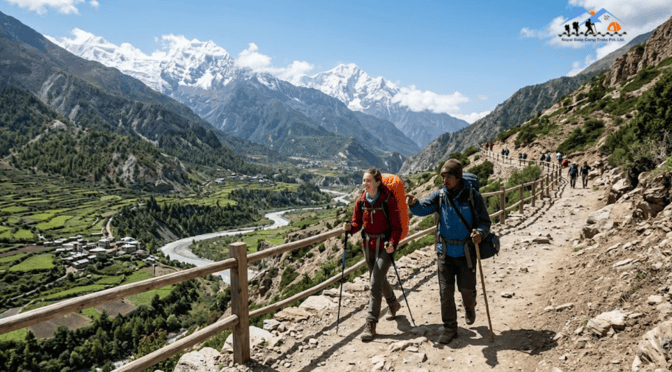
Manaslu Circuit Trek is Nepal’s hidden gem; remote, raw and absolutely unforgettable!
From ancient villages and swinging bridges to snow-capped peaks and rich Buddhist culture, you get the full-feeling Himalayan experience, with no crowds like Everest.
However, the real question is, how difficult is Manaslu Circuit Trek for a first-time trekker?
At Nepal Base Camp Treks, we have led hundreds of first-time trekkers on the Manaslu Circuit Trek.
This trek is challenging, but not impossible.
With a little bit of experience and the right preparation, together with guidance, even a beginner can complete this trek and love every minute of it.
The difficulty lies with the altitude, isolated routes and long hours of walking and hiking.
You will not be doing any technical climbing, though.
Meaning it is much more about endurance, plain and simple, rather than about climbing skills.
And according to the new travel regulations of Nepal, you cannot do Manaslu trekking without guide anymore.
In addition you need two trekkers and a registered guide to start your journey.
This is a guide to the real Manaslu Circuit trek difficulty, how to prepare and more importantly, why this trek is worth every hiker’s step of the way—particularly if you are a first-time hiker looking for an epic hike.
Difficulty of Manaslu Circuit Trek

When people ask how difficult is Manaslu Circuit Trek, the answer comes down to many factors, such as altitude, trek duration and trail conditions.
Altogether, this trek is really challenging, especially for first time trekkers.
If you’re a first-time trekker, knowing these difficulties well in advance can turn a tough trek into an experience of a lifetime.
The Manaslu trek difficulty level does not come from technical climbing and movement.
Rather, it is about endurance, acclimatization and being prepared for the changing weather conditions in a remote area of the Himalaya.
Altitude and Acclimatisation Challenges
One big factor for the Manaslu Circuit trek difficulty is the altitude.
The highest elevation of the Manaslu Circuit Trek is at the Larkya La Pass at 5,106 meters (16,752 ft).
Really high!! Higher than Everest Base Camp!
When you trek at this high altitude the air gets thinner and it takes time for your body to adjust.
If you do not acclimatise properly, you risk suffering from altitude sickness – which can present itself in headaches, nausea or worse – before, during or after your trek.
But, no need to panic.
With the right pace in the itinerary, the right rest days and an expert guiding team, most healthy first-time trekkers will acclimatise safely.
Interested in a full breakdown of elevation gains? Check out our Manaslu Trek Altitude Guide.
Trek Length and Daily Walk Time
The standard Manaslu Circuit Trek with NBCT is 12 days, with the total distance around 180 km (110 miles).
You will be hiking for 6-8 hours most days and longer on the day you cross the high pass.
For first-timers considering how hard is Manaslu Circuit Trek, it is daily endurance that can be difficult, especially with a load on your back.
That is the reason most clients have opted for hire a porter (optional at USD 20/day) and keep the load off their own backs.
The most important thing is to build your fitness before you come.
Practice walking up and down hill with a 5 – 7 kg in your daypack for a few hours.
In addition to that, add cycling, swimming and exercising for your leg and core strength.
Trail Conditions and Terrain Type
The Manaslu Circuit Trek difficulty is also due to the broad changing landscapes and terrain.
You will travel through twelve days of transition:
From fertile valleys in the lower Budhi Gandaki to glacier moraine close to the pass, the Manaslu trek trail is consistently changing.
You will cross suspension bridges over the Budhi Gandaki River, navigate rocky paths, wind through dense forests and occasionally walk on snow.
The remoteness of the Manaslu region means that once you start, there is no fast exit — the nearest road is at Dharapani, on the last day.
This remoteness adds to the adventure, but it also makes careful preparation and reliable trekking guide very important.
In summary
The Manaslu Circuit trek difficulty is extreme due to these different elements.
Altitude: You’ll trek to Larkya La (5,160m) where the air is thin – acclimatizing is necessary.
Remoteness: Once you set out on this trek, the only exit is at the end of the Manaslu trek route at Dharapani.
Endurance: Having the ability to trek 6 – 8 hours a day for 1.5 weeks will be a test of endurance.
Terrain: You’ll trek over rocky paths, swing brideges, forest paths, snow, glacier moraine and other various terrain.
Weather Factor: The Manaslu weather can change fast especially at higher elevations.
Preparation Tip: Be fit, take it slow and have the right gear for the trek to make it more enjoyable and manageable.
Is the Manaslu Trek Suitable for First-Time Trekkers?

Many people who want to take on this challenge ask themselves whether this is a good trekking choice for their very first Himalayan trek.
From our experience at Nepal Base Camp Treks, the answer is YES! provided you are properly prepared and mentally ready.
Although the Manaslu Circuit Trek difficulty is graded as a “strenuous” trek, technical climbing skills are not required.
The challenge is based on a long trekking days, isolated areas and high-altitude conditions.
If you are in good health, physically fit and prepared to train beforehand, all trekkers from beginners onwards can experience and safely complete this trek.
Being a first-timer, there is a lot to consider; the best way to simplify your experience is to set realistic expectations, and use the safety, knowledge and cultural insight from a licensed guide.
Guided vs Unguided Trek – What’s Safer?
Since Manaslu is a restricted area, solo trekking is not permitted.
You will have to go in a group or hire a licensed guide through an authorized trekking agency, like Nepal Base Camp Treks.
With a gude by your side, you get:
- Safe pacing and proper acclimatization advices.
- Help with Navigation regarding the trail and weather conditions.
- Cultural experience/knowledge about the Tibetan influenced village systems that you will pass through.
- Emergency assistance/co-ordination if needed.
Fact An exert guide knows where you can get the best photos, they will lead to different photography spots.
Difficulty Comparison Against Other Treks
If you’re familiar with trekking routes like the Annapurna Circuit, Langtang Valley or Everest Base Camp, here is the comparison of how difficult is Manaslu Circuit Trek vs them:
| Trek | Max Altitude | Duration | Crowds | Difficulty |
| Manaslu Circuit | 5,160 m | 12-16 days | Low | Strenuous |
| Annapurna Circuit | 5,416 m | 14-18 days | Medium-High | Moderate-Strenuous |
| Everest Base Camp | 5,364 m | 12-14 days | High | Moderate-Strenuous |
| Langtang Valley | 4,984 m | 7-10 days | Medium | Moderate |
The Manaslu Circuit is often considered the hardest trek for initial trekkers due to their first experience in a remote, low-facility region in comparison to that of the Annapurna or Everest treks.
However, that is all merit for a rewarding trek.
Preparation Tips for First-Time Manaslu Trekkers
The Manaslu Circuit trek difficulty directly also depends on how your fitness level is, as the trail is tough for its high passes, longer trekking days and isolations.
So, if you prepared for it, you are going to have more fun on this trekking adventure.
At Nepal Base Camp Treks we have seen trekkers from every corner of life be successful, when they have thought ahead in the following three areas – physical fitness preparation, gear selection and paperwork completion.
Develop the Fitness Base
The Manaslu trail requires 6-8 hours of trekking each day. The terrain varies from river valleys to steep ascents, as at Larkya La Pass.
Physical training for endurance is required.
My recommendation is the following: Start training 6-8 weeks before your trek with:
- Long nature walks, or hikes that each week gradually increase to medium length (10-15 km) hikes.
- Hill climbing and stair climbing can prepare your legs to make the uphill trek more manageable.
- Core strength activities (for example, planks, squats, lunges) can build stability for dexterity on the rocky paths.
- Backpack hikes with 5-7 kg (i.e., wear your dayhike pack weight) will mimic a day of your trek.
Pro tip: Including some higher elevation treks if you can. Changing elevations will hel your body adapt to prepares you better when you arrive at Manaslu trek altitude above 3,500 m.
Pack Smart for Variable Conditions
Because the trail goes from warm valleys to cold windy passes, layering is very important.
Pack light but be prepared for sudden changes to the weather – This is particularly true at the pass where snow is possible at any time of year (although rare) even during peak season.
Your Manaslu trek packing list should include:
- Wicking base layers to manage moisture
- Warm fleece or down jacket for cold high-altitude camping nights
- Waterproof and windproof outer layer
- Trekking pants + thermal leggings
- Gloves, warm hat and sun protection
- Trekking boots that are well-broken-in and have ankle support
- Sleeping bag suitable for -10°C to -20°C
- Trekking poles for support on descents and snow
Sort Your Permits and Requirements Early
The Manaslu region is a restricted trekking area so you’ll need:
- Manaslu Restricted Area Permit (RAP) – For the entire trek between Jagat and Dharapani
- Manaslu Conservation Area Permit (MCAP) – For entering the conservation area itself
- Annapurna Conservation Area Permit (ACAP) – You will need this one as the trek ends in Annapurna territory!
Manaslu Circuit trek permits are only allowed for issuance through a licensed trekking agency, and you are going be trekking in a group of at least two trekkers, with a certified guide.
What we will need from you at NBCT are:
1) Passport copy & Nepal visa
2) 2–4 passport-sized photographs
3) Proof of insurance that includes high-altitude trekking
We will take care of the whole permit process so that you can concentrate on getting ready for your trek.
Village Life, Teahouses and Daily Comfort on the Manaslu Circuit

The Manaslu Circuit Trek is special for many reasons, but one of the most important is being connected to the people, culture and everyday life of the Himalayas.
Villages on Manaslu trek have not lost their trekking legacy like some of the more popular routes in the Himalayas and you’ll feel a deeper sense of the Tibetan-influenced way of life.
On the Manaslu trek, when you walk through villages such as Jagat, Lho, Samagaun and Samdo, you’ll pass by stone-built houses, prayer wheels and yak pastures.
The atmosphere in the Himalayas is relaxed and the community engagement is authentic.
As the children happily welcome trekkers on the path, local people will be open and eager to offer information or share their stories.
The Teahouse Experience
The accommodation along the Manaslu trek route is mainly in small family-run teahouses.
In a sense, teahouses should not be considered luxury lodges, but certainly are comfortable and friendly and well-located for onward stages of the trek.
The teahouse experience in Manaslu usually includes:
- A basic private room or twin room, with a very basic bedding arrangement (make sure to bring your own warm sleeping bag as a part of your Manaslu trek packing list).
- A communal dining hall, containing a stove and a bench setting for your seating.
- Electricity from solar. In some guesthouses, they also have charging devices (usually a few dollars for an hour).
- Some limited Wi-Fi available in some locations (but very slow).
Food and Daily Comfort
The food is fresh, hearty and energizing.
The most common meal is dal bhat, lentil soup, rice and vegetable curry, which you refill as much as you like.
The other food options will be Tibetan bread, momos, noodles, fried rice and pancakes.
As you get higher, the menu will be more simple as the challenge of transporting materials into a remote area is difficult.
Many of the meals will be local because of seasonally based vegetables and the unique flavors of each village.
Note: The weather in the Manaslu trek can affect the different types of food — there are loads of fresh vegetables in autumn and spring, while you will always struggle for food during winter’s coldest period.
Culture and Nature
The flora and fauna found in the Manaslu region is equally as important to the trekking experience as the mountain views.
In lower areas you will pass through rhododendron forests and may be lucky to see a number of unique birds to the Himalayan region.
In the higher elevations you may see blue sheep or the Himalayan griffon vulture (if you lucky).
The villages themselves are not just stopping points along your trek, they are historic places in the flesh.
Tourism has had a generally positive impact on locals here, supporting small family run businesses and their traditional lifestyles.
When to Go – Seasons Affecting Trekking Dificulty
So, how difficult is Manaslu circuit trek?
Its a question that can vary quite a lot depending also on the season you choose.
Weather, altitude safety, and even you level and experience of trekking can feel very different during every season: spring, autumn, monsoon or winter.
At Nepal Big Treks, we have seen first-time trekkers succeed just because they chose the right season.
Spring (March – May) – The best for beginners
Spring has generally excellent visibility, rhododendron forests are in full bloom and there are warm daytime temperatures.
The Manaslu trek has it most stable weather.
The higher altitudes have cool breezes while the valleys can be warm to easy your daily walk.
There is more wildlife highlights, with more active flora and fauna and this enhances every step of this trek.
This season is also ideal for you, if you are concerned about Manaslu Circuit trek difficulty level, but still want the immersive trek experience for your legacy.
Autumn (September – November) – Best Time & Most Photogenic
Autumn is the traditional trekking season in Nepal, offering dry, dusty trails, golden trees and sweeping Himalayan views.
The Manaslu trek route is at it’s safest, as it receives less rainfall and there is less variation in temperatures.
You can expect busy teahouses; so, it is best to book ahead if you have a limited time on the Manaslu trek.
Monsoon (June – August) – For the Bold & Experienced
Monsoon transforms valleys to green and rivers to full.
The rewards are wonderful and enjoyable, but the negatives of heavy rain makes trails muddy and slippery.
There is also a risk of landslides and leechs.
It is for trekkers with excellent physical fitness and with quality gear.
A waterproof jacket should be at the top of your packing list for the Manaslu trek.
Though tougher, there will be quiet villages on Manaslu trek and lesser trekkers.
Winter (December – February) – Quiet but Tough
Winter season is the highest when comparing seasons for Manaslu Circuit trek difficulty.
If you like the quiet and solitude winter has you covered.
There will be hardly anyone on the trails, and the snow covered peaks are stunning.
But you will also face freezing cold immense wind, icy passes and limited access where not all teahouses are open so you will experience less rest at each Manaslu trek stop.
FAQS
What is the most difficult part of the Manaslu Circuit Trek?
For most trekkers, the Manaslu Circuit trek difficulty is highest while crossing the high altitude pass of Larkya La Pass at 5,160 m.
You have very thin air which makes breathing harder and you can slow down due to altitude sickness.
Not to mention cold weather and the steep climbs, long days will make this difficult.
Can a beginner do this trek without any experience?
Yes – Many first time trekkers have completed the Manaslu Circuit Trek.
If you have done your physical training, preparation as a trekker and have local guide experience, it is doable.
But just be mindful that you need to take your time, take additional acclimatisation days and follow safety processes.
How does weather affect the difficulty of doing the trek?
The weather directly impacts the Manaslu trek difficulty, as it changes fast and during some seasons, the rain, snow and extremely cold can make the trails very slippery or dangerous.
Having the right trekking season (spring or autumn) means you can almost guarantee of reducing your risks and enjoy the experience more.
How much does it cost to do the trek?
The cost of the Manaslu trek is dependent on your mix of itinerary, group size and comfort level.
At Nepal Base Camp Treks, we have rivced the package at $740 per person.
The packages include permits, transport, accommodation and food options, provided you will be using the teahouse experience in the Manaslu lodges.