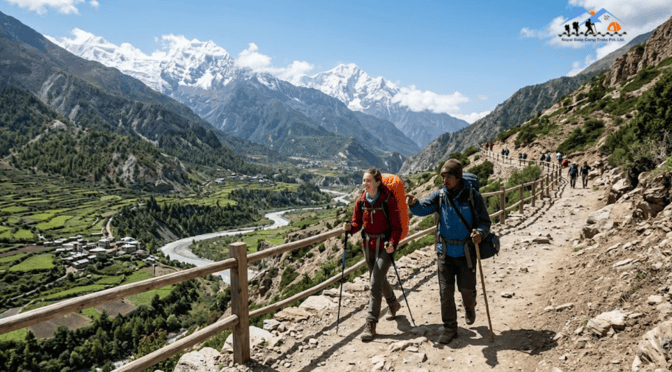
Imagine yourself on a ridge at 3,210 meters as morning coolness tickles your cheeks and the sun rises over the Annaurna ranges, casting peaks like Dhaulagiri, Annapurna South and Machhauchhre in gold.
Trekkers gasp, camera shutters and you?
You will be living one of the best experiences of your life.
But there’s the catch!
The mystical setting will occur only if the Poonhill weather is in our favor.
So, how is the weather in Poonhill Nepal?
From the golden glow of Annaurna in autumn to the sprawling trails colored with rhododendron blooms in spring, from the quiet of winter with snowy peaks to the green valleys of the monsoon season, each season has something new to offer.
Choose the wrong season and you might wake up early, climb in the dark with a sense of hope for what is to come and find nothing but mist.
Nepal Base Camp Treks has guided hundreds of trekkers through every sort of climate, temperature and trekking condition in the Annapurna range.
And, of course, we know all about the weather in Poonhill Nepal – the chill of the morning, the bite of wind speed at the summit, the surprise of sudden rain and when you will need your rain gear the most.
Throughout this guide, we will walk you through the different Poonhill weather, season by season and month by month, and give you our advice on when to travel, what to pack and how the weather will affect everything from the Poonhill trek difficulty to the Poonhill trek cost.
You will find that you can plan when to buckle up your boots and head to the Poonhill Himalayas to witness a stunning sunrise after reading this guide.
Overview – How Is the Weather in Poonhill Nepal, All-Year-Round?

If only you could do the Poon Hill trek every month of the year, would the views be the same?
The fact is that Poonhill weather seasons are unpredictable and knowing these can make or break your trip.
The weather here is affected by the unique topography of the Annapurna region.
There will be variations in the weather as the Poonhill trek altitude ranges from 800 meters to 3,210 meters.
Some mornings will feel fresh and cold, even in the summer months, while afternoons are usually pleasant when trekking.
There are dry months with beautiful sunny sunrises. Then there are the cloudy months with clouds, heavy rain or even snow.
Average Temperatures and Weather Conditions Each Month of the Year
Here is a quick guide to realize how the weather could affect your plans:
| Season | Day Temperature | Night Temperature | Conditions |
| Spring | 15 to 20°C | 5 to 10°C | Warm days, rhododendrons and bright mornings |
| Autumn | 10 to 20°C | 10 to 15°C | Crisp, clean air, clear skies and high visibility |
| Monsoon | 18 to 24°C | 0 to 5°C | High humidity, lots of rainfall and cloudy afternoons |
| Winter | 5 to 15°C | -5 to 5°C | Cold, good chance of snow and silent trails |
Spring (March to May) – Why This Is the Optimal Season to Poon Hill Trek

Our team of guides at Nepal Base Camp Treks will tell you that spring is always one of the most frequently trekked seasons.
The reason for this is that during spring, it offers stable weather, comfortable temperatures and pleasant trekking conditions, so that you can have a great experience seeing both the mountains and the trails.
Day temperatures are 15–20 °C and nighttime temperatures are about 5–10 °C.
You will often have clear mornings, which offer an excellent opportunity to witness a memorable sunrise over the Annapurna and Dhaulagiri Ranges.
Blooming Rhododendron and Great Weather
Spring is the time when the Annapurna region is at its finest.
Rhododendron forests (Nepal’s national flower) color hillsides red, pink and white.
The blooming of rhododendrons will provide an amazing setting for your trek, starting from Ghorepani and crossing Tadapani.
Spring is a climatic weather pattern of dry and predictable weather with little rain and light breezes, allowing for the minimum loss of time and the maximum scenic enjoyment.
Crowd Levels and Accommodation in Spring
There are many groups of trekkers attracted to the season, but it will still be less crowded than in autumn.
Accommodation in Ghorepani and villages will quickly fill up, so it’s best to reserve accommodation in advance, especially in April when the rhododendrons are superb.
NBCT Pro Tip: Even in spring, pack rainproof gear for early morning. The brief trek to the viewpoint will likely be considerably cooler than trekking during the day.
Summer/Monsoon (June to August) – Do You Trek Poon Hill During Rain?

Are you planning to trek to Poon Hill in the monsoon? It’s possible – but it is a completely different type of experience.
The Poonhill weather in the summer is hot and lush, but wet and unpredictable.
Daytime temperature ranges from 18-24 °C and nights are fairly mild at 10-15 °C.
But this is also the rainiest period of the year, meaning it is more humid and not unusual for clouds to hide the famous Himalaya vistas.
Wet Trails and Limited Views
Hiking from June to August will make the hike difficult.
Trails become muddy, eroded rock steps are slippery and leeches are abundant on forest trails covered with grass.
You will have some clear skies, especially afternoons and hiking will be less comfortable, with wet packs and equipment.
Plus for Nature Lovers and Bargain-Hunters
Monsoon may not be a letdown if you love green valleys, tumbling waterfalls and smaller groupings on the trails.
Fewer groups of trekking and fewer people equals loneliness.
Hotels are cheaper as well – a great opportunity for off-season travelers.
The Annapurna forests are filled with wildlife in all directions.
It could be a really great time to bird and smell that earthy smell of rain.
Assuming that your stormproof equipment is up for it.
NBCT Pro Tip: Start as early as possible. You have a better chance of seeing the mountains before the clouds envelop them.
Autumn (September to November) – Peak Trekking Period for Poon Hill

If you’ve heard that October and November are two of the best months to trek due to Poon Hill’s weather, you’ve heard correctly.
This is the peak trekking season – when mountains will appear close enough to touch and the trails will be alive with trekkers from around the globe.
Post-monsoon air is crisp and clean, so you can take full advantage of optimum visibility.
You can expect daytime temperatures of 10 – 20 °C and nighttime temperatures of 0 – 5 °C.
You’ll need warm gear to brave the chilly early morning to watch the sun rise.
Clear weather and Panorama of the High Himalayas
The weather is normally clear from late September to November.
In the Annapurna area, spectacular views of Annapurna South, Dhaulagiri and Machhapuchhre are in store, with none of the smog associated with other seasons.
These months are also best for photography – you’ll find that all your photos are postcard-perfect.
Also, with minimal weather variation, you have fewer chances of weather delays than you would have in monsoon or winter.
Trekking in Groups, Staying Accommodated and Costs in Peak (busy) Months
This is the peak season too!
Tea houses fill up fast, so pre-book accommodation in Ghorepani in advance.
You will have more energetic evening dinner meals in the dining halls with a greater number of trekkers and there is competition to get good spots at the Poon Hill viewpoint.
Thanks to peak season demand, Poonhill Trek costs will be slightly higher in this busy month – but scenery and Poonhill weather in October and November make it more worthwhile.
NBCT Pro Tip: Arrive at Poonhill viewpoint at least 30 minutes before sunrise, so you can claim your view spot well ahead of the crowds.
Winter (December to February) – Is Poon Hill Trekking Safe?
Yes, Poonhill trekking is safe in winter as long as you are properly equipped.
The Poonhill weather at this time of the year is cold but largely unchanging and the routes are wonderfully quiet.
Day temperature will be around 5-15 °C, but temperatures during the nights will be around -5 °C, especially before sunrise.
It is typically snowy higher up, with a winter postcard landscape of the Annapurna region.
Winter snow-capped scenery trekking
Winters are perfect for trekking and you get to enjoy crystal clear trekking weather with stunning views of the snowed mountains.
The air is fresh and crisp and we typically have blue sky days, perfect for photography.
Tea houses have fewer people, so a quieter time and an opportunity to meet your hosts in the area.
Preparations for Winter Treks
- Dress well in good weatherproof gear with multiple layers, as it will keep you warm.
- Watch your pace, stay hydrated and check for altitude issues.
- Use proper footwear for the icy sections.
- Bring gloves, hats and thermal inner wear if you are starting your trek early in the morning.
- Hire local guides who are so familiar they’re creative to reshape as needed if trails become snow-blocked – they know the trails better than we do!
NBCT Pro Tip: Have your batteries handy when not in use since batteries can drain fast in cold temperatures!
Month-by-Month Breakdown – What to Expect of the Poonhill Weather
If you are planning your trek, understanding the Poonhill weather month by month is your best way to pack appropriately, plan your dates and avoid surprises.
Here is a simple, fact-based overview that shows you the monthly average temperature, rainfall, humidity and wind speed.
Average Monthly Temperature, Rainfall, Humidity and Wind Speed
| Month | Avg Daytime Temp (°C) | Avg Night Temp (°C) | Rainfall | Humidity | Wind Speed |
| January | 6-14°C | -4-2°C | Low | Low | Low |
| February | 7-15°C | -3-3°C | Low | Low | Low |
| March | 10-18°C | 2-7°C | Low | Low | Mild |
| April | 12-20°C | 4-9°C | Low | Low | Mild |
| May | 14-22°C | 6-11°C | Moderate | Moderate | Mild |
| June | 18-24°C | 10-15°C | HIgh | High | Mild |
| July | 18-24°C | 10-15°C | Very High | HIgh | Mild |
| August | 18-23°C | 10-15°C | Very High | High | MIld |
| September | 16-22°C | 8-12°C | Moderate | Moderate | Mild |
| October | 14-20°C | 5-10°C | Low | Low | Mild |
| November | 12-18°C | 3-8°C | Low | Low | MIld |
| December | 8-16°C | -2-5°C | Low | Low | Low |
How to Prepare for the Weather in the Poon Hill Trek
The Poonhill weather can change drastically, so packing smartly will be key to a comfortable trek.
You need to have a comprehensive Poonhill trek packing list to be ready for cold mornings, warm afternoons and sudden rain or snowfall, all in one trip.
Clothing and Layering Advice
When it comes to comfort in the Annapurna region, layering is the name of the game.
- Base layer: Moisture-wicking thermal tops and bottoms to push sweat away from the skin.
- Mid layer: Fleece or down jacket to provide insulation.
- Outer layer: A Waterproof, windproof jacket for unexpected rain or snow.
- Convertible trekking pants can be a good choice given the temperature changes.
- Wearing a warm hat, gloves and a scarf is good for early morning hikes.
Essential Items for Weather Variability
- Personal trekking gear: A solid pair of trekking boots, trekking poles and your pack rain cover.
- Clothing that is weather-resistant and can handle wind and rain.
- Sunglasses & sunscreen are important, as the sun at high altitude can be intense even during winter.
- Compact headlamp to use on sunrise treks.
- Reusable water bottle and purifier tablets.
- Light snacks give you added energy between tea houses.
NBCT Pro Tip: If trekking during monsoon season, pack quick-dry clothing with another pair of socks in a waterproof bag.
Weather and Trek Logistics – Accommodation, Permits and Local Guides
The Poonhill weather not only determines your view, but it also ultimately determines your entire trek plan.
You will find that every season in the Annapurna region has different trekking challenges, comforts and costs, from the accommodation and permits to local guides.
Permit Requirements in Each Season
For any poonhill trek, you need:
- TIMS card (Trekkers’ information management system)
- Annapurna Conservation Area Permit (ACAP)
During the peak seasons (spring & autumn), you will find longer queues for trekking permits for Poonhill because of the higher number of trekking groups.
Spring and fall are the best months for the poon hill trek – clear skies, mild temperatures – but permits and accommodation book out quickly.
During the off-season (monsoon or deep winter), it tends to be quicker to obtain permits and some tea houses will even offer discounted prices.
However, trekking conditions are often more difficult because of rain/snow and cold temperatures, requiring you to pack sufficient weather-resistant clothing.
Accommodation by Season
Spring & Autumn: Tea houses and lodges in Ghorepani, Ghandruk and along the Poonhill trek route will fill up quickly.
It’s smart to book ahead, especially if you can get a room with an attached bathroom or at least better heating.
Monsoon: There are a lot fewer trekkers during the monsoon, so more accommodations to choose from and farther distances to travel.
But wet conditions still mean that it is worth paying for a dry and maintained lodge.
Winter: Expect many tea houses to be closed.
The ones that do stay open often have little room for heat, but you should make sure to take a warm sleeping bag and extra warming layers!
Choosing Local Guides and Trekking Groups by Season
Many trekkers ask us, “Do we need guide for poonhill trek?“
Guides are now required for the poonhill trek:
Spring & Autumn: If you’re starting out on the poon hill trek, joining group guided tours can help save money and also guarantee rooms during the busy trekking season.
Monsoon & Winter: A private local guide is better.
The trails can be muddy and or covered by snow.
An experienced guide, who is knowledgeable about seasonal weather, can plan your route appropriately to avoid compromising your safety.
Environmental Considerations and Responsible Trekking in All Weather
Select eco-friendly travel options – Supporting local guides and family-operated lodging in the Annapurna region will help sustain and encourage the long-term commitment of sustainable tourism practices.
Use official trekking routes – Preserves sensitive mountain landscapes and protects plants along the Poonhill trek route.
Wear proper clothing – From rain in the monsoon season to cold winds in the winter season, having the proper clothing will mitigate the need to use disposable ponchos or one-use gear.
Live by ‘leave-no-trace’ principles – Pack your waste, don’t litter, never leave plastic water bottles or wrappers on the trail.
Travel in small trek groups – Minimizes damage to the environment from large groups during the peak sunrise season at Poon Hill.
Avoid over-crowding at vantage points – Being mindful of over-crowding a popular photo opportunity, the trail destination can erode quickly if trekkers stay in the same spot for photos.
Respect wildlife and vegetation – Do not pick flowers such as rhododendrons, or disturb animals living along the trekking routes.
Consider altitude sickness prevention methods – Trek slowly, maintain hydration and use oxygen, but do not leave behind empty oxygen canisters and medical waste along the trail.
FAQs
Can You Trek Poon Hill During the Monsoon Season?
Yes, but be prepared for rain, humidity and limited visibility.
It’s the off-season time to trek to Poon Hill, so accommodation will be less expensive and you won’t run into many trekking groups.
You should have the appropriate waterproof clothing, and it would be good to hire a local guide.
What is the coldest month in Poon Hill?
January is the coldest month with temperatures hovering just above or just below freezing.
Make sure you have your warm personal trekking gear and appropriate waterproof clothing, so you can do it safely.
When are the clearest Himalayan views?
You will almost always be able to see the mountains during the autumn (Oct–Nov) and spring (Mar–Apr) months.
This times offer clear skies and stable times of year with the best trekking conditions to experience the poon hill himalayas views.
Do you need a guide for the poon hill trek?
Yes. The Poonhill trek requires a guide as part of the new Annapurna region trekking rules.
Guides help look after the permits, accommodation and weather-related issues that arise in the trekking adventure.
What do I pack for the Poonhill weather?
Always pack layered clothing, rain gear, trekking boots, gloves and sun protection.
The packing list will always change by season and associated weather.