Are you preparing for your Himalayan tour in 2025 and want to know about the Poonhill trek cost?
Well, you’re not the only one.
One of Nepal’s most favored short treks, the cost of the Poonhill trek is relatively affordable, considering the breathtaking vistas you get.
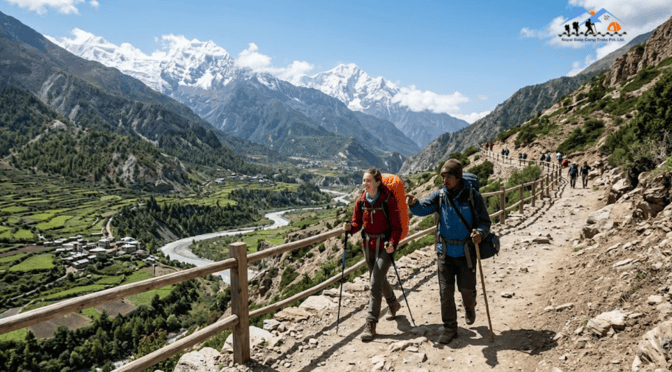
This trek offers stunning views of the Annapurna South & Dhaulagiri ranges, rich cultural & natural diversity and sunrise over the snow-capped peaks.
It’s just wonderful.
So, how much does it cost to do the poonhill trek in 2025?
If you want to know the precise cost for the Ghorepani Poon Hill trek in 2025, here is the straightforward answer: The cost to do the Poon Hill trek in 2025 is $400 – $550 per person, for a standard guided trek.
Nepal Base Camp Treks‘ all-inclusive poon hill trek package costs $490 for a 6-day trek, including permits, meals, accommodations and a qualified local guide.
2025 update:
It is now not possible to trek solo in the Annapurna region, even for the Ghorepani Poon Hill trekking.
You now have to hire a licensed Poonhill trekking guide and get trekking permits to trek safely & legally.
Trekkers were permitted earlier to trek alone in order to save their pocket and that time has passed.
Which means your trekking costs now have to accommodate a guide, but don’t worry, with NBCT, the cost integrity is 100% transparent and honest.
Poonhill Trek Cost Breakdown (Quick Overview)
| Trekking Style | Total Cost (in USD) | Best For |
| Group Trek (6+ people) | $400-$450 | Budget travelers, friends |
| Standard Guided Packages | $490 (NBCT rate) | First-time trekkers, short-on-time trekkers |
| Private Guided Trek (1-2) | $500-$700 | Solo travellers, families |
Ghorepani Poonhill Trek Cost Breakdown (Detailed Expenses)
By breaking down the total Poonhill trek cost, you’ll budget more effectively.
The full package of Nepal Base Camp Treks is $490 per person for 6 days, including permits, guide, accommodation, meals and one-way flight.
| Expense Category | Included in our Package | Approximate Cost (if booked separately) |
| Permits (ACAP & TIMS) | Yes | $38 |
| Licensed Guide | Yes | $30 – $35 per day |
| Porter | Yes | $20 – $25 per day |
| Accommodation | Yes | $5 – $15 per night |
| Meals | Yes | $20 – $30 per day |
| Transportation | Yes | $60 – $130 |
| Rental Gears | Yes | $20 – $30 |
| First Aid Kit + Logistics | Yes | Difficult to arrange |
Ready for an amazing Poonhill trekking experience like 100s of our clients?
Leave all the backend parts to us, and you can just enjoy the sunrise views over the Himalayas.
Transportation Charges (Pokhara to Kathmandu & Beyond)
You’ll initially go from Kathmandu to Pokhara and then from Pokhara to Nayapul, the starting point of your trek.
The mode of transport will be a flight and a private Jeep for your group, which is a big factor in your Poonhill trek cost.
| Route Option | Cost Range |
| Kathmandu → Pokhara | Tourist Bus: $10 – $25 Flight: $90 – $130 |
| Pokhara → Nayapul | Private Jeep: $60 – $80 |
You will get a one-way domestic flight from Kathmandu to Pokhara and a private transfer to Nayapul included in the NBCT package, as well as return transport.
Permits & Entry Fees
You will require 2 different permits to pull off the Ghorepani Poon Hill trek, which are:
Annapurna Conservation Area Permit (ACAP) – NPR 3,000 (~ USD 23)
TIMS Card (Trekkers’ Information Management System) – NPR 2,000 (~ USD 15)
The Poon Hill trek permit costs go towards the conservation of the area as well as the trekking trail.
If you are found trekking without a permit, you would be fined and restricted from further entry.
This is why almost all individuals secure their poonhill trek permit via their agency.
Accommodation and Food Costs
The Poonhill trek route follows a teahouse system as operated by the family-run simple lodges, offering warm meals and simple rooms with a warm bed.
In places like Ghorepani, private rooms with attached bathrooms are available but at a higher cost.
The Poon Hill trekking cost will vary according to the consumption of food and drink.
So, here’s a daily breakdown if you’re not on a package:
| Types of Expense | Average Per Day (USD) | Included in Our Package |
| Room Charges (per night) | $5 – $15 | Yes |
| Dal Bhat | $4 – $6 | Yes |
| Hot drinks / Local tea | $1 – $3 | Yes |
| Breakfast | $3 – $5 | Yes |
| Drinking water | $1 – $2 per liter | Yes |
Cost of Guides and Porters
Trekkers keep on questioning, “Is guided trek necessary?”
Nowadays, every trekker must be accompanied by a licensed guide while doing treks in Nepal.
| Role | Daily Wage | Included in the NBCT package |
| Trek guide | $30 – $35 | Yes |
| Porter | $20 – $25 | Yes |
A good guide does more than navigation and leading.
He assists in:
- Pacing the trek and safety
- Permit regulation
- Cultural and local insights
- Emergency contact and response
- Trekking gear and equipment rental
Trekking Gear and Equipment Rental
A great quality of your trekking equipment is key to making your Poonhill trek experience amazing or bad.
When trekking in Nepal, you should have a proper packing list for Poonhill trek, especially during the colder months.
If you are traveling light, you can rent most of these items in either Kathmandu or Pokhara.
Here’s what the basic gear rental expenses would be like for a 6-day trek.
| Gear | Cost |
| Sleeping Bag | $10 – $15 |
| Down Jacket | $10 – $15 |
| Trekking Poles | $5 – $10 |
NBCT offers free rental of sleeping bags and jackets for travelers who like to carry less.
Hidden Costs on Poon Hill Trek

Most trekkers often choose an all-inclusive package of the Poon Hill trek to simplify things.
This is not a bad option because such a package typically includes your poonhill trek permit, food, accommodation, guide and even gear in some instances.
Although everything is pre-booked, there are still some small per-day fees to be considered.
These are the hidden costs that will increase the Poonhill trek price if you don’t prepare.
Here’s what you can expect and how to reduce them.
Cost 1: Charging Your Devices
Power is limited at higher altitudes for all of us.
The majority of tea houses will charge a small fee to charge your camera or phone, which is $1 – $3 per hour.
Tip: Bring a charged power bank or solar charger with you. With that, you can charge your devices without increasing your daily Poonhill trek cost.
Cost 2: Wi-Fi Costs Money
Yes, you might find tea houses with Wi-Fi, but it could cost you $2 to $5 for a night and be ridiculously slow.
You might be able to send a message home, but do not expect to upload your sunrise view clip immediately.
Most adventurers prefer to shut themselves out and live in the moment.
However, if you really need to have the connection, you need to take into account the extra cost.
Cost 3: Hot Showers Cost Money
Nothing is more heavenly than enjoying a warm shower after a day of trekking, but it has a price.
Most tea houses will charge you $2 to $3 for hot water, especially in colder areas like Ghorepani or Tadapani.
Tip: Don’t take daily showers! You can use wet wipes and/or dry shampoo or skip the warm shower and get by with a quick splash of cold water.
Cost 4: Drinking Water Costs Money, too
You’ll need to drink lots of water on the trek.
The trekking routes’ bottled water costs around $1 to $2 per liter and gets progressively more pricey the higher you climb.
Best practice: Carry a water filter or purification tablets. Or just ask your tea house for boiled water, which is less expensive and much safer than plastic bottles.
Cost 5: Additional Snacks Cost Up
Even though three meals a day are part of your package, you will crave some snacks.
Snacks like chocolate, instant noodles, cookies or eggs are all more expensive in rural areas and can slowly increase the Poonhill trek cost.
The prices of them depend on how high you are.
Chocolate – $2-$3
Boiled Egg – $1-$2
Instant noodles – $1+
You may bring a few trail snacks or energy bars from Pokhara, if available, that can save money.
Cost 6: Tipping Your Team
Tipping is not mandatory, but it is usually customary and welcome.
Tipping can make a significant difference in how local guides and porters support their families.
As a general guideline:
Tip your guide $5-$10 per day
Tip your porter $3-$7 per day
Be sure to take more than enough cash in Nepali Rupees before leaving Pokhara.
There are no ATMs or banks along the trekking routes.
Cheapest Time to Do Poon Hill Trek (Seasonal Cost Differences)

The Ghorepani Poonhill trek cost is not only based on the inclusions of the trek, but also on when you go.
If you’re looking for the cheapest time to do Poon Hill trek, the good news is that it is open 365 days a year.
But each season offers trade-offs between the poonhill trek price, traffic levels and poonhill weather.
Spring (March to May) – Peak
It does not get any better if you want to trek with clear skies, blooming rhododendrons and a warm morning in the mountains.
Poonhill trek Price: Standard to High
Why: Off-season treks = high demand for rooms and guides
Views: Crystal clear
Trail: Dry and best
Experience level: Ideal for first-time trekkers
This is the busiest time for the Ghorepani Poon Hill trek and it is also at its most beautiful.
Autumn (September to November) – Most Popular
After the monsoon comes Autumn, where you will experience stable weather and clean mountain views.
Poonhill trek Cost: High (in October)
Why: Holidays, festivals, support industry activity and high demand for guides and trekking space.
Views: The best mountain views and photogenic opportunities of the year
Trail: Very busy, but very social-friendly trekkers everywhere, who are and a community in love with Nepal!
Experience: Most organized trekking companies will run all their groups at capacity this season
If you’re willing to handle a bit more foot traffic and a slight cost increase, this is the golden window.
Winter (December to February) – Quiet & Cheaper
The season itself is peaceful.
You will find fewer people, cheaper tea house rooms and good deals on guides throughout the trek.
Poon Hill trek Price: Low
Why: Lower numbers of trekkers and off-season prices.
Views: Clear and cold as well
Challenge: Snow at poonhill and icy mornings
Best for: Experienced trekkers looking for isolation
Ensure proper trekking gear for a cold season and check whether passes are open or not.
Monsoon (June-August) – Wet & Cheap
If you are comfortable with a muddy trek, the monsoon remains the cheapest season for trekking.
Just keep in mind that clouds and leeches will abound.
Poonhill trek Price: Lowest
Why: Very few trekkers = low demand
Views: Restricted
Trail: Slippery and unpredictable
Best for: Off-beat adventurers or academic researchers
Unless you can access local support and have flexible timing, this season should be avoided.
Budget Tip
If you want a really great discount on poonhill trek cost, yet do not want to miss great weather, go for the shoulder seasons:
Late February to early March
Late November to early December
During this time, you will find clearer skies, reduced crowds and better prices on tea houses and guides.
Affordable Poon Hill Trek Budget Tips
Although the Poonhill Trek is already a budget-friendly trip, here are some simple tips that will help you save even more money without harming your experience.
Here are some tips to lower the Ghorepani Poonhill trek cost that will make sure you get the most for your money:
Trek as a Group
When trekking in groups, you can expect to share the cost of the guide and porters.
Several agencies, including Nepal Base Camp Treks, also give discounts for group sizes larger than 3.
Rent your Trekking Gear instead of Buying
You do not need to buy new gear for a short trek.
You can simply borrow some trekking gear like sleeping bags, jackets and poles in Pokhara until you complete the trek.
Nepal Base Camp Treks offers free rental services as part of its package, with no extra cost to you!
Make sure to ask about these.
Use a Tourist Bus instead of a Flight
The flight from Kathmandu to Pokhara will be time-efficient, but it will be costlier.
If you have time on your trip, you can catch a cheaper tourist bus from Kathmandu to Pokhara.
It will take you longer, but it will save you up to $90 – $100.
Eat Local Dishes
Stick with local food (dal bhat, local Noodles, soups) at the tea houses.
In the mountains, Western food is the most costly and not often fresh.
Bring your Reusable Water Bottle
Bottled water can get expensive and add to your Poonhill trek cost.
Bring your reusable bottle with purification tablets.
Or, you can also ask for boiled water at the tea houses, which costs extra..
Take a Power Bank
If you want to charge your phone or camera (if you take pictures), there are charging costs at the tea houses.
Buying a power bank or solar charger helps to avoid these annoyingly small daily expenses on Poon Hill trek.
Bring Enough Local Currency
There are not many ATMs along the trail.
Bring enough Nepalese rupees to cover your small costs such as snacks, tips, wi-fi and hot showers.
Is Poonhill Trek Worth It?
If you’re curious whether the Poonhill trek cost is worth it, then yes, it is!
For under $500, you’ll get to experience a full-fledged trek through the Himalayas region that doesn’t require an extended break or a head-spinning altitude.
Ghorepani Poon Hill Trek is short, scenic and just rewardingly easy.
What makes it special is the Sunrise views above the Himalayan ranges.
Climbing up to Poon Hill at 3210 m in elevation, you watch the first light hit the snow-covered peaks.
Dhaulagiri, Annapurna and Machhapuchhre stand out in this view.
This sunrise view is world-renowned; they call it one of the finest views in all of trekking in Nepal.
FAQs – Poon Hill Trek Cost & Budgeting
What is the average Poonhill trek cost in 2025?
The average cost is between $400 and $550 for a person, depending on the group size, services and travel style.
This will include permits, food, a guide, accommodations and transport.
Can I do the Poon Hill trek without a guide?
As of 2025, solo trekking is banned in the Annapurna area.
This means you must use a licensed guide and be in a group of two, even if you are an experienced trekker.
Are permits included in my trek cost?
Yes, if you book a package with Nepal Base Camp Treks, then your poonhill trek permit (ACAP + TIMS) is included.
How much do daily expenses on Poon Hill trek cost?
If you are not on a package, then expect to spend $60–$70 per day.
This is the daily budget for food, accommodation, guide and transport. Will be extra costs if you want Wi-Fi, hot showers or snacks.
Are there any hidden costs during my trek?
Yes, for example, hot showers, phone charging, wi-fi and snacks are not always available, so they can remain hidden from the Poonhill trek cost.
We highly recommend you take about $50–$100 extra in local cash to cover some of these extra small expenses.