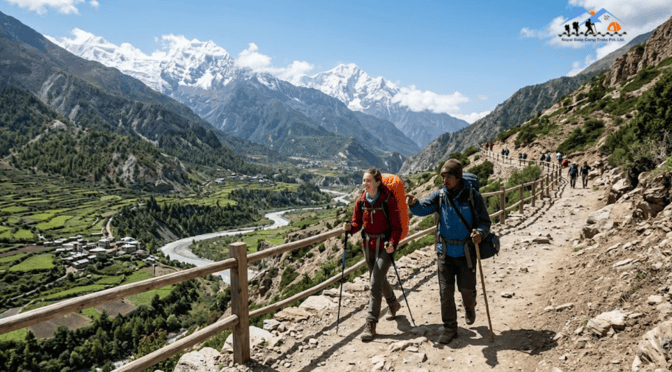
You want to see the legendary Poon Hill sunrise views – Annapurna, Dhaulagiri and Machhapuchhre’s stunning golden peaks shining like they have been kissed by golden magic.
But before you lace up your hiking boots and visualize your Instagram shots, there is one last logistical aspect to arrange – the Poonhill trek permit.
Yes, the permits needed for Poonhill trek are not just a piece of paper; it is a mandatory component of entering one of Nepal’s most well-liked trekking routes.
This Nepal Base Camp Treks guide will take you through the following steps in the poon hill trek permits complete guide:
Which permits do you need and why do you need them?
Costs, where to obtain them from and how long they are valid for?
What do you expect if you trek without them?
The 2025/26 regulations on guided vs independent trekkers.
You also learn how we make it all hassle-free for you so you can enjoy the views.
By the end of this, you’ll know all about your Ghorepani Poonhill trek permits and be set to hit the trail!
Do You Require a Permit for Ghorepani Poonhill Trek?
Yes – you do 100%.
The Ghorepani poonhill trek permits aren’t voluntary paperwork – they are the actual document that allows you to trek in one of the most stunning trekking trails of Nepal.
You won’t get very far past Nayapul or Ghorepani without them, as there will be permit checks at a number of checkpoints.
For 2025/26, you’ll need two permits in advance:
Annapurna Conservation Area Permit (ACAP) – Conservation of forests, wildlife and trails
Trekkers’ Information Management System (TIMS) Card – Record keeping of trekkers; safety & rescue
“We have seen trekkers turned away at the first checkpoint just because they thought the Poon Hill Trek was too small to require permits,” said one of our senior guides, who has been leading guides in the Annapurna region for over a decade. “The rules are the same, even with a short trek.”
Bottom line: No poon hill trek permit means no trekking. Just obtain the permits ahead of time; you will be saving time, money and most of all, frustration.
Types of Permit Required for Ghorepani Poonhill Trek
In simple words, all trekkers, whether new to the Himalayas or on their tenth trek in the Himalayas, are required to obtain two official trekking permits to trek the Ghorepani Poonhill trek route.
There is a purpose for each permit and each one is checked along the route.
Permit 1: Annapurna Conservation Area Permit (ACAP)
This permit is your entry ticket to the Annapurna Conservation Area — a 7,629 km² protected area of mountains, forests and villages.
Your fee directly supports the conservation, trail maintenance and local communities.
This permit is checked at entry points such as Nayapul and Ghorepani.
“Without ACAP, you cannot go to the Annapurna area. It is just like entering a national park without a ticket — but here the conservation Area Permit helps to keep the mountains alive,” said one of our Ghandruk guides, who was born inside the conservation area.
Permit 2: Trekkers’ Information Management System Card
The TIMS card is a registration process that records your trekking details and personal identification.
It is required so that the authorities can keep track of your movement and potentially rescue you if things go badly.
NOTE: You are not allowed to be a solo trekker in this area at present
Rule Change: From April 2023, foreign trekkers are required to be guided by a licensed guide in all major trekking areas, including Annapurna.
Where and How to Apply for Poonhill Trek Permits
Acquiring your Poonhill trek permits is the very first step toward opening up the trails of the Annapurna region.
Whether you are undertaking the short poon hill trek solo or you are combining it with the Ghorepani Poonhill Ghandruk trek, the initial step is to apply for both ACAP and TIMS permits before you can begin.
The permits required for the Poon Hill trek are checked at multiple points along the route, so it is simply not possible to skip them.
Having the right trek permit also shows that you are a responsible tourist who supports conservation, local communities and safe adventure tourism in Nepal!
Kathmandu and Pokhara Offices
If you want to organize your trekking permit in person, you can go directly to the Nepal Tourism Board office in either Kathmandu or Pokhara.
There, you will get your Annapurna Conservation Area Permit (ACAP) and trekkers’ Information Management System (TIMS).
In order to apply for your trekking permits, you need to bring the following:
- Your original passport (valid for at least 6 months)
- Two passport-sized photographs
- Cash amount in Nepalese Rupees (they do not accept cards)
- A trekking start date, route and Poonhill trek itinerary
- Travel insurance (it is important to be prepared for trekking)
Tip: Be there early – especially in spring and autumn when the Poonhill weather is much better and there are longer queues.
These offices also serve as a trekking resource hub – you can gain trail updates on the Poonhill trek altitude, poonhill trek distance and even poon hill trek difficulty.
Online Application Process & Required Documents
If you’re a bit short on time or would prefer to have everything ready when you land, you can email a licensed operator, like Nepal Base Camp Treks, to arrange your Ghorepani Poonhill trek permit for you before you arrive.
Simply email:
- A scanned copy of your passport
- A digital photo of your passport
- Your trekking date and what route you will be taking
- Proof of travel insurance
That way, your trek permit will be prepared and waiting at your hotel and you can start trekking without delay.
Permit Costs and Validity for Poon Hill Trek
Before you start planning for tea house stays and perhaps another round of momos, let’s take a look at the poonhill trek costs when it comes to permits:
Permits are a set fee, established by the government of Nepal and the Annapurna Conservation Area Project.
There is no negotiating on these costs, no discounts to receive and no special deals.
It’s the same cost for everyone in your category.
| Permit Type | Permit Purpose | Cost (Foreign Nationals) | Cost (SAARC Nationals) | Permit Validity |
| Annapurna Conservation Area Permit – ACAP | To protect the environment & conserve the Annapurna region | NPR 3,000 (~USD 23) | NPR 1,000 (~USD 8) | Valid for a single trek |
| Trekkers’ Information Management System – TIMS | Trekking registration & tracking trekker safety | NPR 2,000 (~USD 15) | NPR 1,000 (~USD 8) | Valid for a single trek |
Permit validity notes:
- Each trekking permit is valid for a single and continuous trip along the poonhill trek route.
- You cannot use the same tourist permit for a second trek, or months later.
- Your name, dates and route on the permit must match your trek itinerary.
Guide tip – “If you complete the Ghorepani poonhill ghandruk trek in less time than your plan, keep your trekking permit with you until you are completely out of the region. In case rangers check on the way back.”
Why is this important for trekking preparedness?
When you budget for the poonhill trek permit in advance, there are no surprises to deal with.
It’s part of your overall trekking preparation effort, along with gear, travel insurance and knowledge of Poonhill trek difficulty.
What Happens If You Trek Without a Permit?
Trekking in the Annapurna region without the necessary Poonhill trek permits is not only a dangerous activity, but it also means the end of your trek.
They are legal documents required to enter and trek inside the conservation area.
Here’s what can happen should you try to avoid them:
- You’ll be stopped at the checkpoints
You’ve got tourist permits and trekking permits checked at multiple points along the trail, such as Nayapul, Ghorepani, and on the way back towards Ghandruk or Tatopani.
No permits? You won’t be permitted to continue your adventure.
- You’ll get fined on the spot
Fines can be higher than the permit costs and you’ll still have to buy the permits to continue.
- Possible legal consequences
Trekking with no permits is considered a violation of the Nepalese tourism policies – it can sometimes get reported to local authorities.
- No rescue or support coverage
Without a registered trekking permit, your name will not be in the TIMS safety database, which offers no formal record for search and rescue if you go missing or are injured.
Permit Rules for Guided vs. Independent Trekkers
If you are asking, “Do we need a guide for the Poonhill trek?“, the answer, since April 2023, is yes.
The Nepalese government passed laws to make local guides mandatory for all foreign trekkers on major routes — the poon hill trek is one of the major routes in the Annapurna region.
Why the Rule Changed
Safety: The TIMS database works best when a guide updates your progress and track record of the route.
Rescue efficiency: The use of a guide means that when search and rescue teams need to come and find you, they have immediate, accurate location information in emergencies.
Build community: When trekkers hire local guides, they put money into mountain communities and keep adventure tourism alive in Nepal.
Guided Trekkers
If you are an organized trekker with a registered guide, everything related to the application process for trekking is a lot easier:
- Your guide manages all of your trekking permit application paperwork (ACAP + TIMS).
- Your guide double-checks your correct route requirements so that you don’t run into any issues at checkpoints.
- Your guide assists in your trekking preparedness — from pacing to adjusting for the Poonhill trek altitude.
Independent trekkers (poonhill trek without a guide)
If you are an independent trekker, before 2023, you could trek the poonhill without a guide because you carried your own permits.
This is no longer the case for foreigners.
If you arrive at Nayapul or Ghorepani without a guide, you will be turned around.
There will likely be fines if you try and snub the new rules.
How Nepal Base Camp Treks Can Help with Permits
Obtaining the Poonhill trek permits in Nepal can be a bit difficult due to different offices, forms to fill out and varying rules for each region.
That is where Nepal Base Camp Treks makes it manageable.
Our team handles the trekking permits application process from beginning to end.
Whether you will be taking the Ghorepani Poonhill trek or a longer Annapurna adventure, we will apply for and obtain your Annapurna Conservation Area Permit (ACAP) and your TIMS card well before you depart.
Here is how we can help you avoid any headaches:
Pre-trip preparations – Just send your passport copy and travel details to us in advance and when you land in Kathmandu or Pokhara, you can just pick up your trek permits.
Local knowledge – We know the exact requirements and latest rules to follow, which offices to visit and how to avoid wasting your time lining up.
No surprises – We check all the permit details and ensure that there are no problems with getting through each trekking checkpoint along the Poonhill route.
Multi-trek – If you are going to take other treks in the Annapurna region, then we can also let you know how to reuse or renew your ACAP for the other trek and save you some money, too.
FAQS
Can I reuse my ACAP for another trek in the Annapurna region?
Yes, you can use an ACAP for more than one trek in the Annapurna Conservation Area, but each trek will need a new TIMS.
However, once you have exited the region at the end of your trek, the permit cannot be reused for a later trip during the same season/months later.
Can I get my trekking permit when I arrive in Nepal?
Yes, but applying early via online or by a trekking agency will save you time and ensure trekking readiness preparation.
Is travel insurance needed for the Poon Hill trek?
It’s not necessary to get your permit, but travel insurance covering adventure tourism and high-altitude trekking is recommended.
What documents do I need to apply for a trekking permit?
You will need your passport, photos, and payment for your trekking permit.
If you apply online, you will need scanned documents.