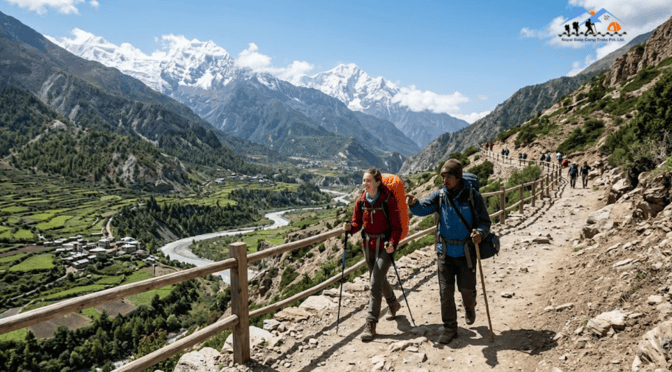
Let’s start by delving right into it: Poon Hill trek difficulty is not something to be concerned about.
It is something to look forward to.
This Poon Hill trek is a much more relaxed trekking experience than most treks, particularly for beginner trekkers.
At Nepal Base Camp Treks, we prefer to tell first-time trekkers that the trekking route is hard enough that you’ll be thinking you’ve earned it, but it is never overwhelming.
Yes, there are difficult areas, such as the notorious steep Ulleri stone steps.
However, you do not have to be an athlete to climb these steps.
The other sections in the Poonhill routes are at a good pace, with sections where you can give yourself good time to rest and break at the teahouses.
Generally speaking, this mountain trek is not one where you will push your limits and be left too exhausted; it is about feeling the mountain’s rhythm.
You do not need to be in great shape to complete the Poonhill trek; if you are someone who can take 4-6 hours of walking a day with some elevation stretches, you should be fine.
Furthermore, the maximum height of the route is 3210 meters and thus, the likelihood of altitude sickness is reduced if you are taking the right pace.
Lastly, the Poon Hill trek difficulty is not defined by how hard it is; rather, it is purely how prepared you are.
So, as long as you have good weather, you take the right pace and you are trekking with a good guide, then the trek can be a great introduction to trekking in Nepal.
Pro Tips: Do you want the best photograph and fewer people? Leave your lodge in Ghorepani at 4:30–5:00 AM to reach the 3,210m viewpoint for the golden hour. Take a headlamp and wear layers, as it will be cold and dark before dawn
Ghorepani Poon Hill Trek At A Glance

Before you can assess the Ghorepani Poonhill trek difficulty level, it is helpful to know what this trek actually is.
Here is a summary:
Trek Duration: 6 days
Max. Elevation: 3,210 meters (Poon Hill viewpoint)
Total Distance: ~50 kilometers/31 miles – round trip
Trek Route: Nayapul → Ulleri → Ghorepani → Poon Hill → Tadapani → Ghandruk
Region: Annapurna region, Western Nepal
Trail Type: Forest paths, stone steps, ridge walks, village paths
Accommodation: Local tea houses, basic but good.
Trek highlights: Blooming Rhododendron forests | Gurung and Magar villages | Ridgelines with views of the Annapurna range | Overall, a scenic, cultural and relatively easy first trekking experience in Nepal.
Day-by-Day Ghorepani Poonhill Trek Difficulty Breakdown
The total Poonhill trek distance is about 40 to 50 kilometers, which will take around 6 days to complete if you trek with us.
What makes the poon hill trek appealing to beginners is its gradual ascents, short daily hiking hours and maintained trails.
Here is a simple table that describes the day by day difficulty of poonhill trek for beginners to get an overview of what to expect:
Day by Day Poon Hill Trek Difficulty Table
| Day | Route | Trekking Distance | Max Altitude | Trekking Time | Difficulty | Terrain Type |
| 1 | Arrival in KTM | – | 1,300 meter | – | – | City Area |
| 2 | Flight from KTM to Pokhara → Drive to Nayapul → Trek to Hille | 42 km drive + 6 km trek | 1,430 meter | 2-3 hours | Easy | Suspension bridges and Farm trails |
| 3 | Hille→Ulleri→Ghorepani | 12 km | 2,860 meter | 6-7 hours | Moderate to Hard | Over 3000 stone steps and a forest ascent |
| 4 | Hike to Poonhill at Sunrise → Trek to Tadapani | 10 km | 3,210 meter | 5-6 hours | Moderate | Climb to the viewpoint and pass forest ridges |
| 5 | Tadapani → Ghandruk → Drive to Pokhara | 8 km trek + 50 km drive | 1,940 meter | 3-4 hours | Moderate to Easy | Stone paths and downhill trails |
| 6 | Drive journey to KTM | 200 km drive | 1,300 meter | 6-8 hours | – | Scenic highway route |
Key Factors That Determine the Ghorepani Poon Hill Trek Difficulty
Now that you’ve gone through the Poon Hill trek difficulty, you probably already know that it is doable.
But what makes it easy or hard?
Let’s analyze the key factors that affect your trekking experience so that you can prepare accordingly and trek with confidence.
Distance, Duration & Daily Walking Hours
While the cumulative poonhill trek distance is 40-50 km across six days, the important thing is how well your body adapts to the daily walking rhythm.
Most days involve walking for 4-6 hours with plenty of breaks and lots of teahouses every couple of km or so along the way.
This is positive for novice trekkers who wish to build their endurance without going overboard.
Pro Tip: In comparison to more challenging treks like Annapurna Base Camp or Manaslu, the Ghorepani Poonhill trek gives a more relaxed pace and gradual ascent. This is also why the Ghorepani Poonhill trek is popular with families, first-time trekkers and older hikers.
Terrain: What to anticipate on the trails
On Day 2, you will walk more than 3000 stone steps through the foliage that is the Ulleri section, a steep climb that will burn your thighs!
This is where the poon hill trek difficulty will show up as something to remember.
After that, the terrain will have more forest with soft land to walk on, with views.
You will be walking on mossy ridges, rhododendron paths and village trails.
During the wet season, there will be muddy patches and in winter, some sections may be icy and/or slippery.
Trekking tip: Bring trekking poles. They will help reduce the strain on your knees, especially as you go down towards Ghandruk. Also, you want to ensure that you have good grip boots.
Altitude and Acclimatization
Poonhill trek altitude reaches the height of 3,210 meters, which is high enough to make your heart go pumping even while stationary.
But it’s not high enough to get you symptoms of altitude sickness.
These are the important reasons why the trek remains low risk:
- You go up to higher altitudes gradually over 4-5 days.
- You sleep at lower levels (Ghorepani at 2860m).
- Your ascent to Poon Hill will be early morning and entails descending.
Compared to treks at higher altitudes, such as Everest Base Camp or Annapurna Base Camp, where you are sleeping at over 4,000m for a few days, Poonhill is a gentle workout for your body.
Effects of Weather on Difficulty
The varying weather conditions can affect the Poon Hill trek difficulty and the trekking experience.
| Seasons | Trek trial conditions | Impact |
| Spring (March to May) | Dry, clear trails, blossoms in forests | Suitable for beginners |
| Autumn (September to November) | Crisp air, great visibility | The most popular trekking season |
| Winter (December to February) | Snow on trails at Ghorepani & Poon Hill | Manageable with warm gear and spikes |
| Monsoon (June to August) | Wet, muddy trails, leeches and limited views | Increased risks, best to avoid if you don’t have experience |
Tip: Always check the Poonhill weather forecast before going for your trek. A trail that may seem like a good fit for you as a beginner can be difficult based on the weather conditions.
Is there a Risk of Altitude Sickness on the Poonhill Trek?

It is one of the most common fears for new trekkers and for good reason.
But when we are talking about the poonhill trek altitude sickness risk, the plain answer is:
Yes, it can affect you, but the risk is significantly lower on this route compared to high-elevation treks in Nepal, such as Everest Base Camp or Annapurna Base Camp.
Let’s clarify.
Why Poon Hill Is Safer Than Other Trekking Routes?
The highest point in the Poon Hill trek is 3,210 meters (10,531 ft), which is considered moderate altitude.
Here are reasons as to why poon hill trek difficulty remains low risk in terms of altitude:
- Even though oxygen levels are lower than at sea level, it is nowhere near dangerous.
- Serious AMS (Acute Mountain Sickness) is very rare.
- You’ll only be at the highest point (Poon Hill) for a small period on your sunrise view hike.
Here it is compared to other popular treks:
| Trek | Highest Sleeping Point | Peak Altitude | Risk of Altitude |
| Poonhill trek | 2,860 meters | 3,210 meters | Very Low |
| Annapurna Base Camp | 4,130 meters | 4,130 meters | Moderate to High |
| Everest Base Camp | 5,364 meters | 5,364 meters | High |
How to Minimize Altitude Sickness on Trekking?
As much as it is a low risk, the following are some tips to watch out for to reduce the risk of altitude sickness and ensure the trek proceeds uneventfully from start to peak:
- Stay Hydrated
Consume at least 3-4 liters of water daily.
Dehydration and fatigue can catch you quickly at such an altitude.
- Trek at Your Own Speed
Don’t hurry to the top.
Slow down and walk seriously, especially on day 3 (Ulleri Steps) and the morning hike to Poon Hill.
These are the sections that increase the Poon Hill trek difficulty.
Slowing your trekking is gentle on the lungs and conserves your energy.
- Take Breaks
The trail has teahouses along the way that welcome you with a smile and “Namaste”.
Have tea, sit and allow your body to acclimatize to increasing altitude.
- Dress in Layers
At high altitudes, the temperature is rapid and it saps your body’s energy.
Wearing layered clothing prevents chills as well as overheating.
- Eat Plenty & Don’t Drink Alcohol
As you are aware, if you have eaten previously, dal Bhat gives you long-lasting energy.
You should not consume alcohol because alcohol dehydrates you and also affects sleep.
Fitness Level Needed for Poonhill Trek
One of the most common questions we hear from new hikers is: “Do I need to be super fit to do the Poon Hill trek?”
The short answer is: No, but a good bit of preparation will help you out.
The Poon Hill trek is probably one of the easiest treks in Nepal and most moderately fit people can complete it without any problems.
There are, however, stairs, hills and long days walking, so a little bit of training ahead of time will make your trek more enjoyable.
Let’s be fair, though.
Do You Need to Be an Athlete to Trek Poon Hill?
Nope.
You don’t need to have a six-pack, marathon legs or any previous trekking experience.
All you need to be able to do is walk for 4-6 hours each day, sometimes on stone steps, other times on doorless, steep forest trails.
And these will help:
- A good walking cadence, preferably uphill, like Ulleri.
- A positive attitude because your effort will be rewarded with stunning views.
- Basic stamina, built through some light cardio or steady walking.
Even if you have never done a high altitude trek before, this trail is designed for you.
The Poon Hill trek difficulty depends on your ability to pace yourself, stay hydrated and rest consistently.
It’s not a race. It’s a purposeful walk.
Even people older than 60 have completed the Ghorepani Poonhill trek with smart training.
Simple Poon Hill Trek Training Plan
You don’t need a personal trainer.
You just need endurance, leg strength and familiarity with carrying a backpack.
Try these 4-6 weeks before your trek:
| Training Area | Activity |
| Endurance | Walk 5-8 km (3-5 miles) a few times a week and gradually improve your speed and time. |
| Stair Practice | Find a set of stairs, walk up and down for 20-30 minutes, two to three times a week. |
| Backpack Conditioning | You will walk with a loaded 5-7 kg backpack |
| Leg Strength | Lunges, Squats and Setups 2 times per week |
| Flexibility | Light stretching or Yoga |
Should You Hire a Guide for the Poon Hill Trek?
The most popular question asked by trekkers is “Are guides really necessary for this trek?” and in 2025, this is quite easy to answer:
Yes, you are required to have a licensed guide.
It has been made mandatory by the government of Nepal.
Even before this rule change, almost 100% of feedback from most trekkers was the same.
Hiring a guide made their trek better, easier, safer and ultimately, much more impactful.
Let’s explore what hiring a guide can add to your experience and how it looks to trek without a guide.
Pros and Cons of Going With a Guide
| With a Guide | Without a Guide |
| Takes care of your permits, booking and logistics | You do all the work (a lot of stress, not longer legal) |
| Improves safety and lowers the poon hill trek difficulty | More tiring, especially for first-time trekkers |
| Share local stories, local cultural experiences and find hidden scenic spots | You might overlook these less-visited viewpoints and cultural information |
| Ability to monitor your pace, lowering the chances of fatigue | You have no data points for health and safety, no backup if you get ill, are lost or are delayed |
| Makes a positive contribution to the local economy and the Himalayan community | Solo trekking does not provide job opportunities for locals |
What Does a Good Guide Actually Do?
Let’s get real.
A good guide from Nepal Base Camp Treks will help decrease the Poon Hill trek difficulty and increase the trekking experience by:
- Helping you wake up early to catch the sunrise, hikes like Poon Hill (you won’t miss it).
- Helping you adjust your pace if you’re tired or sore.
- Pointing you to the best teahouses for food, views and comfort.
- Sharing their stories of the Gurung and Magar communities.
- Assisting you with first aid, water hydration tips or even arranging for a descent.
- Helping ensure that you have a safe and enjoyable experience, even if things don’t go to plan.
Final Thoughts: Is Poon Hill Trek for first-time trekkers?
Let’s bring it back to the beginning:
Is Poonhill trek hard? Not really.
Is it worth it? Yes, absolutely.
It would be hard to think of a more perfect introduction to trekking in Nepal than this short, beautiful and soul-enriching trek.
You will wake early in Ghorepani to a gentle climb in the dark and then, just like that, the mountains reveal themselves.
Suddenly, you are standing at 3,210 meters looking at the sunrise views, as sunlight strikes the peaks of Annapurna, Dhaulagiri and Machhapuchhre.
You will witness one of the most amazing panoramic views of the Annapurna range.
Combined with friendly Magar and Gurung villages and a manageable day-by-day Poon Hill trek difficulty, it’s a trek to be remembered.
This is not just a view, it is a feeling.
Why Nepal Base Camp Treks Makes It Even Better?
With 20+ years of experience guiding both first-time trekkers and veteran trekkers, at Nepal Base Camp Treks, we ensure your trip is not only beautiful but also effortless, safe and memorable.
From the permits to the best sunrise spot, the warm teahouses to the pace on the trail, we have you covered.
You just have to show up and walk!
Are you ready to explore the Himalayan region and collect a memorable experience?
Book with us today!
Recommended Read: Cost of Poon Hill Trek
Faqs
How hard is Poonhill trek for first-time trekkers?
The Poon Hill trek difficulty level is rated as moderately easy.
It is generally considered one of the most beginner-friendly treks in Nepal and you’ll typically be walking between 4-6 hours each day.
The steep Ulleri stairs are the most strenuous part, but you are able to manage that with short breaks along the way.
What is the highest altitude on the Poon Hill trek?
The highest altitude on the Poon Hill trek is 3,210 meters at Poon Hill viewpoint.
You will walk to the viewpoint early in the morning from Ghorepani to get the ultimate Himalayan sunrise view from poon hill.
What type of terrain can I expect on the Poon Hill route?
There is a mix of types of terrains: stone staircases (especially from Hille to Ghorepani), forest trails and some ridge walking.
It is not a technical trek, but it can require some steady footing at times.
How hard is the sunrise hike?
The sunrise hike from Ghorepani to Poon Hill (3,210 meters) takes about 45 – 60 minutes with steep climbing.
It’s considered a moderate challenge, but it is all very safe, guided and absolutely worth it for the very early start.