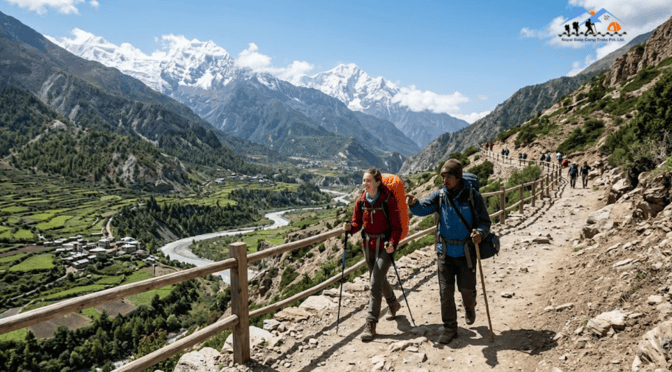
The Manaslu trek after earthquake is fully open and safe for trekking in 2025.
All major bridges and key areas along the Manaslu trek route have been rebuilt or rerouted, and current trail conditions are stable from Soti Khola to Larkya La pass.
Since the Manaslu area is “restricted” and requires trekkers to get the Manaslu trek Permit and a licensed guide (as solo trekking is not permitted).
Choosing the right season is key: late autumn or late spring offer the driest paths, with the least risk of landslides.
With ongoing daily field updates and emergency planning, Nepal Base Camp Treks provides the best way forward for exploring the legendary route with total peace of mind.
The April 2015 Earthquake and Its Impact on Manaslu

On April 25, 2015, a devastating earthquake impacted the Gorkha region and caused an immediate disaster scenario for the Manaslu region.
In just minutes, homes were cracked open, bridges fell and hundreds of kilometers of trails were deposited in landslides, causing dramatic landscape change.
Families had their travel completely cut off as they faced weeks and months of uncertainty about when there would be steady food or supplies.
During the entire time, the spirit of the people never wavered and their quick resilience brought them back sustainably after the earthquake.
Before the 2015 Earthquake
Prior to April 25, 2015, the experience of trekking Manaslu was one of the more remote and undisturbed experiences in the Himalayas available in Nepal.
The valley route for trekking Manaslu passed through lush forests, quiet valleys and ancient stone villages like Soti Khola, Jagat, Lho, Samagaun and Samdo.
The stone houses were built to last many generations, considering travelers’ safety and dependability.
The wooden bridges provided safe passage.
Teahouses provided simple food and warming fires where trekkers could relax and unwind, while the Budhi Gandaki River flowed calmly beside the route, offering dramatic landscapes.
Life moved slowly here, where trekkers could walk along without seeing a single road or modern-day construction.
It was nearly undisturbed by modernity and the experience here represented pure Himalayan beauty.
Manaslu Trek After Earthquake
Everything changed overnight.
Several houses collapsed and parts of the Manaslu circuit were buried under landslides or simply swept away by rivers.
The infrastructure damage cut some villages off from each other and from the outside world.
All of this subsequent silence suggested just how deeply the disaster affected daily life and commutes in the high Himalaya.
The earthquake’s impact was felt throughout the Nepal tourism industry.
Villages Affected and Trekking Trails Affected
The village of Khorla Bhotekoshi and villages along the Manaslu trek were severely affected.
Stone houses literally collapsed, bridges were destroyed or fell into rivers and significant sections of the trail in the Manaslu trek simply ceased to exist altogether.
Families were forced to move away from where danger was more present and daily village life came to a standstill as villagers waited for trails to be opened.
Quick Rescue Operations and Response
Aid came within minutes after the earthquake.
Rescuers and villagers were performing heroic rescues, leading people down treacherous, unstable slopes to safety.
Helicopters later arrived and started evacuating people to hospitals and delivering relief supplies to the people who stayed behind.
These emergency workers were a godsend to so many and their speed and bravery were worth more than gold in helping the community for the first few months after the earthquake.
Is the Manaslu Circuit Trek Safe to Do Now?

Yes, the Manaslu trek after earthquake is safe to traverse in 2025.
The paths are open, the teahouses are welcoming guests and the local check-ins ensure that travel is safe and organized.
With the right preparation for the Manaslu altitude and seasonal weather changes, you can complete this trek safely.
Trekkers arriving in the best seasons benefit from dry trails and clear skies, which also decreases the odds of slides or heavy snow.
Current Trail Conditions Section-by-Section
From Soti Khola, it’s a wide and strong lower trail to reach Machha Khola.
From Jagat to Namrung to Lho, the trail continues to climb through small villages in the forest, and although some sections may be muddy, this trail is less impacted.
In the upper region, from Samagaun to Larkya La pass, the cold air and less oxygen waivers; however, the trail is clearly marked and safe to cross in the correct season.
The final lap to Dharapani takes trekkers through uninhabited forests and ends on a stable track alongside the Annapurna road.
Did You Know? The Larkya La is the highest point of the Manaslu circuit at 5160 m and it offers wide mountain views, including the four major ranges of the Himalaya.
Updated Infrastructure and Teahouse Amenities
All of the trek’s main villages have rebuilt teahouses that are sustainable.
The roofs and walls are stronger, and the kitchens are generally cleaner.
As a result, the teahouse experience in Manaslu is much safer and more comfortable, even at high altitude, where a warm and secure room means a lot.
Local and Government Safety Regulations in Effect

Depending on the Manaslu region being restricted, all trekkers are required to obtain three permits: Manaslu Restricted Area Permit (MRAP), Manaslu Conservation Area Permit (MCAP) and Annapurna Conservation Area Permit (ACAP).
Permits must be obtained through a registered Nepali agency and a licensed guide must accompany you in order to go trekking.
It’s not possible to conduct a Manaslu trek without a licensed guide.
Additionally, checkpoints along the trail record each group’s whereabouts, allowing for quick evacuation in case of emergency.
Challenges Still Exist on the Manaslu Trek After the Earthquake
Even though the Manaslu trek after earthquake is safe for visitors, natural and high-mountain conditions can still pose challenges.
Here are the main details every trekker should be aware of before starting the circuit trek of Manaslu:
- Landslides and rockfalls. During the summer monsoon, heavy rain can loosen soil and change the landscape into a landslide or falling rocks along the trekking route.
- Seasonal weather risk. Early spring and late autumn months can bring sudden snow or ice close to Larkya La, adding to environmental concerns and other sections may be slippery during certain times of the year.
- High altitude effects. The trek ascends to over 5,000 m, which is significantly high. Many hikers also ask how difficult is Manaslu circuit trek due to its higher altitude and the risk of altitude sickness.
- Air ambulance and insurance. Having a good travel insurance policy that provides you with helicopter assistance if disaster strikes is crucial. A good insurance plan will allow emergency evacuation at (6,000 m), which provides peace of mind to trek the remoteness of the Manaslu circuit trek after earthquake in Nepal.
- Weather windows. The safest trekking time remains September–November, and April–May. Trekking in the other months leaves you at risk; your trail will have unstable conditions and there is a chance of heavy rain, which can automatically get you into a treacherous situation.
Solo vs Guided Trekking After the Earthquake
The Manaslu trek after earthquake requires you to trek with a licensed guide, but many trekkers wonder how a solo walk would have compared if it were possible.
Here is a clear comparison of guided treks to the Manaslu trek without a guide and why guided is a safer and legally mandated option.
| Aspect | Guided trekking | Solo trekking |
| Permits & Policies | A guide helps meet all legal requirements and acquires all three permits – MRAP, MCAP, and ACAP | Obtaining an MRAP permit is not possible without a guide |
| Safety & Trail Experience & Training | On a guided trek, a guide sees sudden changes in the terrain and knows how to handle trail safety in those situations | No one to help you if you face bad trail conditions, rockfall or altitude sickness |
| Emergency Plan & Evacuation Support | A guide can call a medical emergency using the emergency evacuation process, call for rescue operations and provide first aid fast. | No direct means for contacting emergency rescue; delays could be life and death. |
| Navigation & Weather Decision Taking | Daily access to the weather and bearer trading decision-making to avoid environmental surprises | Different levels of accuracy; higher risk of getting lost or encountering surprise weather conditions. |
| Cultural Experience | A licensed guide shares information and stories about the culture and helps with decisions about communicating with local villagers on the route | No access to cultural experiences; major problems with communication in remote villages |
Local Communities and Tourism Recovery
Since the opening of the Manaslu trek after earthquake, it has given remote Himalayan villages a new life.
As hikers return, families receive a reliable source of income from simple lodges, food stalls and local transportation services that help mountain life grow again.
Villages Rebuilding Efforts Through Trekking Tourism
In settlements like Soti Khola, Jagat, Lho, Samagaun and Samdo, visitors’ money is turned into real-life progress.
Money from meals and room rentals helps pay for schools, make repairs to homes, or find clean water solutions.
The reliable stream of visitors is an important part of the post-earthquake recovery and long-term rebuilding process.
How Trekkers Support Mountain Life
Every meal eaten in a tea house and every guide or porter you pay contributes directly to village life.
By using local operators such as Nepal Base Camp Treks, you ensure more of your tourism spending remains in the Gorkha region, supporting the health and viability of the route while supporting families’ income and culture.
Did You Know? A week of trekking can support dozens of local jobs from cooks, porters and small shop owners along the Manaslu circuit trek after earthquake in Nepal.
Preparing for the Manaslu Trek Today
Comprehensive planning makes a significant difference on the Manaslu trek after earthquake.
Since permits are in order, you can now focus on the gear that you will carry, your preparation and physical readiness and simple safety measures that allow for comfortable travel from the first steps on the trail to the Larkya La pass.
Packing and Trekking Gear
Good gear will keep you comfortable when mountain weather changes and allow for safe travel at high altitude.
You want to keep your pack light, but you want to get in everything basic:
- Layered clothing. Moisture-wicking (quick-drying) synthetic or wool base layers, warm (but lightweight) mid layers and a waterproof jacket.
- Sturdy boots: Waterproof boots that support (which will be important for the variability of trail conditions).
- Sleeping bag rated for sub-zero nights to keep you warm in a chilly village.
- Trekking poles will reduce the strain of moving on your knees and provide better balance when navigating rocky climbs.
- First-aid kit & water purifier. First-aid is a good safety measure to have (just in case) – and you want to make sure you are drinking clean water.
- Head-lamp & power bank. A headlamp with a power bank is helpful for early starts or if you have to travel unexpectedly late.
- Rain cover & dry bags. They help keep gear dry if there are sudden showers or a breakfast spritz from trekking across a river.
Pro Tip: Make sure your total pack weight is under 12 kg. Packs that weigh less allow you to reduce fatigue and make physical adaptation to the thinner air at a slower rate in your packs.
Fitness and Health
Start taking short hikes or stair climbs for weeks before your trip.
Strong legs and lungs will decrease your risk of developing altitude sickness and will make the long ascents along the route easier.
Plan a rest day at a higher village, such as Samagaun, to acclimatize your body.
Insurance and Emergency Safety
You should ensure your insurance coverage clearly includes helicopter rescue and emergency evacuation to at least 6000 m.
Provide your guide with your insurance policy and emergency contact details in case a nasty situation arises.
Choosing the Right Season
To guarantee stable weather and dry ground, plan your trip for mid-September to November or April to May.
These are the peak trekking seasons to enjoy the stunning views of the Manalsu region to the fullest
Avoid travelling in heavy monsoon rain or mid-winter snowfall, when landscape changes can happen suddenly and you may have to go off the regular paths.
Additionally, delays and hazards can be expected.
FAQs
Is it safe to trek Manaslu after the earthquake?
Yes. The Manaslu trek after earthquake is safe when trekked in the right season with a licensed guide and proper permits. The trails, bridges and teahouses along the Manaslu trekking route are completely open.
What parts of the Manaslu region were most affected by the quake?
Lower and mid-valley villages (Soti Khola, Machha Khola, Jagat, and Philim) and higher areas (the main village of Samagaun and the village of Samdo) were affected by extensive infrastructure damage, as well as landslides.
Are teahouses and bridges built back?
Yes. The lodges along the Manaslu trek route are back in business and a few bridges have been rebuilt, and all bridges have new designs that allow for safety and strength.
Do I need special insurance for this trek?
Strongly yes. Look for insurance that includes high altitude rescue and evacuation for emergencies up to at least 6,000 m.
Can I trek Manaslu without a guide?
No. A Manaslu trek without a guide is not allowed. The Manaslu region is a restricted area that requires a licensed guide and all permits (MRAP, MCAP, ACAP).
Is Tsum Valley open after the earthquake?
Yes. Tsum Valley is open, but conditions do change quickly after heavy rain or snow. It is best to check the latest trail conditions with your guide prior to starting.
In conclusion
The Manaslu trek after earthquake is open, safe and ready for your first night.
You have fantastic trails, comfortable teahouses and straightforward instructions for your journey, enabling everyone to get outside.
Select your time, pack your bags and use a reputable guide to enjoy a low-stress time in the mountains.
Tracking in this area is more of a ramble than a trek.
You will see how the people have rebuilt their communities since the devastation of an earthquake and the breathtaking beauty of nature will still be present.
Local planning and consideration will put you in the space of amazing mountains and beautiful towns as you support the area, most of which is now recovering from the earthquake.
The Manaslu region shows a powerful story of mountain recovery and the strength of Nepal tourism.
.