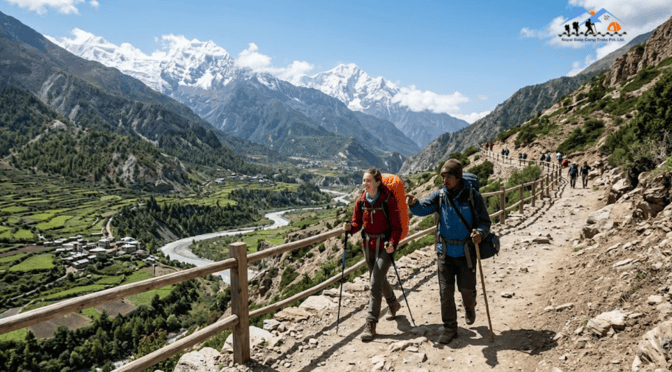
The Manaslu Circuit Trek, located in Gorkha District, Nepal, offers a complete round-the-world 8th highest peak and one of Nepal’s least travelled high mountain routes.
Beginning in sub-tropical valleys and finishing at the dramatic Larkya La Pass trek at 5,106m, the trek provides a mix of unique wilderness, Tibetan-influenced villages and ancient monasteries.
Because the trek takes place in a Manaslu restricted area, every person on their trek route should consider the regulations, permits associated with the Manaslu trek and practical safety issues prior to leaving their home.
Many adventurers will seek a Manaslu trek without guide, either for budget travel or the desire to travel light.
An adventurer will depend on their willingness to trek alone, weigh either a Manaslu solo trek or a guided style, versus the safety provided by a fully guided trip.
This guide is crafted from the local knowledge of Nepal Base Camp Treks, which explains current regulations, costs and explores how a guide brings more than ust navigation.
Can you do the Manaslu trek without Guide?

This leads to the first high-profile question for many hikers: Can you do the Manaslu trek without guide?
The simple answer is no.
Manaslu is located in a restricted zone set by the Nepal government and the government trekking regulations stipulate that all visitors must travel with a licensed guide and also obtain a Manaslu restricted zone permit with a registered agency.
Permits will only be sent with a certified guide’s name during the application process, along with the MCAP and ACAP community conservation permits.
Is Solo Trekking okay in Manaslu?
Even from some blogs that still speak about a Manaslu solo trek or a Manaslu circuit trek solo some time ago, the law does not permit you to travel on a full independent trip.
In 2023, under the new permit regime, solo permits were tightened even more, and permits are held up to your name in every permit checkpoint along the Manaslu trek route.
Hikers who consider themselves experienced must have at least one licensed guide to even enter.
Why the Manaslu Circuit Requires a Guide or Porter
This requirement can be put into context aside from bureaucratic or legal concerns, given the physical environment.
The Manaslu circuit route climbs very quickly into thin air and the weather around Larkya La Pass could change near instantaneously.
Having a professional guide not only helps with the regulatory item above but also adds considerable travel safety to the equation, immediate help related to health considerations and enables on-the-ground decisions when the conditions change.
The travel guides also make things smoother, especially in relation to accommodation in villages on the Manaslu trek, dealing with an emergency and both types of insurance paperwork.
As there are realities, if you are planning this trek, you should plan it for a small guided group or a flexible guided solo trek Nepal, to get the most freedom without risking safety or legality.
The Benefits of a Guided Manaslu Circuit Trek

When you book a trip with a licensed team via Nepal Base Camp Treks, you’re doing more than simply adhering to a government requirement; you’re maximizing your overall experience.
Here are the main benefits of having a Manaslu guide with you.
Benefit 1: Travel Safety and Emergency Assistance
A trained guide in altitude response and first aid will be closely monitoring your health along every stage of the Manaslu trek.
If you suddenly feel symptoms of altitude sickness, or if a storm rolls in near the Larkya La Pass trek, they arrange for a helicopter evacuation and keep you on a safe slope.
This level of travel safety is difficult to achieve on the Manaslu trek without guide.
Benefit 2: Accurate Navigation and Access to Remote Villages
Local travel guides have an intimate knowledge of every single bend along the trek route and can lead you through the remote and hidden villages along the Manaslu trek – villages that many trekkers will entirely miss.
They’ll save you time and the potential wrong turn as well as create authentic cultural experiences that you will never see on a map or phone app.
Benefit 3: Cultural Context and the Tsum Valley Side Trip
With a guide, it’s quite easy to add the Tsum Valley Manaslu Circuit Trek side trip.
Guides will help make sense of the monastery rituals, introduce you to village elders and entertain you with the often eccentric backstory of the legends and festivals surrounding the area.
Benefit 4: Seamless Permits, Logistics and Cost Organization
Your guide will arrange all the necessary Manaslu trek permits, including the Manaslu restricted area permit, MCAP and ACAP.
They also provide you with a straightforward breakdown of your Manaslu trek cost, reserve tea houses and organize transport.
You’ll also avoid unanticipated costs and headaches associated with the Manaslu self-guided trek.
Benefit 5: Better Total Experience and Value
A guided trek puts safety precautions, culture, and organization into one single, smooth and easy plan.
Instead of worrying over permits or delays, you experience pure adventure travel, with local insight and reliable backup.
When all the above factors are combined, a guided trip guarantees your time on the Manaslu trail is safe, culturally enriched and hassle-free, something a Manaslu solo trek cannot provide.
Challenges and Risks of a Self-Guided Manaslu Trek

Planning a Manaslu trek without guide may seem an exciting and even attractive proposition, but some challenges arise and can make the experience demanding and often unsafe.
The following are the key challenges that every independent traveller should consider carefully.
Challenge 1: Permit Restrictions and Legal Concerns
A standard requirement for a valid Manaslu restricted area permit is to be accompanied by a registered (licensed) guide and registered agency.
If a trekker attempts a Manaslu trek without guide, the trekker risks being stopped at checkpoints or turned back mid-trek.
Challenge 2: Confidence Navigating and Route Finding
The remote Manaslu trek crosses unmarked junctions and a deep gorge.
GPS often has trouble in narrow valleys and snow appearing near Larkya la pass can erase markings on the trail to find the route, making it a blunder to navigate the trek alone.
The difficulty of the Manaslu trek increases tremendously without a guide.
Challenge 3: Altitude and Health Risks
A fast rate of ascension increases the risk of acute mountain sickness.
Without travel safety checks from professionals and rapid evacuation support, a Manaslu trek self guided, can quickly become dangerous.
Challenge 4: Hidden and Unexpected Costs
Another challenge you have to face doing the Manaslu trek without guide is unforeseen weather delays, additional nights in tea houses and reapplying for the trek passes.
This can lead to your trekking costs quickly escalating and eliminating the savings of a self-guided trip.
Challenge 5: Limited Local Engagement and Assistance
If you travel to the remote villages on the Manaslu trek without a guide, you will likely have language barriers and fewer opportunities to engage with the culture around you.
When booking rooms or meals, you may get frustrated and waste time.
Challenge 6: Food and Fuel Shortages by Season
In winter or heavy monsoon rains, some tea houses can run out of basic essentials.
Guided groups are given priority over self-guided treks, meaning you may have to wait a long time for food and lodging or get refused entirely.
Challenge 7: Cultural Sensitivity and Restricted Entry Sites
Sacred monasteries and caves often have local entry rules.
When trekking without the advice of a guide, trekkers risk disrespecting or straining relationships or possibly accruing small fines.
Challenge 8: Data and Connectivity Gaps
Access to mobile coverage is limited across the Manaslu Circuit Trek.
Without a guide’s radio or contacts with an agency, it may be almost impossible to call for help or get an updated weather report.
Cost Factor – Solo versus Guided Trekking
The cost of the Manaslu trek is highly dependent on the number of people you are sharing the trek with.
For example, at Nepal Base Camp Treks, a fully guided Manaslu Circuit Trek starts at USD 740 per person for a full group of 8 – 10 trekkers.
Smaller groups will pay a little bit extra because things like permit fees, guide wages, and transportation costs are now divided among fewer people.
For example, if someone wants to go on a private guided trek or solo trek to Nepal, costs will run about USD 1,100 – 1,300, since they would be paying for the same permits and logistics as if they were going solo.
On a trip where a person attempted to go trekking in Manaslu without a guide is not just against current regulations and it turns out to be expensive anyway.
To go trekking solo, the hiker still needs to obtain a permit for the Manaslu restricted area during the off-season.
They will also have to pay for the MCAP and ACAP fees, daily meals, lodging and possibly private transportation.
When they add the costs of the last-minute guide or porter (if caught) and the costs of re-application for the permits, this sort of self-managed trip can easily get into the range of USD 1,200 – 1,400 or more.
Quick Comparison
| Option | Total Average Cost | What’s Included |
| Guided Group Trek (8-10 people) | USD 740 per person | All permits, guide, porter, transfer, meals, tea-house accommodation |
| Small Group Trek (2-4 people) | USD 900 – 1,050 per person | Same inclusions, but costs divided by fewer trekkers |
| Guided Solo Trek | USD 1,100 – 1,300 | Fully private service and flexible itinerary |
| Attempted self-guided (illegal solo) | USD 1,200 – 1,400+ | Permits, food, lodging, transport, or hidden or emergency costs |
The above demonstrates why a price-transparent, fully guided Trek is always a better value than a Manaslu trek without guide option.
Packing for the Manaslu Trek
Good preparation will keep the Manaslu Circuit trek enjoyable and safe!
Before you depart, review your Manaslu trek packing list, consider any health precautions and prepare for basic safety measures.
Required Gear for Guided and Independent Treks:
Clothing Layers – Clothing that is light, warm, and waterproof to accommodate temperature changes.
Footwear – A good trekking boot with ankle support; gaiters for snow or heavy rain.
Safety Items – At a minimum, pack a first-aid kit, water purification tablets, and a headlamp for night hikes.
Backup Navigation – If trekking independently, carry offline maps and spare batteries. This information is particularly important for the Manaslu solo trek, where there will be minimal mobile coverage.
Permit Copies – If trekking independently, have both printed and digital copies of the Manaslu restricted area permits and insurance documents for checkpoints.
Best Time to Trek the Manaslu Circuit
The best time to trek the Manaslu Circuit Trek is for most trekkers during spring (March–May) or autumn (September–November).
These seasons offer clarity of skies, stable weather, and beautiful views of the mountains.
Daytime temperatures are pleasantly cool for walking and nighttime temperatures are manageable if you have good-quality trekking gear.
Outside of the above windows, it becomes very hard to do so due to unpredictable conditions.
Monsoon rains from June to August bring heavy rains, causing landslides and slippery trails.
Also, winter (December–February) brings drifts of deep snow and continuous icy wind, which commonly closes the Larkya La Pass trek.
Weather Challenges for Solo Trekkers
While a Manaslu trek without guide is always difficult, the time of year we attempt it only intensifies the situation.
Many tea houses are closed during the off-season, storms roll in suddenly, and river crossings become dangerous again, adding time and cost to potential crossings during the wet season Manaslu treks.
That’s why you need an expert guide who can help you reroute quickly and ensure your safety in case of emergencies, which would be almost impossible on the Manaslu Circuit trek solo.
Trekking Stories and Authentic Experiences
In addition to its scenery, the Manaslu Circuit Trek is all about the people and culture that exist in the mountains.
Guides from Nepal Base Camp Treks regularly have guests sharing evenings in monasteries that have existed for centuries, the low chant of monks at dawn, or sipping butter tea together in scenic villages on the Manaslu trek.
Many guests savor their crossing of the prayer-flag hung summit on the Larkya La Pass trek at dawn, a moment in the Himalayas that will remain wherever trek they have from memory!
Some even recount spontaneous invitations to participate in a local harvest dance or helping a teahouse family prepare a meal.
These trekking stories, along with the genuine human experience, give depth and warmth to the trek that neither GPS maps nor adventure itineraries can replicate.
For those trekking looking for meaningful adventure travel, it is often these human connections that end up being the highlight of the trek, long after the mountain views are gone.
Frequently Asked Questions
Can I do the Manaslu trek in Nepal without a guide?
No, currently all trekkers must use a licensed guide and obtain permits through a registered (official) agency in Nepal.
How much does a trek package cost for the Manaslu Circuit Trek?
Nepal Base Camp Treks offers group departures in the basic range of around USD 740 per person. Private or professionally guided solo treks in Nepal usually cost in the range of USD 1,100 to USD 1,300, depending on the season and customized services.
What permits do I need for Manaslu Trekking?
Every single trekker is required to have a Manaslu restricted area permit, in addition to an ACAP and MCAP conservation permit. We will arrange and prepare the required permits for you before your trek begins.
How hard is the Manaslu Circuit Trek?
The Manaslu Circuit can be considered a moderate to challenging trek, with long daily hikes and a final summit crossing at 5,106 meters at the Larkya La Pass trek. It is highly suggested that the trekker maintain good fitness and acclimatization to changing altitudes.
Can I do Manaslu and Tsum Valley together?
For sure! Many hikers often add the Tsum Valley Manaslu Circuit Trek for a deeper exploration into Buddhism and remote scenery.
Conclusion
After reviewing all the details, permits, cost, logistics and safety, the decision is easy.
A Manaslu trek without guide is illegal, and while the costs may initially be less, in the end, most trekkers will pay more considering all the hidden costs and emergency risks.
A guided trek through Nepal Base Camp Treks offers clear and transparent pricing with an experienced guide who knows the area deeply.
Whether you go through a group trek or on your own with a flexible guided trek, Nepal offers you more than just convenience.
You’ll obtain Manaslu trek permits, you’ll have an understanding of the trails, weather, and if an emergency health issue or perhaps a route problem arises, you will have an expert who can handle such situations.
Instead of worrying about permits and several checkpoints, you’ll relax and enjoy every ridge and valley.