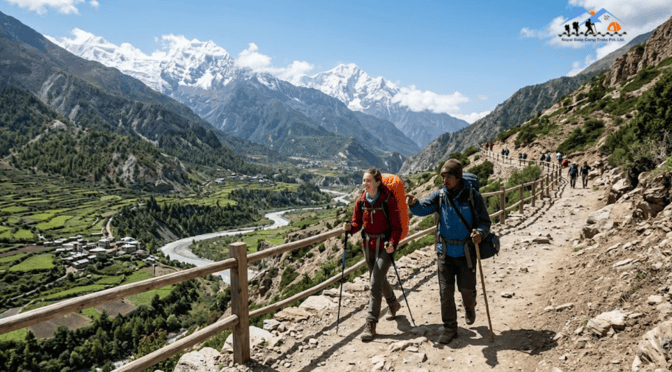
Imagine having the opportunity to walk for days through pine and rhododendron forests, while crossing clear rivers or standing under massive white peaks.
That is the beauty of a Langtang Valley trek and that can be felt regardless of whether you are on a trek with a guide or on your own.
What makes a langtang trek without guide unique is how you travel.
You figure out the route yourself; you allocate your own pace each day and you make every decision along the trail.
A lot of trekkers dream of access to that freedom and the opportunity to connect more closely with nature.
However, since April 2023, every foreign visitor in Langtang National Park must hire a licensed guide to trek.
You will also need a Langtang trek permit.
This rule was established for trekkers’ safety, sound aid for rescue teams, and to protect the Langtang National Park animals, like red pandas and Himalayan black bears.
If you still would like the feeling of independence, check the Langtang Valley trek route first for the daily walking hours and the major villages you will come by.
This guide by Nepal Base Camp Treks will explain applicable rules, routinely needed permits and safety advice for adventure.
Can You Trek Langtang Without a Guide?

Many trekkers have been asking if it is still possible to do the Langtang trek without guide.
The short answer is no, not in the same way.
As of April 2023, Nepal has mandated that all foreign visitors to Langtang National Park be accompanied by a licensed trekking guide.
This rule was issued to protect trekkers, enable faster rescue responses and aid in the preservation of fragile mountain wildlife and culture.
This doesn’t mean you lose all autonomy.
You will still be able to create your own daily itinerary, carry your own backpack and choose where to eat and stay.
The main purpose of a guide is to keep you safe, manage your permits, and share and support local knowledge.
Rules and Permits Requirement
Before heading out, make sure you have:
- A valid Langtang trek permit. It is checked at several entry stations into the park
- A TIMS card (Trekkers’ Information Management System) to track your trek experience.
- A pre-registered guide, as identified on your permits
If you wish to receive assistance organizing a permit or a reputable guide, contact Nepal Base Camp Treks for assistance.
Knowing these rules now will save you time and keep your trek to Langtang safe, smooth and compliant with the law.
Independent vs Guided Trekking – What’s the Difference?
| Aspect | Solo Langtang trek (old style) | Guided Trek (current legal way) |
| Legal status | Not allowed for foreigners after April 2023 | Yes – fully allowed |
| Map reading and route finding | You rely on your map reading and navigation alone | Your local guide knows every trail and every shortcut |
| Emergency support | You call emergency contacts and rescue services | Your guide manages the rescue, first aid, and travel insurance details |
| Cultural access | Harder to access and communicate in remote Tamang villages | Your guide shares cultural stories and relationships |
Regardless of having a guide, you can keep the feel of a very independent trek by planning your own short hikes, having the option to stay wherever you want and trekking in a self-sufficient style.
Benefits of a Solo Langtang Trek

A solo Langtang trek, even as you nearly always have to use a licensed guide, will still provide you with many freedoms.
You will plan your own itineraries, decide how far you will walk each day and take time to appreciate the quiet enjoyment of Montana.
This safety-independence combination is what allows you to get independent trekking in Langtang National Park to be so precious.
Let’s look at some advantages of doing the Langtang trek without guide.
Freedom and Flexible Itinerary
You will have covered daily paces and secure stops along the Langtang Valley trek route.
Change plans if you find some hidden waterfall, quiet forest, spare a little time to put your head over the new viewpoint.
You will experience true self-sufficient hiking, with only the things you need for the day of trekking.
Budget-Friendly Travel
You are in control of where you want to sleep, or even eat, partially deciding how far you’re going to trek on your Langtang Valley trek in the first place.
You will stay in simple tea houses or even shared rooms and be able to spend more money on local food, side trips or whatever else makes the new discovery longer in existence than bigger rotational packages.
Great way to travel debt-free if you are solo traveling, while still being comfortable, and increasing your savings.
Personal Growth and Adventure
Physically build up some fitness with steady climbs to destinations like Kyanjin Ri and Tserko Ri.
Elevate awareness of self-confidence as more trekking companions are watched, set and expressed.
Cherish the self-led, involved quiet time while in the mountains, as you reflect on personal safety measures and a good mental refresh.
Risks and Challenges of Trekking Without a Guide

A langtang trek without guide implies freedom in choosing the trek route and pace, but the Himalayan environment demands respect.
The weather can change in minutes, trails can disappear under snow and help may be far away.
Appreciating the main risks involved in trekking in Langtang Valley will keep personal safety as your priority, so you can enjoy the adventure with confidence.
Lost in Navigation and Map Reading
Finding the correct way while trekking through the trek route can be trickier than is imagined.
Trails may be covered over by landslides, the environment may be foggy and signboards may not be clear.
If you cannot read the map or a GPS device that works independently for offline navigation, a wrong turn means you will not only lose hours, but may also get completely lost.
Suggestion: It is a good idea to carry a paper map that is marked with tea houses and some emergency contacts so that you are sure of the trail direction each morning.
Safety, Accidents and Emergency Preparedness
The trails in the mountains are very steep and rocky, as are most river crossings, each of which can be very slippery after a rain.
Doing the Langtang trek without guide can get you in trouble in terms of your safety.
A small slip may turn into a major problem, especially in your self-sufficient trek, since medical attention may be very far away.
Always have emergency contacts saved on your phone and written down in paper format; also, make sure your travel insurance covers a helicopter rescue in case of an emergency.
While trekking on your own, it’s up to you to determine when you’d like to rest or turn back. Being responsive to your body and aware of your surroundings can circumvent many accidents.
Altitude, Fitness and Health Risks
The ascent from Syabrubesi at 1,550 m to Kyanjin Gompa at 3,800 m is a good test of your physical fitness.
Rapid ascent can make you ill and may begin with symptoms of headache, nausea, or shortness of breath.
Walk slowly, drink lots of water, and/or plan for acclimatization days in your itinerary.
Wearing good gear from your Langtang trek packing list, like warm clothing and good hiking boots, can ultimately prevent exposure to sudden cold and keep your trek safe.
By balancing a sense of independence with a sense of diligence, risks can be mitigated and you can still experience the beauty of Langtang National Park explored through independent trekking.
Necessary Preparations for Self-Guided Langtang Trek
Good preparation allows you to savor the Langtang trek without guide while remaining safe and legal in Langtang National Park.
Even with the new requirement for guides, it is easy to preserve some sense of self-sufficiency by preparing every aspect of your trek before you leave Kathmandu.
Permits and Paperwork to Obtain in Kathmandu
It is essential to get a couple of required permits: the Langtang trek permit and a TIMS card.
To obtain them, bring your passport, two photos and the information for your guide.
You can apply for them at the Nepal Tourism Board office or you can give the task to a local company to do for you.
While you are at it, you might check on the current Langtang Valley trek cost so that you can also prepare a clear budget for permits, food and lodging.
Packing List for Independent Trekkers
Weather can vary from the warmth of the valleys to the chill of the high points, so packing smart is key.
Layered clothing and a down jacket, a waterproof shell, good sturdy boots and a warm sleeping bag.
First-aid kit, headlamp and some snacks for long days and long nights.
Use an extensive Langtang trek packing list to make sure you have not forgotten anything important, and so that you can pack lightly, but appropriately.
Navigation Tools and Maps You Must Have with You
The trails on the Langtang Valley trek can be confusing and disappear, so having paper maps with you and an offline GPS app is essential, but you need to know how to read a map.
Make sure you map out tea houses, contact phone numbers, and check the day’s conditions each morning, and resources such as local guides or lodge owners.
By preparing in advance the permits, the trekking gear and the navigation tools, it becomes possible to preserve the spirit of independent trekking in Langtang Valley while enjoying all the flexibility and accomplishment as well as staying fully safe and prepared for the Himalayas.
Safety Suggestions for Solo Trekkers in Langtang
Although solo trekking in Langtang is exhilarating in terms of independence, safety should always be your first priority.
Good planning, sensible habits and knowing where and when to find assistance should help ensure your own safety and a smoother experience.
Communicating with Authorities / Emergency Plan
Before departing from Kathmandu, be sure to communicate your complete itinerary and key emergency contacts with your trekking agency or family.
When you check in at Langtang National Park HQ or other checkpoints, be sure to register your route.
And if you’ve planned to travel at high altitude, then confirm your travel insurance covers altitude sickness and helicopter evacuation (if necessary).
This is important so rescuers can act if need be and can do so quickly, particularly if there is an accident or adverse weather.
Meeting other Trekkers Along the Way
Even if you’re looking to travel solo, it’s a good idea to meet fellow hikers along the way.
Many trekkers cluster in locations like Syabrubesi or tea houses, making it easy to find a short-term trekking buddy.
You can have fun and enhanced safety walking with another hiker for a day or two, while still maintaining your independent travel style and plans.
Using Local Experience When Necessary
The weather and conditions change rapidly in the Himalayas.
Local guides and lodge owners learn the safest or least risky days for different trails on the Langtang Valley trek each morning.
They are happy to provide that information each morning so you can make smart decisions whether to change your route or keep it the same.
Advice from the locals and lodge stayers can help you avoid landslides, blocked trails from landslides or surprise river crossings.
By paying attention, asking locals each day, and keeping your lines of communication open, you can make your Langtang trek without guide, the adventure it is supposed to be, while also making it as safe as possible.
When Should You Think About a Guide Instead
If you’re still considering a langtang trek without guide, remember that Nepal instituted a rule as of April 2023 that requires all foreign trekkers to have a licensed guide when trekking in Nepal.
This was for better safety and rescue information. Hiring a guide is no longer optional – it is the only legal way to trek in the Langtang National Park.
But beyond obeying the rule, there are also times when hiring a guide significantly improves the experience, too.
Safety and Peace of Mind
A professional guide will help keep your personal safety in mind.
She or he will look for altitude symptoms, facilitate quick access to emergency contacts and know how to respond if an accident occurs.
You can still walk at your own pace, but have the professional backup that provides you with a sense of comfort in case something out of the ordinary happens along the way.
Cultural Insights and More Effortless Communication
Trekking with local guides also means you’ll learn more about Tamang culture, monasteries and village life.
They can translate conversations, set up pleasant tea house arrangements and relay local stories that enrich your experience culturally as well.
For good, friendly service and current route information, Nepal Base Camp Treks connects treks with trusted and knowledgeable guides who know every which way in the Langtang.
FAQs – Trekking Langtang Without a Guide
Is it allowed to do the Langtang trek without guide?
No. As of April 2023, everyone visiting Langtang National Park from outside of Nepal must have a registered guide.
It is no longer permitted to do a trek completely independently.
What is the cost to do a solo Langtang trek?
The cost of the trek in Langtang Valley will be affected by permits, food for the hike, accommodation and the daily cost of the guide.
We offer this guided trek package for 500$.
Is it safe to trek in Langtang on your own?
An entire independent trek is not possible and it can be dangerous.
It is important to always hike with a registered guide for your own safety, always carry full emergency contact information and always obtain travel insurance that covers high-altitude rescue.
Can I still make companions while trekking?
Yes. You can find trekking companions while in Syabrubesi or during a trek along Langtang Valley.
You may want to discuss meals or a section of the trail, but keep in mind that everyone is required to have a registered guide.
Conclusion
Currently, it is no longer legal to do a Langtang trek without guide.
As of April 2023, the Nepal government requires everyone who is trekking (outside of the locality) in the Langtang National Park to travel with a certified, licensed Guide.
The rule intends to improve the personal safety of trekkers in the Park, to ensure trekkers have quick access to emergency contacts and to help keep the fragile mountain environment unharmed from outside agencies.
As a trekker, you could still make your own itinerary, move at your own pace, and enjoy your quiet moment along the Langtang Valley trek while your Guide has permits, navigation and rescue skills organized on your behalf.
Having a self-sufficient and trusted local operator like Nepal Base Camp Treks will ensure your journey is organized while you have fun exploring in peace!
This way, you will enjoy the spirit of an independent trek while remaining fully legal and safe in the high Himalayas of Nepal!