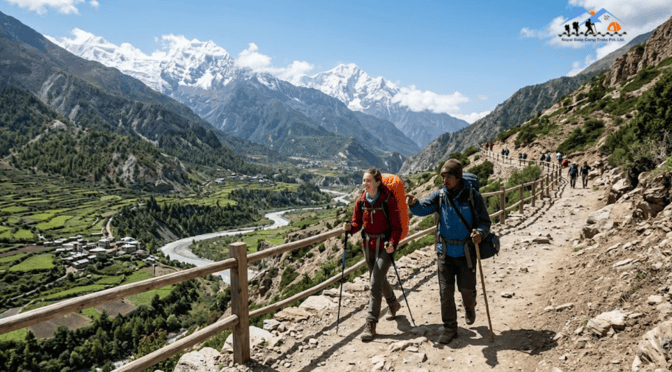
Prayer wheels spin. Bell from the yak rings off in the distance.
Fog slowly drifts off the rooftops as the villages on Manaslu trek wake up to the first morning light.
If you have ever imagined walking to places where ancient monasteries meet snow peaks and the very rhythm of life follows the wind of the mountains, then the Manaslu Circuit Trek is your stage.
Unlike the more crowded Everest trails, the Manaslu trek route feels intimate and wonderfully wild.
From the warm rice terraces of the Gorkha District to the icy villages just outside of the Larke La Pass, every village has a new story of faith, survival and smiles that still communicate without even using a language.
Pro Tip: Trekkers often call this the “Trek of Real Nepal.” That’s simply because the villages on Manaslu Circuit trek have not had to trade authenticity for tourism. Without a doubt, every encounter feels genuine, as if the universe and time stood still just for you.
Introduction — Why These Villages Make the Manaslu Trek Unforgettable

The Manaslu region has a heartbeat, a pulse that a photograph cannot capture.
The trail climbs through mountains, but does not just transport you through a landscape; it transports souls.
Each village you visit throughout the Manaslu Circuit Trek offers centuries of history and values recorded in its stones, its prayers and its people.
After the earthquake of 2015, Manaslu trek after earthquake became a story of resurrection.
The very individuals who lost their homes rebuilt them themselves, and are now more resilient, proud and full of life.
As you walk here today, you see not just the view, but a landscape sewn together with tenacity and hope.
Everywhere, prayer flags flap alongside rooftops, monks chant from concealed gompas and children laugh and wave at trekkers.
Each village along your journey is not just a settlement, but a manifestation of living culture that lingers long after the trek is over.
From fertile valleys bursting with vitality to cold, desolate passes cradled in the clouds, the villages on Manaslu trek offer an equal measure of natural beauty accompanied by cultural experience, better than any other trail in all of Nepal.
Fun Fact: “Manaslu” comes from Manasa, meaning “soul.” The name is fitting because every trekker who crosses its path leaves behind a piece of their soul.
What Makes the Manaslu Route Unique Among Nepal Treks
Imagine walking next to the Budhi Gandaki River in the distance roaring as you walk through bamboo forests and waterfalls cascading.
Above, Mt. Manaslu, the 8th highest mountain in the world, looks down on you quietly, at over 8,163 meters.
This is what makes the Manaslu Circuit Trek route different. It is raw, spiritual and diverse.
You begin in subtropical heat through banana trees and gradually climb upwards toward frozen valleys marked with prayer wheels, stone mani walls.
Every day feels like entering another world – from Hindu villages in the low Gorkha hills to Tibetan Buddhist communities further up.
With over 20 years of experience in leading trekkers in the Manaslu region, our team from Nepal Base Camp Treks can say that there are not many treks in Nepal that offer transformation like this Himalayan adventure.
Overview of the Manaslu Circuit Trek Route
Manaslu Circuit Trek Snapshot
Total Duration: 14 – 18 days
Starting Point: Soti Khola (710 m)
Highest Point: Larke Lha Pass (5160 m)
Major Attractions: Budhi Gandaki River, Lho Monastery, Manaslu Base Camp, Larke Lha Pass
Favorite Villages on Manaslu trek: Machha Khola, Jagat, Namrung, Samagaun, Samdo
Difficulty: Moderate to Difficult
Before you encounter the five most picturesque villages of the Manaslu trek, it would be useful to think of the journey as if once again you were reading a story that unfolds and, in general, does move.
The Manaslu route begins at Soti Khola and gradually rises alongside the Budhi Ghandaki River.
Like a book, the scenery changes from rice terraces and waterfalls to glaciers and moraine valleys.
With each twist comes a new mood and new altitude.
The trail winds through jungle-clad hills and over wooden bridges, then directly opens up into an open, wind-blown valley with peaks reaching into the puffy skies.
Trekkers walk through the Manaslu Conservation Area, which is home to red panda, blue sheep and over 2000 species of plants.
But the people place the heart of these trails, which give warmth and wisdom refined by the mountains.
Did you know? The villages on Manaslu Circuit Trek are along ancient trade routes that traversed between Nepal and Tibet, which is why you might see Tibetan crossing.
Village 1: Machha Khola – The First Gateway to the Manaslu Circuit

The car journey comes to an end and the adventure begins!
Machha Khola is beside the roaring Budhi Gandaki River and represents your first step into the ancient villages on Manslu trek.
After a long journey through a winding road through the hills of the Gorkha District, the riverside destination feels rewarding.
You will experience creaking of wooden bridges beneath you, banana trees swaying in the humid air and the obscure ridgelines visibly shining in the afternoon haze.
At 870 meters, Machha Khola is warm and wild.
You will see millet and maize farming while locals wave at trekkers passing by on the Manaslu trek route toward the higher Himalaya.
Fun Fact: Machha Khola literally means “Fish River,” indicative of the time the valley produced fish to support families long before tourism arrived.
Teahouse Experience in Machha Khola
The evenings in Machha Khola are extremely cozy and calm.
The wooden teahouses glow with warm light and there, you are served fresh dal bhat and ginger tea while listening to the sound of the Budhi Gandaki River rushing.
You’ll meet friendly Tamang hosts, share lots of laughs with other trekkers and watch a sky full of stars in one of the most tranquil villages on Manaslu trek.
Pro Tip: After dinner, step outside. You will be amazed when you look up at the sky in Machha Khola, it looks like a galaxy that you’ve never seen before and won’t forget.
Village 2: Jagat – A Traditional Village with Stone Paved Streets

After Machha Khola, the trail takes a slow ascent beside the Budhi Gandaki River as it meanders toward Jagat.
This is one of the sweetest villages along the Manaslu trek.
At 1,340 meters, this stone village gives you a feeling of traveling back in time.
The narrow lanes pitch between stone buildings with slate roofs, while mani walls mark the way and colorful flags flap in the wind.
This is when you start to realize the essence of the Manaslu region.
The air gets cooler, the smoke gets sharper and every corner becomes alive with culture.
You will see locals caring for their small fields, or chatting with their neighbors, while travelers pass by and connect or share stories near cafes.
Jagat is also the jump into the Manaslu Conservation Area, where nature and tradition coexist peacefully.
Starting Point for the Manaslu Conservation Area
Jagat is the starting point of the Manaslu Conservation Area and also where your permits will be checked before heading up-trail into the heart of the Himalayas.
From here, the Manaslu Circuit Trek gets more wild – the forests drop away to cliff faces and the next section takes you even closer to mountain views.
Every step out of Jagat is like spending time deeper in the spirit of Nepal.
Pro Tip: Get the sunrise over the rooftops – it’s one of the best photo moments in any of the villages on Manaslu trek.
Village 3: Namrung – A Village with Majestic Mountain Views

The path becomes tranquil as you progress upwards through a thick stand of fir trees.
Then suddenly, the forest disappears and there you are at Namrung, still as you like, on top of the ridge above the clouds.
This is some of the most beautiful scenery along the Manaslu trek.
You are not just in the presence of mountains, you are surrounded by them.
The first thing that strikes you is the light.
The morning sun beams down on the peaks of Manaslu and Himchuli, painting them a warm, soft gold.
The air is cool and crisp and you can almost taste the high altitude.
You will see stone archways for entry points and small wooden balconies that overlook the deep valleys below.
At this point of the trek, the Manaslu Circuit begins to feel distinctly Himalayan.
You stop to look not because you are tired but because the view asks you to.
Fun fact: Namrung sits at 2630 m and is known as “the sunrise village,” being the first place on the trail to welcome the sun on its snow peaks in the morning.
Local Life and Tibetan Influence
The essence of life here is a strong one.
You will hear soft chants emanating from stone houses, see grandmothers weaving wool, and smell barley roasting over open flames.
The omnipresence of Tibetan influences is everywhere you look: prayer wheels near the trail and butter lamps flickering inside a shrine, right in people’s homes.
You might even find yourself sharing a bench with a local who is drinking yak butter tea or hearing the faint tinkling of bells from yak herds in the distance.
The Manaslu region beats to its own drum and in Namrung, you begin to march with it.
Pro Tip: Stay up late at night. The thin air causes the stars to look like you can reach out and touch them – a gift from a high ridge that only it has to offer.
Village 4: Samagaun – The Cultural and Scenic Heart of Manaslu

From the moment you arrive in Samagaun (3,530m), you will feel the world is larger.
The air feels sharper, the silence is deeper and the mountain views, more expansive.
Ahead, Mount Manaslu looms like a mountain Guardian wrapped in prayer flags and morning mist.
Stone houses cling to the slopes, monks chant from little gompas and at every turn, you are met with beauty and tranquility.
After days of steady upward climbing, this is when you begin to finally slow down, breathe and feel the authentic rhythm of the Manaslu Circuit Trek.
Interesting fact: Well before trekking began, Samagaun was a hub of trade with Tibet and the spirit of trade and journeys still remains in smiles and stories in the community here.
Side Trips from Samagaun
As a base point for short side trips, Samagaun is ideal.
The trail to Manaslu Base Camp climbs through icy streams and yak pastures before you’re greeted with astounding views of mountain vistas.
It’s a half-day hike full of prayer stones, glaciers and complete silence, which is every trekker’s dream.
Pungyen Gompa, a Buddhist monastery, is another hidden gem that has been perched above the valley floor for centuries.
You’ll enjoy glorious views of Mount Manaslu and the glacial plains below, a sacred place that seems untouched by time.
Food and Teahouses
The teahouse experience on Manaslu culminates in Samaguan.
Teahouses are warm wooden lodges where you sit around the fire after a long day of hiking, sipping yak milk tea and telling stories together.
The air is warm with the smell of dal bhat and the flickering of butter lamps means it’s warm inside and laughter is all around.
Some teahouses even make their own yak cheese, creamy and rich — a great find for trekkers exploring the villages along Manaslu trek.
Pro-tip: Don’t miss the local drink of barley beer called chang — have warm and mild chang to toast! It’s a lovely touch to drink a toast to the heart of the Manaslu region.
Village 5: Samdo – The Final Village Before the Pass

The ascent to Samdo is a transition to a different universe.
The trees disappear, the air becomes thin and the landscape is white with snow, wind and beauty.
When you finally arrive in Samdo, the village is at rest below cliffs — a rugged outpost among the highest villages on Manaslu trek.
At 3,875 meters, this is the boundary of the Manaslu region, a region where people’s lives are suspended between the earth and the sky.
The wind whistles through stone walls, and the lines of prayer flags sharply snap against the cold.
You feel small but strong, both humbled by silence yet proud to have arrived.
The paternal faces you’ll meet in Samdo are different too — worn by sun, kind, and peaceful.
They live by rhythm, not by time.
At night, the stars burn brighter than ever before.
Fun Fact: Samdo is located just a few kilometers from the Tibetan border. On the mornings when the weather is clear, you will be able to spot some ancient trade routes that crossed over from one world to another.
Preparing for Larke La Pass
At this point, you will start your physical and mental preparation for the great crossing.
You will feel the high altitude in your breath and the cold in your bones, but also a quiet excitement that will keep you warm.
Larke La Pass represents the highest point of the Manaslu Circuit Trek.
You will spend the evening packing light, checking your layers and drinking soup while watching the sun disappear behind Ganesh Himal.
Then the next day, you will cross one of the most beautiful high passes in Nepal.
Pro Tip: Take a step outside early the morning before you leave – the sunrise over the valley is one of the most profound experiences you will have on the villages on Manaslu trek.
Tsum Valley – A Hidden Cultural Treasure
If you ever fantasize about leaving the common trekking routes to observe something uniquely spiritual, Tsum Valley is your answer.
Nestled deep in the Manaslu region, this low-key valley feels like a covert chapter.
You will bear witness to ancient monasteries, stone courtyards and an ambiance that stays with you long after you leave.
The Tsum Valley Manaslu Circuit Trek has many villages untouched by time.
All along the way, prayer flags flap across suspension bridges, monks walk barefoot to 200-year-old gompas in their red and saffron robes and chant can be heard echoing across the cliffs.
It is life that predominantly moves at the pace of the mountain with deep peace and gentle smiles.
It is an optional side route, but for most backpackers, it is what stays with you the most on the Manaslu Circuit Trek, a glimpse of the true Himalayas.
Life in the Villages on Manaslu Trek – Culture and Teahouse Experience
Each village on the Manaslu Circuit Trek has its unique blend of cultural experience, religious beliefs and local food, which enriches the trek.
You’ll spend time in warm teahouses, share stories and laughter over a steaming bowl of dal bhat and observe villagers in their day-to-day life surrounded by prayer flags that are always in motion.
Life is simple and meaningful; a reminder that being comfortable in the Manaslu region is achieved through connection with people and nature, not from luxurious facilities and amenities.
Hospitality of the Tamang and Gurung People
The hospitality of the Tamang people and Gurung families will resonate with you long after your trek is over.
You are welcomed with tea, stories and smiles that say more than words can express.
Every teahouse has laughter, stories, generosity and care (the kind that takes strangers and turns them into acquaintances).
Pro Tip: Learn a few greetings in Nepali. It is a small, thoughtful gesture that villagers will quickly appreciate and it keeps you engaged in true connection through a language barrier.
Traditional Dishes & Drinks
Food in the villages on Manaslu trek is not just fuel, it is culture served on a plate.
You will experience warm dal bhat, rich yak milk products and local breads baked over a wood fire.
In some villages, you will also receive some locally made sea buckthorn juice, a vibrant, tangy drink that tastes like the mountains themselves.
When Is the Best Time To Visit These Villages?
The villages on Manaslu trek change with each season, each adding a different virtue to the trail.
If you are seeking blue skies and bright summits, plan a spring trek (March–May) or autumn (September–November).
The trekking season in these months provides clear trails, blooming rhododendrons and the best combination of warm days and cool nights.
During the monsoon season (June–August), the trail becomes lush and green and, while the heavy rain does make for some muddy sections, the vegetation is entirely wild.
Winter closes the higher section of the trail and brings unrivaled solitude to the lower villages.
Weather Conditions During Spring and Autumn
In spring, the forests bloom with vibrant rhododendrons, blue skies and gentle warmth in the lower valleys.
In Autumn, the air feels crisp, the winds are calm and the panoramic views of the mountain are as clear as you’ll experience all year.
During both seasons, the weather in the Manaslu region remains friendly for long treks and the villages are crowded with the local and traveling community.
Pro Tip: For photographers – October is magical. The sunlight kisses every peak with the perfect amount of angle.
How the Manaslu Villages Reflect the Living Heritage of Nepal?
Every minute spent in the villages on Manaslu trek feels as if you are a witness to the living story of Nepal.
You observe faith and devotion rescued in stone prayer wheels, culture expressed in architecture and acts of kindness that epitomize a united community.
The Manaslu region is remarkable as one of the few remaining places where ancient customs are alive, where people cohabit with the earth and reside close to divinity.
As you walk from the Gorkha District to the foot of Ganesh Himal, these trails preserve the very heart of what kept Nepal timeless: simplicity, fortitude and grace.
Why You Should Explore These Villages with Nepal Base Camp Treks?
When you trek with Nepal Base Camp Treks, you’re not just trekking a route, you’re living a story.
Our local team has the capability of knowing every square inch of the Manaslu Circuit Trek from the quiet guest houses to the unobstructed views most won’t even notice.
We take care of everything from the logistics, the permits and arrangements, so you can just walk without any thoughts of the complicated details.
With years of experience and true local ties, we make your trekking experience feel safe, meaningful and very personal.
Visit Nepal Base Camp Treks to start your next Manaslu Circuit Trek.
Join us and trek where stories, culture and mountains collide.