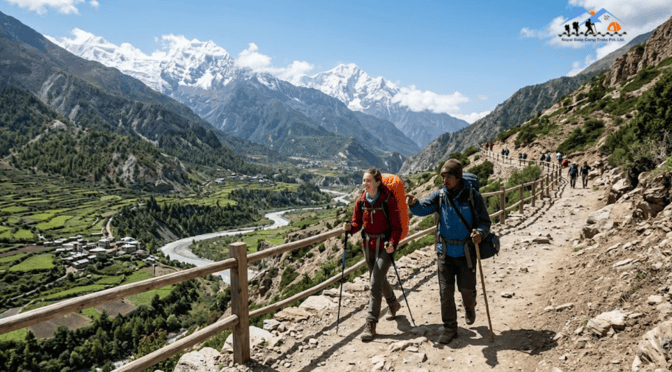
Secluded in the inner parts of the Rasuwa district, Syabrubesi is where the city noises fade and the Himalayas begin to speak.
This small village in northern Nepal is the starting point of the legendary Langtang Valley Trek – a journey through glacial rivers, forests and the warm smile of Tamang villages.
But Syabrubesi isn’t just an indicated place on a map; it is the gateway to Langtang National Park.
It’s a junction of trails that connects with the Tamang Heritage Trail, Ganesh Himal Trek and the Langtang region.
In this guide, you will find everything a trekker should know – how to get to Syabrubesi from Kathmandu, when to visit, where to stay, what the road looks like and how much the weather will affect your trek.
We will explore the local culture and customs, safety information and explain why beginning your journey with a trustworthy trekking company in Nepal, like Nepal Base Camp Treks, is important.
Whether you are planning or just dreaming of the route, this blog illustrates the Syabrubesi Langtang – the first step into the mountains that will keep calling you long after you have gone.
Syabrubesi Quick Facts
Before you start your journey to the Langtang region, it can be helpful to get your bearings.
Here is a brief introduction to Syabrubesi, Nepal.
| Details | Information |
| Location | Rasuwa District, Bagmati Province — Northern Nepal |
| Elevation | Approximately 1,503 meters (4,931ft) above sea level |
| Distance from Kathmandu | About 122 kilometers north of the capital |
| Travel Time | 6 – 8 hours by road (through Trishuli and Dhunche) |
| GPS Coordinates | 28.17° N, 85.30° E |
| Nearest Town | 18 kilometers from Dhunche |
| Main River | Part of the Bhote Koshi River originates from the Tibet border |
| Best Time to Visit | March – May and September – November for clear skies and pleasant trekking |
| Primary Trekking Routes | Valley Trek, Langtang Tamang Heritage Trail, Ganesh Himal Trek |
| Local Community | Culturally predominantly Tamang that are known for their Buddhist heritage, festivals and hospitality |
Fun Fact: Even though it’s small, Syabrubesi village connects a few of the most amazing trekking trails in Nepal. It’s also one of the few places where you can see the characteristics of both Tibetan culture and Nepali mountain culture blending harmoniously.
Where is Syabrubesi Located in Nepal?
Syabrubesi (sometimes spelled Syabru Besi) is a small village in the Ramganj District in Bagmati Province, Nepal.
Syabrubesi’s location lies about 122 km north of Kathmandu.
Its elevation is around 1,503 meters (4,931 feet) above sea level.
Coordinates: 28.17° N, 85.30° E
Province: Bagmati Province
District: Rasuwa
Distance from Kathmandu: 122 km (around 6 to 8 hours on the road via the Trishuli and Dhunche routes)
Syabrubesi Nepal, is geographically the gateway to the Langtang region and is right on the banks of the Bhote Koshi River, which is one of the major tributaries that flows down from the Tibetan border to the central part of Nepal.
Syabrubesi is the southern entrance to Langtang National Park, which is the first Himalayan national park that was established in Nepal.
The village is situated north of Kathmandu and the Pasang Lhamu Highway (F070) runs through the village.
On the Nepal map, if you look closely at Syabrubesi, it is located just below the Langtang Lirung massif and west of Kyanjin Gompa.
Thus, make this small village, a natural base point for the Langtang treks.
Why Syabrubesi Is Known as the Gateway to Langtang Valley Trek?
Syabrubesi has the reputation of being called “The Gateway to the Langtang Valley Trek” as all trails leading directly into the Langtang region enter from here.
This village is the official entrance to Langtang National Park, Nepal’s first Himalayan National Park.
From Syabrubesi, you can commence three of the most well-known trekking routes — the Langtang Valley Trek, the Tamang Heritage Trail Trek and the Ganesh Himal Trek.
When setting foot in Syabrubesi, you are amidst the confluence of culture and adventure.
The northern trail winds along the Langtang Khola River, then climbs through lush flora toward Lama Hotel and Langtang Village before giving way to Kyanjin Gompa, where glaciers and sacred peaks touch the horizon.
Meanwhile, for those looking for culture instead of elevation, the trail branches west, toward the Tamang Heritage Trail, a looped trek passing along authentic mountain villages and experiences, hot springs and monasteries with rich Buddhist cultural foundations.
Given its central location, Syabrubesi serves as a starting point and meeting point for trekkers from all corners of the globe.
You can easily obtain permits, hire local guides and porters and stock up on supplies at various fully equipped tea houses before heading further up the mountains.
How to Get to Syabrubesi from Kathmandu

The journey to Syabrubesi from Kathmandu is the first part of your adventure into the Langtang Valley Trek.
Located approximately 122 kilometers (76 miles) north of the capital city, Syabrubesi is accessible via the Pasang Lhamu Highway (F070) towards the Rasuwagadhi border to Tibet.
The trip to Syabrubesi from Kathmandu is scenic and rough.
The journey can take you anywhere from 6–8 hours by car, depending on traffic and road conditions of the season.
The drive begins climbing gradually from the subtropical valley of Trishuli Bazaar through Dhunche before finally descending into Syabrubesi, located beside the Bhote Koshi River at 1503 meters (4,931 feet) in elevation.
Kathmandu to Syabrubesi Distance and Route
| Route | Distance | Duration | Stops |
| Kathmandu to Trishuli to Dhunche to Syabrubesi | 122 km | 6-8 hours | Galchi, Betrawati, Kalikasthan, Trishuli Bazaar, Dhunche |
Best route: From Kathmandu, go west for 35 km on the Prithvi Highway to Galchi, then head north onto the Trishuli – Dhunche – Syabrubesi road.
Elevations are approximately 1,300 m in Kathmandu, 2,030 m in Dhunche and 1,503 m in Syabrubesi.
Transportation Options from Kathmandu to Syabrubesi
Option 1: Public Buses
Departure location: Machhapokhari Bus Park, Balaju, Kathmandu
Cost: NPR 700-1000 (approximately USD 5-8)
Duration and Customer Journey: 7-9 hours
Description: Bus from Kathmandu to Syabrubesi departs daily in the morning (usually around 6-7 a.m.). You need to obtain bus tickets.
The trip stops frequently to pick up passengers or take a break for meals. This is great for budget travelers who are looking for a slower and local experience.
Option 2: Shared Jeep
Departure location: Machhapokhari near the Gongabu area
Cost: Kathmandu to Syabrubesi jeep costs around NPR 1200-2000 per person (approximately USD 10-15)
Duration and Customer Journey: 6-7 hours
Description: More comfortable and faster than local bus trips. The jeep seats around 7-9 passengers.
This option is highly recommended for trekkers who want a compromise between price and convenience.
Option 3: Private Jeep / 4×4 Hire
Departure: leave flexibly from your hotel in Kathmandu or from Thamel
Cost: NPR 18000-25000 for the vehicle (approximately USD 130-180 one way)
Duration and Customer Journey: 6-7 hours
Description: This service offers door-to-door transportation and has usual scenic stops along the way.
This service provides flexibility during landslide or construction delays, which makes it the best service for groups or trekkers with heavy equipment.
Syabrubesi: Altitude, Season and Best Time to Visit

Syabrubesi altitude lies at 1,503 meters (4,931 feet) above sea level in the Rasuwa District of northern Nepal.
There is a very modest elevation gain going from Kathmandu (1,300 m) to Syabrubesi (1,503 m), allowing your body to slowly adjust to altitude before entering high elevations.
But once you start the trek north, the elevation gain becomes steep:
Lama Hotel: ~2,480 m
Langtang Village: ~3,430 m
Kyanjin Gomp: ~3,870 m
Tsergo Ri (optional climb): up to ~5,000 m
This slow ascent from Syabrubesi is important for safe and enjoyable trekking.
Spending the first night here allows your body to adjust to altitude before gaining any serious elevation inside Langtang National Park.
Brief Overview of Season and Ideal Times
| Season | Average Temperature | Conditions | Ideal Times for Trekking |
| Spring (March to May) | 10–22 | Clear skies, a colorful environment and good trail conditions | Yes |
| Monsoon (June to August) | 15–25 | Rainy, wet trails, lush forests and unpredictable | Experts only |
| Autumn (September to November) | 8–20 | Dry, clear skies and most popular | Yes |
| Winter (December to February) | -2–12 | Cold times, calm environment and fewer trekkers | Only for the prepared |
Best Time to Visit Syabrubesi
The ideal time for beautiful weather, safe roads, and panoramic views of the mountains in Syabrubesi is in the spring (March to May) and fall (September to November).
During these times, you can usually count on nice temperatures during the day with good visibility as well as good trekking conditions on the Valley trek.
Where to Stay: Accommodation and Tea Houses in Syabrubesi
Before heading off on your Langtang Treks, Syabrubesi is a great place to relax, repack and recharge.
Though it is a small village in Rasuwa, it has many accommodation options, including tea houses, guesthouses and mid-range hotels.
The village itself is entirely built around the trekking community, so you’ll have no trouble finding a clean bed, warm meal, and mountain view.
Popular Tea Houses and Local Guesthouses
Tea houses in Syabrubesi Nepal are much more than simply a place to stay; they are an introduction to local Tamang culture and mountain living.
These small lodges are run by welcoming families, and they provide simple but cozy rooms, warm meals and the sort of friendliness that you typically find while trekking in Nepal.
Tea houses will provide:
- Twin-bed rooms with warm blankets
- Shared bathrooms (sometimes with hot showers)
- Some simple Wi-Fi
- Charging options
- Traditional Nepali meals (dal bhat, noodles, soups, and tea)
You will often find hosts who are eager to share stories of the Langtang region, local festivals and even how their families have been living off of this trekking trail for years.
Staying here is a genuine experience and a great way to glimpse Tamang living, especially if you are heading towards the
Tip: Consider selecting a tea house located near the Bhote Koshi River to enjoy tranquil mountain views and be conveniently situated to begin the next morning’s trek easily.
Budget vs. Mid-Range Accommodation: What to Expect
Budget Hotels & Guesthouses (NPR 800–1500/ USD 6–12 per night)
This option is suitable for individual travelers or backpackers.
Accommodations would tend to be simplistic, but typically clean here, often with breakfast included.
For example, Hotel Namaste, Hotel Village View, or other family-run guesthouses located along the main road.
Mid-Range Hotels (NPR 2000–4000/ USD 15-30 per night)
These hotels are more comfortable with the availability of facilities such as an attached bathroom and hot water.
You will also get power backup, dining area or a private balcony with the anticipated mountain view.
For example, Hotel Red Panda, Hotel Tibet Guest House, and Hotel Langtang View.
In Syabrubesi, hotels are conveniently lined along the route entering the village, generally with no prior knowledge required to navigate through.
Trekkers, who have booked their Langtang Valley Trek package through agencies in Nepal like Nepal Base Camp Treks, have already pre-booked accommodations.
Local Culture & People of Syabrubesi
In addition to its trekking trails and mountain panoramas, Syabrubesi Langtang is a living exhibition of the ancient Tamang culture, one of Nepal’s most distinctive and oldest ethnic groups.
The Tamang people (both men and women) are thought to have migrated from Tibet many centuries ago, mixing their Buddhist traditions and ways of Nepali mountain life.
While walking through the village of Syabrubesi, you will see prayer flags blowing from rooftops, see mani wheels spinning and local monks chanting in small Gompas (monasteries) spread throughout the village.
The air feels both sanctified and familiar as the locals go about their routine of life, along the forest hills and snow peaks.
The Tamang are known for their warm-hearted hospitality, and the community has a deep connection to nature.
Most families are farmers or lodge owners who live in harmony with the mountains that give them life.
Visitors of the Tamang community are often invited to share a cup of butter tea or taste the local yak curd, which are such simple gestures, yet can carry deep cultural symbolism.
Festivals, Food & Daily Life in the Langtang Region
The festivals here are vivid and spiritual as well as connected to the lunar calendar.
The most known festival is Lhosar, the Tamang New Year, which is celebrated with dance, drums (Damphu), and food to bring together an entire community.
Saga Dawa, Buddha Jayanti and other Buddhist festivals incorporate bright prayer rituals and many butter lamps to illuminate the monasteries, blue skies and mountain ranges.
Diet in Syabrubesi conveys the simplicity of the highlands, examples include dal bhat, buckwheat pancakes (Fing), yak cheese and hearty stews.
Tourists consistently enjoy the taste of the Tamang tea (made with butter and salt), as well as the local millet wine, which is shared freely during festivals and celebrations.
Life in Syabrubesi is slow.
Children walk to school along the Bhote Koshi trail and elders spin the prayer wheels, while the sound of the mountain drum echoes through the valley in the evening hours.
Did You Know?
The Tamang Heritage Trail starts right from the town of Syabrubesi. It was created to ensure the preservation of this unique culture, while also inviting visitors to engage with that culture responsibly.
Syabrubesi as a Trekking Hub: Routes You Can Start From Here

Syabrubesi serves as the starting point for every major trek in the area, including the famed Langtang Valley Trek, scenic Tamang Heritage Trail and the remote Ganesh Himalayan Trek.
Syabrubesi sits directly on the boundary of Langtang National Park, where beautiful, lush forests transition into the high Himalayas.
From here, the treks meander through terraced hills, bamboo forests and traditional Tamang villages on a gradual approach to the snow-capped peaks, such as Langtang Lirung (7,234 m).
Whether you want a short hike for a couple of days, or deep in the mountains for weeks, Syabrubesi is where it all begins.
Now let’s take a look at the most popular routes from Syabrubesi.
Trek Route to Langtang Valley
The Langtang Valley trek route is the classic trekking route from Syabrubesi.
It is short, beautiful and has a variety, which makes it good for first timers or seasoned trekkers.
Day 1: Syabrubesi → Lama Hotel (2,480 m) — The first day is all forest trails and suspension bridges.
Day 2: Lama Hotel → Langtang Village (3,430 m) — Experience the Tamang culture and enjoy broad views of the mountains.
Day 3: Langtang Village → Kyanjin Gompa (3,870 m) — Enjoy the ancient monastery and stunning views of Langtang Lirung.
From Kyanjin Gompa, you can hike to Tsergo Ri (4,984 m) for amazing panoramic views of the Himalayas.
Tamang Heritage Trail
If you want to delve into the cultural side of the Himalayas, then the Tamang Heritage Trail should be your reliable option.
This trek is close to Syabrubesi and loops through completely unforgettable Tamang villages like Gatlang, Tatopani and Thuman.
Here, you will meet local villagers who live by ancient Buddhist customs, stop for nights in community-run homestays and experience typical warm mountain hospitality.
You can visit natural hot springs in Tatopani and stop at monasteries that are adorned with prayer flags and beautiful carvings made from mani stones.
Best of all, you can connect this trail easily back to the Valley Trek for a completely cultural and mountain scenery experience.
Ganesh Himal Trek
For trekkers who seek seclusion and adventure, the Ganesh Himal Trek begins just west of Syabrubesi and leads further into stunning mountain landscapes.
The trek leads to remote valleys, alpine meadows and typical hamlets while getting stunning views of Ganesh Himal (7,422 m) and Manaslu in the background.
The route is not as traveled frequently and offers a rugged and authentic experience of the Himalayas for trekkers who enjoy off-the-beaten-path journeys.
Tips for Traveling to Syabrubesi
Before embarking on your Langtang Valley Trek, a little bit of preparation will help you get to Syabrubesi Nepal, much easier and safer.
Driving there: The drive from Kathmandu to Syabrubesi (122 km) is approximately six to eight hours via Trishuli and Dhunche. But keep in mind that the Syabrubesi road is narrow and winding, so it’s best to start traveling in the morning to avoid traffic and arrive before sundown.
Traveling Options: The best options to travel there, in order of cost, would be $3 local buses, $8 shared Jeep or, if you have more budget, you can try the $40 private 4X4 vehicle, for your comfort.
What to Bring: Bring key things such as a first-aid kit, a rain jacket or even a power bank. You can buy most trekking gear in Kathmandu and there is some basic stuff in Syabrubesi village.
Altitude and acclimatization: Syabrubesi is at 1,503 m, which is perfect for resting and acclimatizing before the hike to either Lama Hotel or Langtang Village.
Weather and best time: The best time to travel to Syabrubesi is in the spring (March – May) and the autumn (September – November), as these are when the weather is mostly dry and you will see the Splendor of the Langtang region, which is beautiful.
Try to avoid the monsoon season if you can, because the roads can get blocked due to the heavy rains.
Trekking Support: If you go with Nepal Base Camp Treks, then everything regarding your trek in Syabrubesi will be handled from start to finish, including all permits, guides, transportation and lodges.