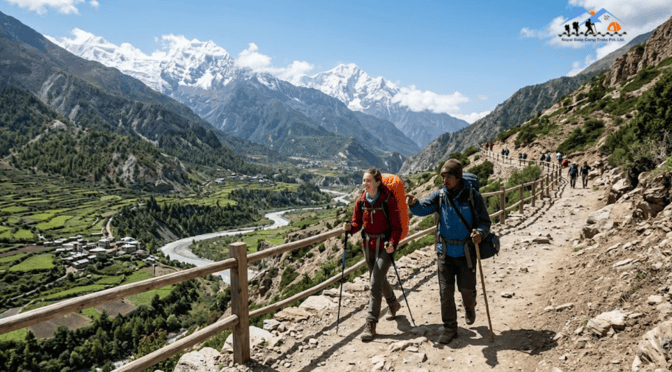
Samagaon Nepal, is where the Manaslu Circuit Trek turns magical.
For the most part, until you reach this point, you are hiking through forests, river valleys and warm hillside villages.
But then suddenly, the coldness of the air hits you, the mountains spring up like giants and a sense of spirituality radiates through you and the surrounding landscape.
Samagaon sits quietly as a beautiful Himalayan village beneath the shadow of the eighth-highest mountain in the world, Mt. Manaslu (8,163m), which has become one of the more memorable stops along the Manaslu trek route.
Trekkers come here not only to rest but also to see and feel how mountain people live — you see stone houses, yak-herding fields, old monasteries and experience the very warm rhythm of Sherpa hospitality.
This place isn’t only about natural scenery; it is also a key factor in the trek.
Your body needs time to acclimate to the Manaslu trek altitude.
Generally, every trekker spends an acclimatization day at Samagaon Manaslu, either consciously or unconsciously, before moving on to Samdo and beyond.
Regardless of your reason to stop here, whether to experience local culture, see the beautiful natural scenery or prepare for higher altitudes, it is the heart of the expedition that embodies a perfect blend of nature, tradition and adventure.
How to Reach Samagaon from Kathmandu
You will likely take several days to reach Samagaon village because you need to walk through the Manaslu region, which starts in warm weather, before moving up into a higher alpine terrain.
When traveling to this village, most trekkers take 6-7 days to make the trek, depending on how long they choose to spend on the journey.
There are many different types of landscapes along the way to Samagaon, ranging from busy riverside trails to quiet villages, situated high in the mountains.
From Kathmandu to Soti Khola: Getting Started
The actual journey from Kathmandu to Soti Khola starts with a 7-9 hour drive.
Your adventure has officially begun!
On the way to Soti Khola, you will travel through beautiful rolling hills and farm fields.
You will also see small farm villages along the road that you are traveling on and get your first glimpse of the Budhi Gandaki River.
Click here to read the detailed blog about the KTM to Soti Khola adventure.
Interesting Fact: This drive takes you to 700-800 meters before the start of your trek.
From Soti Khola to Machha Khola: Entering the River Valley
The trek from Soti Khola to Machha Khola is approximately 5-6 hours.
The amazing views of the river will truly leave you in awe of the natural scenery.
There are many great sights and sounds to enjoy on this stretch of the trek.
The warm sun, the roar of the rushing river, along with the narrow paths through thick vegetation create a vibrant and wonderful atmosphere.
A Scenic Mountain Pathway from Namrung to Samagaon
After Namrung, the scenery around you changes significantly.
The trail from Namrung to Samagaon will take approximately 6-7 hours, depending on your hiking pace.
You’ll traverse through various types of foliage, open pastures, large areas of mountain grass and traditional Tibetan-style villages, eventually to witness the beauty of Samagaon Manaslu below towering snowy mountain tops.
You can expect:
Visible Manaslu peaks, cooler climate, more prayer walls, Yak grazing areas and wide glaciated areas
This is one of the best days on the trek with a “Himalayan” feel.
The Route of the Manaslu Trek – When Does Samagaon Fall Into Place
The following is a general idea of when you’ll arrive at Samagaon from your starting point:
| Day | Route | Time |
| 1 | Kathmandu – Soti Khola | 7-9 hours drive |
| 2 | Soti Khola – Machha Khola | 5-6 hours trek |
| 3 | Machha Khola – Jagat | 6-7 hours trek |
| 4 | Jagat – Deng | 6-7 hours trek |
| 5 | Deng – Namrung | 6-7 hours trek |
| 6 | Namrung – Lho | 4-5 hours trek |
| 7 | Lho – samagaun | 4-5 hours trek |
Most trekkers make it this village in 6 or 7 days, depending on how well they adjust to higher altitudes and their general physical condition.
Helpful Hint: The gradual increase in altitude is by design, as individuals can suffer from AMS when travelling quickly to new heights. Samagaon village Nepal, is situated at a good height for your first major acclimatization experience.
Understanding Samagaon Altitude & Weather Conditions
Located along the Manaslu Circuit, this village offers dramatic views of the surrounding mountain ranges and glaciers.
Along the route, you will notice differences in climate (the air gets colder) and a loss of oxygen due to altitude change (since the higher you are, the less oxygen is in your bloodstream) as you trek from lower elevations to higher elevations.
When trekking to this village, be aware of altitude, temperature, weather patterns and seasons, as these factors can greatly impact your trek.
Samagaon Elevation – 3,530 meters
The altitude gain while trekking from lower elevations to Samagaon can significantly affect your body and how you trek.
You are going from a hot-temperature area (below 1,000 meters) to a freezing-temperature area (above 3,530 meters), where the landscape changes into alpine terrain.
Many trekkers experience their first significant changes in breathing and stamina at this altitude.
The air is less dense, movement will be less efficient and your body will require more energy to complete a task than at lower altitudes.
Here is a brief description of what you will experience:
- You will notice that you take a deeper breath while walking on flat terrain.
- The uphill sections of your track will be more difficult due to the lack of oxygen.
- During the evenings, your body cools rapidly.
- You will require more water to replace the moisture you lose in the thin, dry air at high altitudes.
- You will notice an increase in the trail difficulty, making it harder to navigate at approximately this elevation.
Did you know? The oxygen level at Samagoan, which lies at 3,530 meters, drops to nearly 66% of sea level.
Samagaon Nepal Weather by Season
The glacial melt, elevation and changing winds of the valley influence the weather in Samagoan.
The weather conditions can vary greatly from moment to moment and significantly impact visibility, comfort and the pace of the trek.
Knowing when to visit Samagaon will help trekkers prepare for the perfect trek!
Spring (March – May)
This season is one of the best times to visit this village, as daytime will have relatively mild temperatures of 5°C to 12°C, with nighttime lows dropping to -5°C to -8°C.
With clear skies, trekkers can expect to see beautiful views of the mountains throughout the morning.
This time of year is very conducive to acclimatization days hikes, as the weather is stable and the hiking trails are moderately difficult.
The warmer sun also provides a delightful experience in the local teahouses, as your body adjusts to the higher elevation.
Autumn (September – November)
The best time to visit Samagaon is during the autumn months, as you will get clear visibility and dry weather for all activities.
Daytime highs range from 2°C to 10°C, while nighttime lows range from -8°C to -12°C.
If you are wondering about the Manaslu weather in October or November, you can expect clear skies for all your trekking needs.
These conditions make for ideal hiking and acclimatization hikes, especially when traveling to the Manaslu Base Camp.
The views from the village and surrounding areas will be spectacular!
Winter (December – February)
The winter months are cold and snowy here.
Daytime temperatures range from a high of -5°C to a low of 5°C and nighttime temperatures can drop as low as -10°C to -20°C.
At Samagaon, due to the elevation, there is a loss of oxygen; therefore, the hiking trails become more difficult because they are covered in ice.
Most teahouses will be closed due to the winter months, so only experienced trekkers should attempt a winter trek.
Monsoon Season (June – August)
During the monsoon season, Samagaon’s river valley trails are consistently cloudy with constant rain.
Daytime temperatures average between 10°C to 15°C and nighttime temperatures average around 2°C to -5°C.
The mountain landscape is generally hidden from view, making it difficult to train for the high elevation due to the limited visibility.
This is considered the least popular time of the year to trek the Manaslu Circuit.
Acclimatization at Samagaon – Rest, Recover and Explore
Samagaon is the main place where most trekkers acclimatize to the high altitude of the Manaslu Circuit and the feeling of altitude starts as soon as you arrive at 3,530 metres.
Over the last 5-6 days of walking up and down warm valleys, you will start to feel how much thinner the air becomes once you reach Samagaon and therefore, it is important to allow your body to acclimatize.
This little village has a quiet ambience, great mountain views and attractive little teahouses where you can rest before continuing to Samdo and higher-altitude trails.
What Do Trekkers Do When They Acclimatize?
Most trekkers will not spend a day sitting doing nothing while they are acclimatising.
Instead, they will do an optional hike during their acclimatization day.
The two best short acclimatization hikes from Samagaon are to Birendra Lake and Manaslu Base Camp, both offering amazing mountain views.
Manaslu Base Camp is considered one of the best acclimatization hikes in Manaslu as it involves a short period at higher altitudes, then lets you have a good night’s sleep back in the village.
After the hike, many trekkers will settle into their teahouses, explore the village or simply enjoy the peace and tranquillity of the high-altitude environment.
How To Stay Healthy While In The High Altitudes
Because Samagaon has lower oxygen levels than other areas of the Manaslu Region, special care must be taken to ensure that your body can safely adjust to this new environment.
In addition, even the easiest trails at Samagaon may feel difficult due to the cold and dry air at high altitude.
Here are some helpful tips to make your stay comfortable and prepare you for continuing adventures to higher elevations.
- Drink lots of water throughout the day to avoid dehydration, which is common in dry high-altitude areas.
- Walk slowly and maintain a steady pace while trekking up a mountain, as lower oxygen levels make even the softest of trails feel much more challenging.
- Eat lots of warm, healthy meals in local teahouses to keep you properly fueled for the rigors of climbing and to help your body acclimate to altitude.
- Sleep early each night and give your body sufficient time to recover from the previous day’s climb before heading back out the following morning.
- Be attentive to any early warning signs of altitude sickness, including headache, dizziness or excessive fatigue. If you begin experiencing these signs of altitude sickness, stop climbing higher until you feel better.
Samagaon Village – Tranquility Meets Tradition
This is a village where mountains and culture co-exist.
After several days of climbing the narrow trails along the rivers, the small valley of Samagaon opens into a large valley with some of the best mountain views in the Manaslu Circuit.
It is the only village in the entire valley (and surrounding glaciers) that sits on a shelf on the ground, making it feel like an island in an ocean.
The stone houses, spinning prayer wheels and grazing yaks of Samagaon reflect a unique glimpse of the remote Himalayan culture that has existed here for centuries.
Located at an elevation of 3,530 meters above sea level, the village has a cooler, crisper air and its slower pace encourages visitors to rest and observe what life is like in a very remote, high-altitude part of the world.
Samagaon Gomba and Monastic Life
A major feature of this village is the Samagaon Gomba, a tranquil Buddhist monastery that embodies the richness of Tibetan culture in the Gorkha District.
Sitting atop a gentle hill overlooking the village, the monastery offers tranquil spots to observe daily rituals performed by the monks, view ancient murals and admire the beautiful mountain scenery from its courtyard.
The visit to the Gomba also allows trekkers to gain a clearer appreciation of the religious practices that govern the community of this area of the Manaslu.
Local Lifestyle and Hospitality
The true spirit of Samagaon is found in its people.
Many trekkers say that the warmth and hospitality of the village is what attracted them to stay and explore further. When stopping in a local teahouse, you will always find families eager to open their doors and share a simple but delicious meal with trekkers.
As you walk through the village, you will see children running along stone paths, elders chatting near the prayer wheels and yak caravans that are part of everyday life.
Even at high altitude in the Himalayas, it feels alive and welcoming.
The combination of the slower pace of life and the stunning mountain backdrop makes Samagaon a wonderful experience for trekkers on the Manaslu Circuit.
Day Hikes and Adventure Around Samagaon
Samagaon is the perfect place to start your acclimatization process on the Manaslu Circuit.
The village lies in a large valley, surrounded by beautiful, rugged glaciers and steep hillsides, so even the smallest hike will reward you with stunning views of incredible mountain ranges.
These short hikes will help your body to acclimate to the higher elevations while giving you a chance to see some beautiful areas within Manaslu.
Each trail starts easily, giving you a sense of being higher up and leads back to Samagaon for some comfortable rest.
Manaslu Base Camp
Manaslu Base Camp (4,600m) is one of the most popular acclimatization hikes in Manaslu region.
The first section of the hike consists mainly of walking gently up and back behind the village, while gradually ascending towards the glacier on an open trail along the edge of the glacial moraines.
As you walk along the trail, you will gradually feel the change in altitude.
The further you walk, the thinner the air becomes and the larger the views of the mountains will appear.
As your body adjusts to the glacier’s increasing elevation, the trail will gradually become more difficult, but the views and the scenery will improve.
You will see the jagged ridgelines, massive ice cliffs and the north face of Mt Manaslu, towering right in front of you!
When hiking this trail on clear days, particularly during the best time, the entire trail becomes illuminated with brilliantly shining white snow.
It is easy to see why this hike is regarded as one of the best hikes for acclimatization.
Birendra Lake
Birendra Lake is an excellent choice for all trekking enthusiasts looking for a slightly easier day trek, yet still enjoy amazing views.
This is a relatively simple, easy-to-follow path and provides comfortable footing to ‘warm’ up your legs before heading to higher elevations.
The lake is breathtaking, with its bright blue water resting peacefully and beneath the enormous glacial walls.
This makes Birendra Lake a prime location for photography, meditation and doing gentle forms of exercise, all of which are beneficial without placing too much strain on the body.
With such effortless beauty and serenity, many trekkers opt for Birendra Lake to acclimate to the Samagaon altitude.
Trail From Samagaon to Samdo
Upon departing from Samagaon, you will notice the transition from a rural village to true wilderness as you embark on the Manaslu Circuit.
As the terrain begins to rise toward the dry and windy hills of this region, you are initially treated to a gentle slope, with large expanses of land carved by glaciers and many mountains looming closer.
Even though the slope is very gradual, the steady increase in altitude forces you to slow down considerably, confirming that you are about to enter one of the most densely populated regions on the circuit.
Trail Overview
The trail from Samagaon to Samdo is not considered difficult; rather, it’s one of the most peaceful and tranquil paths, thanks to the beautiful surroundings and views at every step.
As the trail continues to climb through the wide-open grasslands where the yaks graze and the edges of the valley, you will enjoy unobstructed views of Manaslu, both Naike Peak and the sharp ridges leading toward Tibet, throughout your journey.
Due to the openness of the landscape, the winds will be stronger than they would otherwise be, especially during the later autumn months when temperatures will drop significantly.
You will see small stone structures that are currently being used by yaks, along with wooden tow bridges and an occasional group of yak haulers crossing the high-altitude landscape.
What Is Awaiting You in Samdo
A cluster of stone houses can be found near the border of Tibet.
As such, Samdo has been described as one of the remote villages along the entire Manaslu Circuit route.
Although small, the village has a welcoming feel and offers several local teahouses that serve food and provide shelter from the area’s extreme winds.
Trekkers usually spend one final night acclimatizing before heading off toward Dharamsala and then up to the high pass.
From Samdo’s position, you can get spectacular mountain views, see wide-open ridgelines and enjoy the quiet atmosphere, where you can prepare for your final push up to the Larkya La high pass.
Samdo is the final village that feels like an outpost, preparing you for an impending high-altitude hike.
Manaslu Conservation Area: A World of Natural Beauty
In the heart of Manaslu Conservation Area lies Samagaon, one of the most pristine and protected high mountain areas in Nepal.
Once you walk past the village, you will see glaciers, icy rivers, pine trees and the enormous walls of the Himalayas.
This protected area is known for its rare wildlife, untrodden trails and its wonderful cultural heritage, a tradition that dates back centuries in the Gorkha District.
Whenever you step into the wilderness surrounding this village, you will have an experience unlike any other with the raw beauty of nature’s creation: peaceful valleys, frozen lakes, sheer cliffs and breathtaking panoramic views from the summit of the circuit trek.
Ecological Significance of Flora, Fauna, and Other Natural Features
The conservation area protects a significant amount of biodiversity of plant and animal life.
The lower slopes are covered in dense forests of Rhododendron, Birch and Pine.
At the same time, at higher elevations around Samagaon, the environment will change to alpine meadows full of hardy shrubs that withstand the cold.
You may see snow leopards, Himalayan Tahr, Blue Sheep and innumerable species of birds living throughout these areas, which host stable and dynamic ecosystems.
Because there is far less visitor traffic here than in many other trekking areas, the opportunity to see wildlife is much more natural and even more special.
Conservation and Cultural Preservation Efforts
The balance of nature and culture makes this Conservation Area a very special place.
Through collaboration between local communities and numerous conservation organizations, environmental and cultural conservation are both supported.
Waste is treated with care; trekking trails are well-maintained and trekking routes have specific guidelines for sustainable tourism.
Ethically using local teahouses, respecting local customs in the villages and following eco-friendly options while travelling all contribute to the ongoing preservation of the Manaslu region’s extraordinary wilderness for future trekkers.
Every individual traveler has a role, no matter how large or small, in preserving the unspoiled beauty of the Manaslu area.
Essential Information and Trekking Tips for Visiting Samagaon
- Plan your trip so that you arrive in Samagaon around your 6th or 7th day, gradually gaining altitude before the last days of climbing and/or trekking to the higher trekking passes.
- Use one full acclimatization day to acclimatize to the thin air of the region; during your acclimatization day, you may want to consider doing light movement in either direction: going to Birendra Lake or going to base camp.
- Permits (RAP, MCAP, and ACAP) must be obtained via registered trekking guides to support your trekking in the region of Manaslu.
- It is important to take a variety of warm layers and weatherproof clothing with you, as the weather in Samagaon Nepal, changes quickly, especially in the early mornings and late evenings.
- Drinking plenty of water is essential for maintaining adequate hydration while trekking, as it can be challenging to reach Samdo and the higher trekking passes due to the lower oxygen levels.
Why Choose Nepal Base Camp Treks for Your Manaslu Adventure
Choosing Nepal Base Camp Treks ensures your adventure travel to the Manaslu Circuit as safe, smooth and enjoyable as possible.
Our guides are familiar with the entire Gorkha District, including its steep ridgelines and weather patterns, as well as provide an itinerary that gradually and comfortably helps you to acclimatize to the altitude.
We place a high value on safety, proper acclimatization and responsible travel, helping you enjoy the culture, scenery, and high mountains of Nepal without feeling overwhelmed.
With the local guide’s experience and expertise, your trek to Samagaon and over the high pass will be more than just a trek; it will be a memorable experience in the heart of the Himalayas.
Conclusion
Samagaon is an important centre of the Manaslu Circuit, located in the heart of this region, where the high mountains are found, along with ancient cultures and the tranquil living of the Himalayas.
You can hike to Birendra Lake, stroll through the stone-paved streets of this village and witness the beauty of the sun rising over the northern face of Manaslu.
But your trek will be more memorable because of the connection you make with Samagaon’s ancient culture.
This village prepares you for your next trek on the higher trails and acts as a bridge to connect you with the people and culture of the Manaslu area.
If you are looking for an unforgettable experience in Samagaon and the overall wonder of the Manaslu Circuit, just let our team at Nepal Base Camp Treks assist you on your journey with care, safety and the true hospitality of the Himalayas.